The Latin word pietas does not translate cleanly into English. “Piety” is the nearest equivalent, but modern piety implies a primarily private and religious devotion — a feeling, an attitude, something internal. Roman pietas was nothing like that. It was an active, public, obligatory network of duties that structured every significant relationship in Roman life: between a person and the gods, between a son and his father, between a citizen and the state, between a general and his troops. It was less a virtue than a system — the operating system of Roman moral life — and its failure at any point threatened the whole.
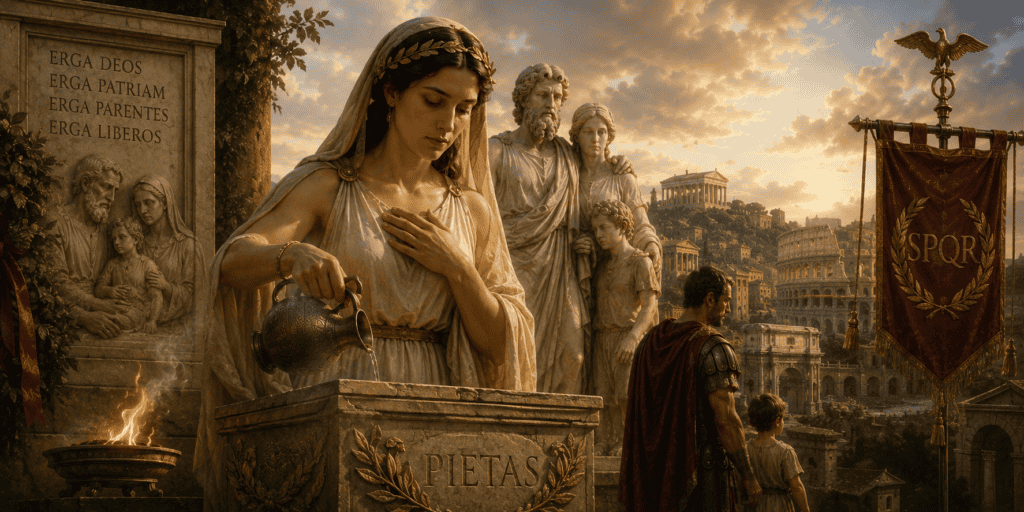
The Romans personified this concept as a goddess, Pietas, and built her a temple. But the personification was secondary to the concept. Understanding Pietas the goddess requires understanding pietas the value, because the goddess was nothing more than the value made visible and given a place to receive offerings.
For the broader concept of pietas as a Roman virtue, see Pietas in Roman Culture.
What Pietas Actually Meant
The core of pietas was obligation — specifically, the obligations that flow from relationships of dependency and care. A son owed pietas to his father because the father had given him life, raised him, and made him what he was. A Roman citizen owed pietas to the state because the state had protected him, given him law and order, and made his life possible. Every Roman owed pietas to the gods because the gods had created the world and continued to sustain it.
These obligations were not optional and they were not merely emotional. A son who failed in his duties to his father was not simply a bad son — he was a man whose fundamental moral character was deficient. A citizen who abandoned his obligations to Rome was not merely disloyal — he was impious, which in Roman thought was a more serious charge. Pietas was the framework within which everything else was evaluated.
The word shares its root with pius, dutiful, and with the concept of pium, something owed or right. It is related to, but distinct from, religio (the proper observance of religious obligation) and fides (good faith in agreements). Pietas was the broader category within which these more specific obligations were subsumed.
Aeneas as the Model of Pietas
The literary embodiment of pietas was Aeneas, and specifically Aeneas as Virgil constructed him in the Aeneid. Virgil’s most repeated epithet for his hero is pius Aeneas — dutiful Aeneas — and the epic is in large part a sustained exploration of what that duty costs and what it produces.
The defining image of Aeneas’s pietas is the scene in Book 2 of the Aeneid: Troy is burning, his father Anchises is too old to walk, and Aeneas carries him out of the city on his back while leading his young son Ascanius by the hand. He holds the household gods of Troy in his arms. He loses his wife Creusa in the chaos. He escapes carrying the past (his father, the old gods) and the future (his son) but cannot save the present.
This image — the man weighed down by obligation, choosing duty over personal safety, losing what he loves most immediately in order to preserve what he loves in the larger sense — became the visual shorthand for pietas in Roman culture. It appears on sarcophagi, on public monuments, in poetry. It was the image Romans reached for when they wanted to show what the virtue looked like in action.
Throughout the Aeneid, Aeneas is repeatedly asked to sacrifice what he personally wants for what the gods and fate require. He leaves Carthage and Dido — the woman he loves — because Jupiter demands it. He descends into the underworld not for glory but to consult his dead father. He fights wars in Italy not for conquest but to fulfill a divine plan he did not choose. His pietas is exhausting, unglamorous, and continuous. Virgil does not present this as easy. He presents it as necessary and as the quality that makes Rome possible.
The Temple and the Cult
The temple of Pietas in Rome was built in 191 BCE by Manius Acilius Glabrio following his victory at Thermopylae against Antiochus III of Syria. The vow to build a temple to Pietas was made during the campaign, and the temple’s location near the Forum Holitorium, the vegetable market, placed it in one of the oldest parts of Rome. The temple stood until the middle of the first century BCE, when it was demolished to make way for the Theater of Marcellus.
A temple to an abstraction might seem philosophically odd — you cannot worship a virtue the way you worship a person — but Roman religion was comfortable with precisely this kind of personification. The temple did not contain a myth of Pietas’s birth and adventures. It contained a statue of a veiled woman making an offering, and it received sacrifices from Romans who wanted to affirm their commitment to the obligations the goddess embodied. The building was simultaneously a religious site and a civic statement: this is what Rome values, this is what Rome worships, this is the quality on which Roman civilization depends.
Pietas on Coins and in Imperial Ideology
The image of Pietas appeared on Roman coins throughout the Republic and Empire, and the frequency and context of those appearances tells you a great deal about how the concept was deployed politically. Republican-era coins featuring Pietas typically showed her in the act of sacrifice — emphasizing the citizen’s obligation to the gods as foundational to civic life. Imperial coins shifted the emphasis: emperors from Augustus through the later Empire used Pietas imagery to associate themselves with the virtue, claiming that their authority rested on their exceptional fulfillment of divine and familial obligation.
Augustus was particularly sophisticated in his use of pietas as political language. He presented himself as the restorer of Roman religion after the impiety of the civil wars — a man who had fulfilled his duty to the divine Julius Caesar by avenging his murder, his duty to the gods by rebuilding their temples, and his duty to Rome by ending a century of civil conflict. The Ara Pacis, the Altar of Augustan Peace, is covered in imagery that expresses this narrative. The scene of Aeneas sacrificing on arrival in Italy, depicted on one of its panels, connects Augustan pietas directly to Trojan and divine precedent.
Subsequent emperors continued the pattern. Coins issued with the legend PIETAS AVG — the pietas of Augustus, or of the Emperor — were assertions of legitimate authority, claims that the emperor’s power rested on proper fulfillment of cosmic obligation rather than mere military force.
Pietas in the Roman World
What made pietas the central Roman virtue rather than simply one virtue among others was its relational character. Unlike virtus (courage), which was about what a person did in isolation, or temperantia (moderation), which was about internal self-governance, pietas was entirely about relationships. It existed only in the space between a person and the gods, between a son and a father, between a citizen and a city. A person with perfect pietas had fulfilled every obligation that their position in the world required of them.
This made pietas the virtue that held Roman society together as a structure. The state’s claim on the citizen, the father’s authority over the son, the gods’ demand for regular sacrifice — all of these were expressions of the same underlying principle. Pay what you owe. Honor what made you. Do not mistake independence for freedom from obligation. The Romans who genuinely believed in pietas understood that human life was constituted by dependencies, and that acknowledging those dependencies through active duty was not weakness but the highest form of moral seriousness.
Aeneas carried his father out of Troy on his back. That was not a metaphor. It was a demonstration of what the Romans believed civilization required.
Share This Page
Cite This Page
MLA
Editors of RomanMythology.com. "Pietas: The Roman Virtue of Duty, Devotion, and Obligation." RomanMythology.com, 2025, https://www.romanmythology.com/roman-gods/personifications/pietas-goddess/. Accessed June 9, 2026.
APA
Editors of RomanMythology.com. (2025). Pietas: The Roman Virtue of Duty, Devotion, and Obligation. RomanMythology.com. Retrieved June 9, 2026, from https://www.romanmythology.com/roman-gods/personifications/pietas-goddess/