When a Roman poet sat down to begin an epic, he did not start with his subject. He started by calling on Apollo and the Muses, because the Romans believed that ordered, beautiful sound was not a human invention but a divine one — and that Apollo held its source.
To understand why music mattered so much to them, you have to see what they thought it actually was.
The Leader of the Muses
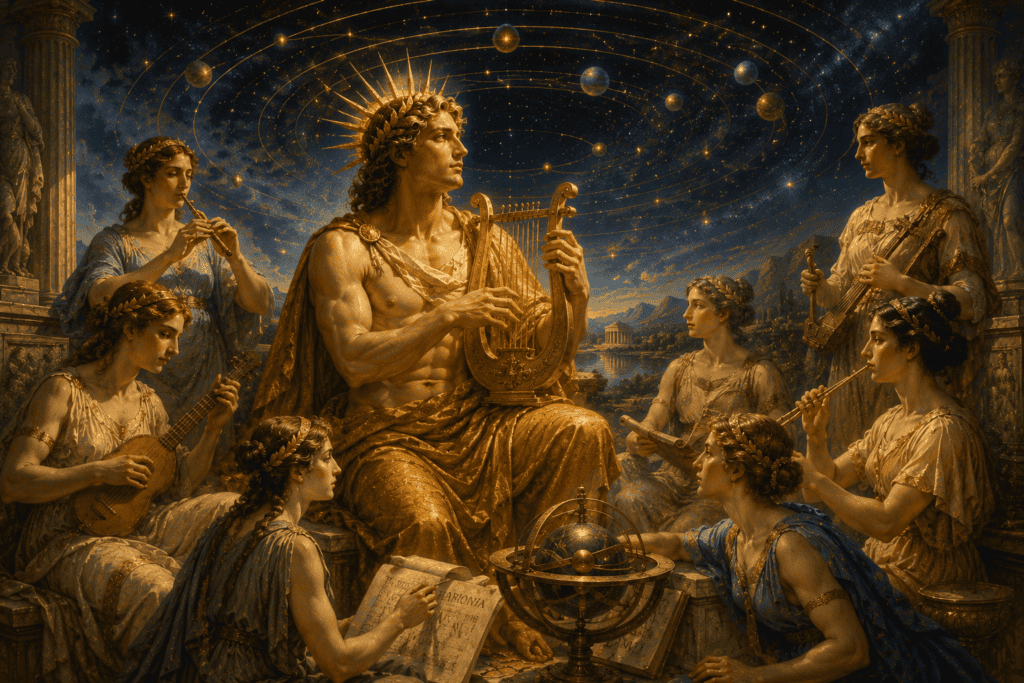
Apollo’s title in this domain was Musagetes (myoo-SAJ-uh-teez), leader of the Muses. The Muses were the daughters of Jupiter and Mnemosyne (nee-MOS-uh-nee), the goddess of memory, and Apollo conducted their chorus on the slopes of their sacred mountains.
That parentage is telling. The arts were imagined as the children of the king of the gods and of memory itself — born from power and from the act of holding the past in mind, and presided over by the god of clarity.
To be inspired by the Muses, then, was not to feel a vague creative urge. It was to be granted access to a structure that already existed, with Apollo standing at its head.
The Nine Muses
The Muses were nine, and over time each came to govern a distinct branch of art and knowledge. Calliope (kuh-LY-uh-pee) presided over epic poetry, Clio over history, and Erato over the poetry of love.
Euterpe was given the lyric and the music of the pipes, Melpomene tragedy, and Thalia comedy. Terpsichore led the dance and the choral song, Polyhymnia the sacred hymn and solemn eloquence, and Urania the heavens and astronomy.
The grouping shows how the ancients carved up the world. Poetry sat beside history and astronomy as branches of a single ordered discipline, all of it gathered under one god — a sign that to the Roman mind, art and knowledge were not separate things.
The Lyre and the Flute
Apollo’s instrument was the lyre, said to have been invented by the infant Mercury from a tortoise shell and handed to Apollo to settle a quarrel over stolen cattle. Its strings could be tuned to fixed mathematical intervals, which made it, to ancient ears, an instrument of reason.
Its rival was the flute, and the contrast between them carried real meaning. The lyre left the player’s face and voice free, so that words and music could join, while the pipes filled the mouth, distorted the features, and spoke without language.
One instrument was Apollonian — measured, verbal, governed. The other belonged to the world of frenzy and the wild rites of Bacchus. A contest between them was a contest between two ideas of what art was for.
The Flaying of Marsyas
That contest became a literal one in the myth of Marsyas (MAR-see-us), a satyr who found a set of pipes that the goddess Minerva had invented and thrown away in disgust at how they twisted her face. Marsyas grew so skilled on the instrument that he challenged Apollo to a musical duel.
The Muses judged, and Apollo won — in part by turning his lyre upside down and singing along as he played, a feat the pipes could never match, since a mouth full of reed cannot also sing. As victor, Apollo claimed the right to do as he wished with the loser.
What he did was hang Marsyas from a tree and flay him alive. The punishment horrified even ancient audiences, which is almost certainly why the story was told.
The myth insists, in the bluntest possible terms, that the gap between divine art and mortal art is not a difference of degree. To challenge it is not arrogance to be forgiven but a violation to be punished without mercy — a warning that beneath Apollo’s serenity lies a floor of absolute severity.
The Ears of Midas
A gentler version of the same lesson appears in a second contest, this time between Apollo and the rustic god Pan. A mountain divinity judged the two and awarded the prize to Apollo’s lyre over Pan’s reed pipes.
Only King Midas, listening, dissented and declared for Pan. Apollo answered the bad judgment in kind, giving the king the ears of a donkey — a mark of a mind that could not hear the difference between order and noise.
The point lands more lightly than the flaying of Marsyas, but it is the same point. To misjudge Apollo’s art is to expose a defect in oneself, and the god will make that defect visible for all to see.
The Ethics of Harmony
Because music was thought to mirror a deeper order, the Greeks and Romans believed it could shape human character, for better or worse. The steadying, martial modes were held to build discipline and courage, while softer or more frenzied modes were thought to loosen the soul.
This gave music a moral and even political weight. Serious thinkers argued that a well-governed community should permit only the ennobling kinds of music, treating the wrong sort as a genuine danger to the citizens who absorbed it.
The same opposition that set Apollo against Bacchus therefore ran through Roman thinking about art itself: order against excess, the well-formed against the unrestrained. To praise Apollo’s music was to make a claim about how a person, and a state, ought to be composed.
The Music of the Spheres
Behind all of this lay an idea the Romans inherited from Greek philosophy: that the cosmos itself was musical. The followers of Pythagoras had discovered that the harmonies of a plucked string follow exact numerical ratios, and they extended that insight to the heavens.
The planets, they taught, moved at distances set in those same ratios, and their motion produced a vast harmony — the music of the spheres. Apollo’s lyre, tuned to the same intervals, was understood as an earthly echo of that cosmic order, its strings sometimes matched one by one to the wandering planets.
Cicero gave the idea its most influential Roman form in the Dream of Scipio, in which a Roman general is carried up among the spheres and hears their overwhelming music — a sound, he learns, so constant that mortal ears have gone deaf to it, as people who live beside a great waterfall no longer hear the roar.
The vision was older than Rome and would outlast it. Plato had imagined the heavens as a great spindle of revolving circles with a singing Siren set on each, every one holding a single steady note so that together they formed one chord; centuries later, writers handed the same scheme to the Middle Ages, which divided all music into the harmony of the cosmos, the harmony of the human soul and body, and the audible music made by instruments.
Music, in this vision, was never mere entertainment. It was a way of touching the order that held everything together, and the man who played in tune reproduced, in miniature, the structure of the universe.
Apollo and the Poets
All of this is why Roman poets opened their works by invoking Apollo and the Muses. They were not striking a pose; they were asking to be admitted, for a moment, to the divine order of which their verse hoped to be a faithful copy.
Horace called himself a priest of the Muses and wore Apollo’s laurel as the badge of his calling, the same tree the god had claimed in grief for Daphne. The crown of the poet and the crown of the victorious general were leaves from one branch.
To write well in Apollo’s name was thus to take part in something larger than literature. It was to align a human work with the harmony of the cosmos, however briefly the alignment might hold.
Final Take: Apollo and the Arts
For the Romans, Apollo’s lyre was never a decorative detail. It was the sign that beauty and order were the same thing, and that a well-made poem, a well-tuned string, and a well-governed city were all echoes of one underlying structure.
That belief explains why their poets invoked him, why their philosophers heard mathematics in his music, and why they told a story as brutal as the flaying of Marsyas to guard the boundary around his art. Harmony was too important to be left undefended.
It also produced an extraordinary body of work, made by people convinced that to compose something beautiful in Apollo’s name was to join, for a moment, the music holding the cosmos together.
Share This Page
Cite This Page
MLA
Editors of RomanMythology.com. "Apollo, the Muses, and the Music of the Spheres." RomanMythology.com, 2026, https://www.romanmythology.com/roman-gods/major-gods/apollo-music/. Accessed June 13, 2026.
APA
Editors of RomanMythology.com. (2026). Apollo, the Muses, and the Music of the Spheres. RomanMythology.com. Retrieved June 13, 2026, from https://www.romanmythology.com/roman-gods/major-gods/apollo-music/