Gods, heroes, myths, and the beliefs of ancient Rome — revealing how religion, culture, and power shaped one of history's greatest civilizations.
Try: Jupiter · Vestal Virgins · Twelve Labors · Saturnalia
Start here
Myths and Legends
Major Roman Myths: The Complete Story Collection*Major Gods
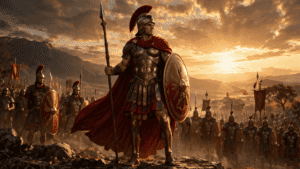
The Twelve Major Roman Gods*Julius Caesar was assassinated in 44 BCE. Octavian vowed to Mars that he would have vengeance. The temple he built twenty-seven years later was Rome's most deliberate piece of political theology.
The Romans had a word for the advance — and a god for it. Mars Gradivus governed the moment between preparation and battle, when discipline either held or broke.
Rome had one god of war and dozens of names for him. Each name was a different situation, a different need, a different version of the same divine force.
The gods gave the goddess of beauty to the lame god of the forge. Venus got a husband who could make anything. Vulcan got a wife who wanted someone else.
Pompey classified his theater's seating as steps leading to a temple of Venus Victrix. The Senate approved. Rome got its first permanent stone theater. Venus got a monument.
The night before the Battle of Pharsalus, Caesar vowed a temple to Venus Genetrix if she gave him victory. She did. He built it at the center of his forum, with a cult statue by the Greek sculptor Arcesilaus and a controversial golden statue of Cleopatra beside it.
In 508 BCE, one man held the Etruscan army at a bridge long enough for Rome to destroy it. His name was Publius Horatius Cocles. He survived, which surprised everyone including him.
Tarpeia is one of the few figures in Roman mythology told entirely without sympathy. She opened Rome's gates for gold, died under a pile of Sabine shields, and gave her name to the cliff from which the Republic threw its traitors. Her story was never meant to be complicated — it was meant to be remembered.
Romulus built Rome with a sword. Numa built it with a calendar, a priesthood, and a nymph he met in a grove at night. The Romans remembered both kings, but they credited Numa with something Romulus could not give them: the gods' cooperation.
Aeneas was the son of Venus and the man the Romans chose as their mythological ancestor. Not the strongest hero of the ancient world. Not the most dramatic. The one who carried his father out of a burning city and kept going.
Romulus killed his brother to found Rome, abducted the Sabine women to populate it, ruled for thirty-seven years, and then vanished in a storm. The Romans deified him. They also suspected the senators had torn him apart.
The Greeks called him Heracles and made him a tragic hero. The Romans called him Hercules, gave him actual divine cult worship, and made him the model for what a human being could become through suffering and virtue.
Explore all categories
Foundations Gods Myths Heroes Minor Deities Creatures Symbols Realms Comparative Mythology Culture