By the height of the Roman period, Diana had become far more than the huntress of the woods. The poets addressed her as a goddess of three realms at once: the moon in the sky, the forest on the earth, and the dark crossroads that led down toward the dead.
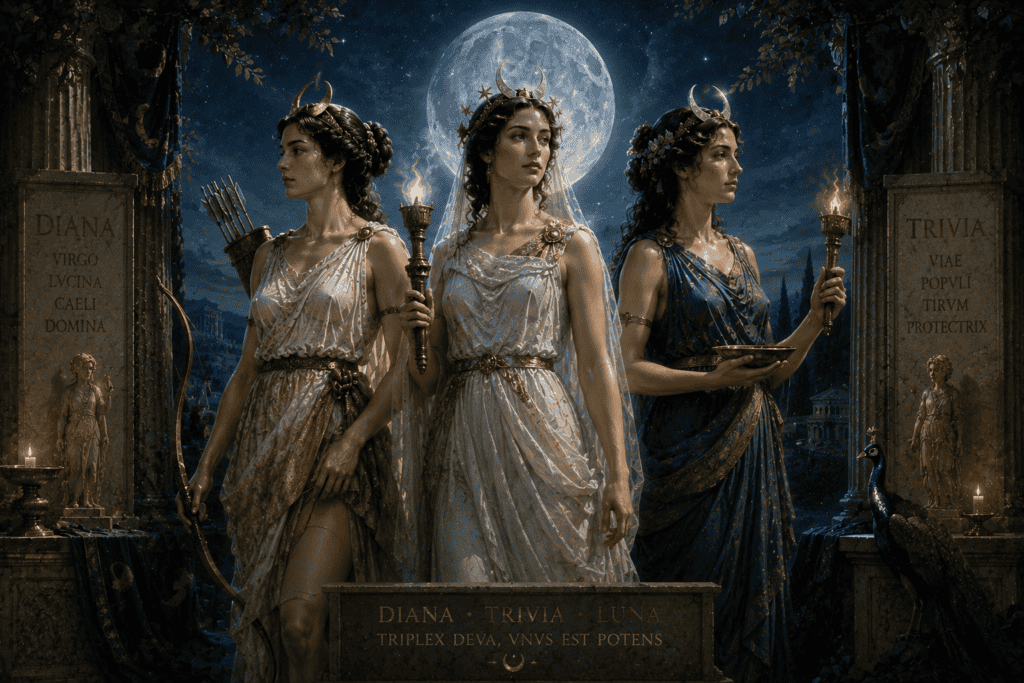
One goddess, three faces. This is Diana at her most mysterious, and understanding the triple goddess is the key to understanding why so many different powers were gathered under a single name.
Diana of the Moon
The oldest link in the chain was the moon. As the twin of Apollo drifted toward identification with the sun, Diana drifted just as naturally toward the moon, the great light of the night sky to balance her brother’s light of day.
Through this association she merged with Luna, the moon itself made divine. Where Luna was the pure personification of the disc in the sky, Diana brought to the moon a personality and a mythology, and the two became difficult to separate.
The fit was a deep one. The huntress already belonged to the night and the wild, ranging the dark forests while the city slept, and the cold, remote brilliance of the moon suited a goddess who kept her distance from gods and mortals alike.
The Powers of the Night
To rule the moon was to rule much that the moon was thought to govern. The Romans connected the moon to the tides, to the cycles of the female body, and to the slow turning of the months, so that Diana’s lunar aspect tied her to time, to women, and to fertility.
The moon also governed the uncanny. Magic was worked by moonlight, ghosts walked under it, and the dark arts drew their power from it, which gave the lunar Diana a shadowed and dangerous side absent from the bright huntress of the day.
This is why the moon goddess could never be a simple or gentle figure. She presided over birth and growth on one side and over witchcraft and the dead on the other, holding the bright and the dark of the night in a single hand.
Trivia of the Crossroads
From the moon, Diana shaded into a third identity: Trivia (TRIV-ee-uh), the goddess of the crossroads. The name means simply “three roads,” the point where three ways meet, and it marks one of the most charged places in the ancient imagination.
A crossroads was a true threshold, a spot that belonged to no single road and pointed in several directions at once. The Romans left offerings there, especially by night and at the dark of the moon, and treated such places as gateways where the ordinary world thinned and the powers of the dark could be reached.
As Trivia, Diana became the deity invoked at these crossings. It was an aspect that fit her perfectly, for the goddess of every boundary belonged above all at the boundary where the roads themselves divided.
Hecate and the Shadowed Face
Through Trivia, Diana absorbed the Greek goddess Hecate (HEK-uh-tee), the dark mistress of magic, ghosts, and the crossroads. Hecate carried torches in the night, ran with hounds, and answered the prayers of witches, and the Romans laid her image directly over Diana’s lunar and crossroads forms.
With Hecate came an outright connection to the underworld and the dead. The threefold goddess now reached all the way down, and in some accounts her lowest face merged with Proserpina, the queen of the underworld herself.
This was the most fearsome version of the goddess. Invoked by night at a crossroads, with torches and the baying of dogs, she was no longer the chaste huntress of the morning hills but a power of shadow, magic, and the grave.
The Threefold Goddess
Out of these overlaps the Romans built the idea of the diva triformis, the goddess of three forms. The poet Horace addressed her so, and the image became a commonplace of Roman verse: one deity ruling heaven, earth, and underworld through three aspects of herself.
In the sky she was Luna, the moon. On the earth she was Diana, the huntress of the woods. Below the earth she was Hecate or Proserpina, the dark queen of crossroads and the dead. The three were not three goddesses but one, turned toward three worlds.
The symbol of this unity was sometimes a single figure with three bodies or three faces, set at a crossroads to look down every road at once. It is among the most striking divine images Rome produced, a goddess who could see in every direction because she belonged to every realm.
One Goddess, Three Faces
It can seem strange that a single deity could hold together the silver moon, the wild hunt, and the magic of the grave. But the logic that joins them is the same logic that runs through all of Diana’s worship: she is the goddess of the threshold, and each of her three faces guards a different kind of edge.
The moon stands at the edge of day and night. The forest stands at the edge of the wild and the settled. The crossroads and the grave stand at the edge of the living world and whatever lies beyond it. Diana’s three forms are not a contradiction but a single principle, seen from three sides.
Once that is grasped, the triple goddess stops being a muddle of borrowed identities and becomes coherent. She is the one power that presides wherever a boundary must be crossed, and there are boundaries in the sky, on the earth, and under it.
The Triple Goddess in Later Culture
The threefold Diana proved one of the most enduring of all classical ideas. Medieval and Renaissance writers kept the image of the goddess who was Luna above, Diana on earth, and Hecate below, and it passed from there into later poetry and drama.
Shakespeare’s witches and their dark patroness Hecate draw on the same tradition, and the figure of the triple goddess was revived again in modern goddess-centered religion, where she is often reimagined as maiden, mother, and crone. The specifics shift, but the core survives: a single female divinity who spans three realms and three states.
That long afterlife is a measure of how powerful the original idea was. Rome took a huntress, a moon, and a crossroads spirit and bound them into one goddess, and the knot has held for two thousand years.
Final Take: Diana, Trivia, and the Moon
The triple goddess is Diana at her largest and her strangest. She begins as the huntress, gathers the moon, and ends as the dark power of the crossroads and the dead, until a single name covers nearly the whole vertical span of the cosmos.
It would be easy to read this as mere accumulation, one goddess swallowing the roles of others. But the deeper truth is that the three faces were always one face. Diana ruled the boundary, and she ruled it in the heavens, on the earth, and below them.
That is why the image of the threefold goddess at the crossroads is the right one to keep. She stands where the roads divide, looking down each of them at once, the single goddess of every edge in a world made of edges.
Share This Page
Cite This Page
MLA
Editors of RomanMythology.com. "Diana, Trivia, and the Moon: The Triple Goddess." RomanMythology.com, 2026, https://www.romanmythology.com/roman-gods/diana-moon/. Accessed June 13, 2026.
APA
Editors of RomanMythology.com. (2026). Diana, Trivia, and the Moon: The Triple Goddess. RomanMythology.com. Retrieved June 13, 2026, from https://www.romanmythology.com/roman-gods/diana-moon/