Of all Apollo’s powers, the one that reached deepest into politics was prophecy. He was the god who knew what would happen before it did, and in a world where every great decision risked offending heaven, that knowledge made him indispensable to kings, generals, and the Roman Senate alike.
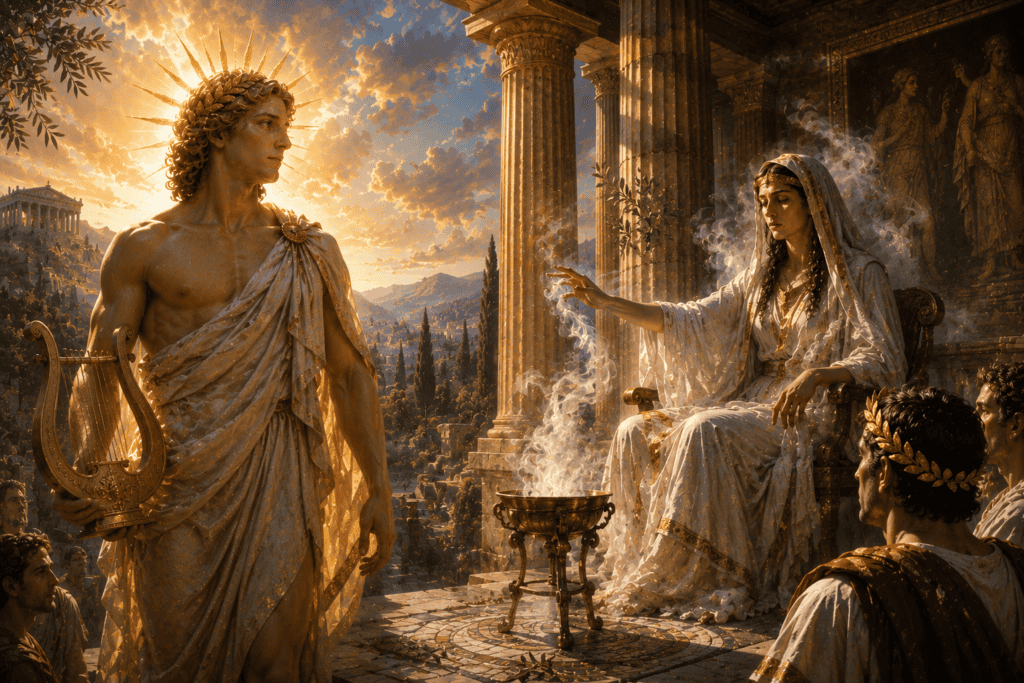
But Apollo never simply told people the future. He gave them just enough of it to be dangerous.
The Voice at Delphi
Apollo’s greatest oracle sat at Delphi, the site he had claimed by slaying the serpent Python. The Greeks marked the spot with the omphalos (OM-fuh-los), a stone they called the navel of the world, and treated it as the place where the human and the divine came closest.
There a priestess called the Pythia (PITH-ee-uh) spoke in the god’s name. Kings, cities, and ordinary people made the long journey to put a single question to her and carry her answer home.
What they carried home was rarely simple. Apollo’s responses were famous for an ambiguity that placed the whole weight of interpretation back on the person who had dared to ask.
How the Oracle Worked
The ritual was deliberate and constrained. On the appointed days the Pythia purified herself at a sacred spring, then descended into the inner chamber of the temple and took her seat on a tripod above what the ancients described as a cleft in the rock.
From that cleft, they said, rose a vapor that filled her with the god, and under its influence she uttered Apollo’s words. Attendant priests took those utterances and rendered them into the polished hexameter verse in which the most famous responses survive.
Above the temple entrance were carved two short commands that summed up everything the god demanded of those who came to him: know yourself, and nothing in excess. The oracle did not hand out certainty. It handed out a mirror, and waited to see whether the questioner could read it.
The Trap of a True Answer
The most famous case is Croesus of Lydia, the richest king of his age, who first tested Delphi’s accuracy and then trusted it with the question that destroyed him. Asking whether he should march against Persia, he was told that if he did, he would bring down a great empire.
He marched, and the great empire that fell was his own. The oracle had not lied; it had told the exact truth in a form that let a confident man hear only what he wished to hear.
The Greeks treasured a contrasting case to prove the god rewarded careful reading. Before the Persian invasion, Delphi told the Athenians to trust in their wooden walls, and where others despaired, Themistocles understood the god to mean their ships — and won the sea battle at Salamis that saved Greece.
Together the two stories form Apollo’s theology of knowledge. Prophecy reveals that the future is fixed and knowable, but it never lifts from human beings the burden of understanding it correctly, and that burden is where most of them fail.
Rome’s Own Prophetic Books
Rome did not depend on Delphi alone. It possessed its own Apolline prophecy in the Sibylline Books, a collection of Greek oracular verses that the city guarded as a treasure of state.
Legend traced them to the Cumaean Sibyl (SIH-bul), Apollo’s prophetess on the Italian coast, who offered nine books of prophecy to the last king of Rome. When he balked at her price she burned three and offered the remaining six for the same sum, then burned three more, until he finally bought the surviving three for the full price she had asked for all nine.
The story is a parable about the cost of ignoring the god. Prophecy was not a bargain to be haggled over; the longer Rome hesitated, the less of the future it was allowed to keep.
The Keepers of the Books
The books were too dangerous to be left open. They were kept under guard and consulted only when the Senate formally ordered it, in times of plague, military disaster, or terrifying omen.
A dedicated priestly college held the sole right to open and interpret them. It began as a board of two men, grew to ten, and finally to fifteen — the quindecimviri (kwin-deh-kim-VEE-ree) charged with overseeing sacred rites.
This made Roman prophecy a controlled instrument rather than a free-for-all. No private citizen could invoke the books, and no general could wave a verse of Apollo’s to justify his ambitions; only the Senate, through its priests, could ask the god what Rome must do.
Prophecy as a Tool of State
What the Sibylline Books usually prescribed was change. Again and again, in a crisis, they directed Rome to adopt a new cult or import a foreign god — Apollo himself in 433 BCE, the healing god Aesculapius in 293, and the Great Mother of the gods in 204.
The arrival of the Great Mother shows the mechanism at full stretch. Late in the war with Hannibal, with Italy ravaged and morale collapsing, the books were read to require her sacred black stone be brought from Asia Minor, and Rome reorganized part of its religion around a foreign goddess almost overnight.
This made prophecy a constitutional device as much as a religious one. When a conservative state needed to do something unprecedented, the books supplied divine authorization, letting Rome break its own habits without ever admitting it was improvising.
Rome and the Greek Oracle
For all its own machinery, Rome kept a wary respect for Delphi itself. After the catastrophe at Cannae, where Hannibal annihilated a Roman army, the Senate sent an envoy all the way to the Greek oracle to ask what the gods required — a striking gesture from a city that had prophets of its own.
Earlier still, Rome had dispatched a golden offering to Delphi to mark the capture of a rival city, acknowledging the god’s share in the victory. The oracle’s authority was old and international enough that even proud, practical Rome treated it with deference.
Apollo, in other words, held prophetic authority on two fronts at once. He spoke to Rome through the sealed books on the Capitol, and Rome went out to speak to him at the navel of the world.
The Sibyl and the Founding
Apollo’s prophetic authority ran straight into Rome’s founding myth. In the Aeneid, it is the Cumaean Sibyl, filled with Apollo and resisting the god who possesses her, who foretells the wars Aeneas must fight in Italy and then leads him down into the underworld to meet his future.
Through her, Apollo became a guarantor of Rome’s destiny, the divine voice confirming that the city was meant to exist. When Augustus later moved the Sibylline Books into his new temple of Apollo on the Palatine, he bound that prophetic authority directly to his own regime.
The god who had foretold Rome now kept his prophecies in the emperor’s house. It was a quiet claim that the future itself was on the regime’s side.
The Silence of the Oracles
Apollo’s prophetic power did not last forever. By the time of the early empire, thoughtful Romans and Greeks were already asking why the great oracles had grown quiet, and the philosopher Plutarch devoted an entire essay to the obsolescence of oracles.
Delphi spoke less and less, and tradition preserved a haunting final response, given to an emperor centuries later, that the god’s fair-wrought hall had fallen and the speaking spring fallen silent. Whether or not the words are authentic, they capture how the ancient world remembered the end.
The voice that had guided kings and saved Greece simply faded, until the most famous mouthpiece of the gods had nothing left to say.
Final Take: Apollo and the Oracle
Roman prophecy was never really about satisfying curiosity over what tomorrow held. It was about authority — about who got to declare that an unprecedented action carried the sanction of heaven.
Apollo supplied that authority precisely because his oracles were hard to read. An answer that demanded interpretation gave Rome’s priests and Senate room to find in the god’s words whatever the moment required, while still bowing to a power higher than themselves.
That is why a legalistic, practical people kept faith with the obscure voice at Delphi and the sealed books on the Capitol. They were not buying certainty. They were buying permission, and Apollo was the one god who could grant it.
Share This Page
Cite This Page
MLA
Editors of RomanMythology.com. "Apollo and the Oracle: Prophecy in the Roman World." RomanMythology.com, 2026, https://www.romanmythology.com/roman-gods/major-gods/apollo-oracle/. Accessed June 13, 2026.
APA
Editors of RomanMythology.com. (2026). Apollo and the Oracle: Prophecy in the Roman World. RomanMythology.com. Retrieved June 13, 2026, from https://www.romanmythology.com/roman-gods/major-gods/apollo-oracle/