Ask most people what Apollo was the god of, and the sun will be near the top of the list. It is one of the most familiar facts about him — and to an early Greek, it would have been simply wrong.
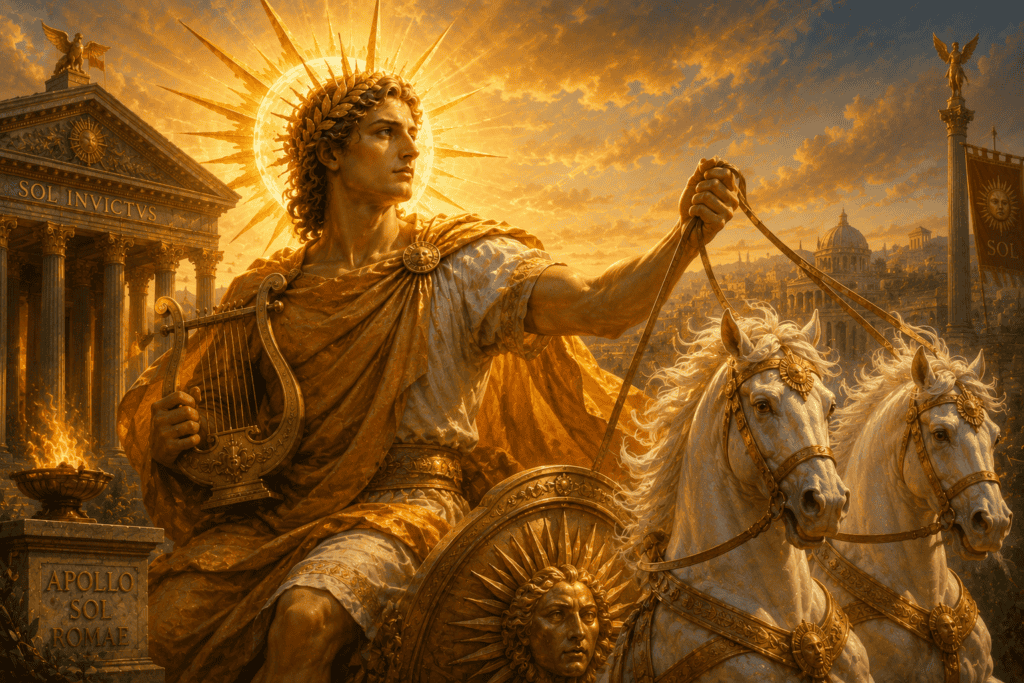
Apollo became the sun. He was not born that way, and the story of how he acquired the sky’s brightest object is largely a Roman one.
Two Different Gods
In archaic Greek religion, the sun had its own deity, Helios (HEE-lee-os), who drove a blazing chariot across the sky each day and saw everything beneath him. He was a distinct power, older than the Olympians, and he was the sun in a plain and literal sense.
Apollo, by contrast, governed prophecy, music, healing, and archery. He was a god of light only in the sense of clarity and illumination — of things made knowable — and not the physical disc burning overhead.
For centuries the two stayed apart. Helios drove the chariot; Apollo kept the oracle. Confusing them would have struck an early Greek as a basic error of category, like mistaking the lamp for the room it lit.
The God of Light, Not the Sun
It helps to be precise about what kind of light Apollo had always carried. His was the light of understanding — the clarity of a true oracle, the order of a well-tuned string, the moment when confusion lifts and a thing becomes knowable.
That is a different thing from the fire in the sky. A culture could call Apollo radiant, even luminous, for centuries without ever meaning that he was the object that rose in the east each morning.
The slide from one kind of light to the other was easy precisely because the metaphor was so apt. Once people pictured reason as a kind of brightness, the brightest thing they knew was always going to pull the god of reason toward it.
The Slow Merging
The merging began among Greek thinkers who liked to read the gods as masks for deeper principles. If Apollo stood for the light of reason, and the sun was the source of physical light, the step from one to the other was short and tempting.
The Stoics encouraged it above all. They treated the many gods as faces of a single rational power running through the cosmos, and the sun, the brightest and most ordering presence in the sky, made an obvious seat for that reason — and so for Apollo, the god of order.
By the later Greek world the identification was already widespread. But it was in Rome that a poetic flourish hardened into common cultural property, until educated Romans spoke of Apollo and the sun almost in one breath.
Phoebus, the Bright One
The pivot was one of Apollo’s oldest titles: Phoebus (FEE-bus), meaning bright or radiant. It had originally described his brilliance and purity in a general way, but as the solar reading spread, the name was increasingly heard as a name for the sun itself.
Roman poets used it constantly and interchangeably. In Virgil, Horace, and Ovid, Phoebus rises and sets, drives the gleaming chariot, and lights the day, until the older Helios all but disappears behind Apollo’s radiant second name.
Language did much of the work that theology never formally decided. Simply by calling the sun “Phoebus,” generations of Romans bound the two gods together in the only place where most people met their gods at all — in poetry and everyday speech.
Ovid and the Blur
The most vivid evidence of the merging is in Ovid’s telling of Phaethon (FAY-uh-thon), the boy who begs to drive his father’s solar chariot and loses control, scorching the earth before Jupiter strikes him down.
Throughout the tale, Ovid slides between calling the boy’s father the Sun and calling him Phoebus, the radiant palace belonging now to one identity and now to the other. The poet does not pause to reconcile them, because by his day no reconciliation was needed.
For Ovid’s readers, the sun-god and Apollo had become two names for a single shining figure. The slippage that would have scandalized an archaic Greek had become the natural way to tell the story.
Rome’s Own Sun
None of this displaced Rome’s native sun worship, which ran on a separate and much older track. The Romans had an ancestral sun god of their own, Sol Indiges (sohl IN-dih-jeez), honored in archaic rites long before Greek philosophy reached the city.
For cultured Romans, then, there were in effect two suns. There was the Sol of inherited ritual, and there was the literary, philosophical sun who was Phoebus Apollo — the sun understood as a symbol of reason, order, and the clarity Rome liked to claim for its own civilization.
That second, Apolline sun fit the imperial mood perfectly. When Augustus made Apollo the patron of his reign, the god’s growing solar character only sharpened the message of light returning to a Rome emerging from the long night of civil war.
The Philosopher’s Sun
By late antiquity the tendency had reached its logical end. The scholar Macrobius (muh-KROH-bee-us) devoted a long passage to arguing that nearly all the gods of Rome — Apollo above all, but also Bacchus, Mars, and others — were in truth aspects of a single deity, the Sun.
This was solar theology pushed almost to monotheism, the many gods collapsing into one radiant power. Apollo was no longer merely associated with the sun; he was offered as proof that the sun was the hidden identity behind the whole pantheon.
The god of clarity had become the clearest thing in the sky. What began as a metaphor — Apollo as the light of reason — had ripened into a claim about the structure of the divine world itself.
Why the Sun Suited an Empire
There was a reason the merger took hold so firmly in Rome rather than fading as a poet’s conceit. The sun made an almost perfect emblem for the kind of state Rome was becoming.
It was single and supreme, crossing the whole sky alone, just as the emperor now stood alone above a world of provinces. It was all-seeing, missing nothing that happened beneath it, and it shone on every land Rome ruled without distinction — an image of a power both universal and impartial.
An Apollo who was also the sun therefore offered rulers a ready-made theology of monarchy. The god of order and clarity, lifted into the sky as its brightest body, became a mirror in which a single emperor could see his own reign reflected back as the natural order of the cosmos.
Toward the Unconquered Sun
This long habit of solar theology helped prepare the ground for something new. In the later empire the sun rose to the summit of Roman religion as Sol Invictus, the Unconquered Sun, raised to a major state cult by the emperor Aurelian in the third century.
Sol Invictus was not simply Apollo under another name. He drew heavily on eastern sun worship — an earlier emperor had already tried, disastrously, to impose a Syrian sun god on Rome — and he carried a character of his own. But centuries of Romans speaking of Phoebus the radiant, of solar reason, of the sun as the seat of cosmic order, had made a sun-centered religion feel natural rather than foreign.
The emperors who then wrapped themselves in solar light, down to Constantine and his coins honoring the Unconquered Sun, were building on a foundation the long marriage of Apollo and the sun had quietly laid.
Final Take: Apollo and Sol
There is a neat irony at the center of all this. Apollo is often called the one major god the Romans took from Greece and left unchanged — they kept his name, his myths, and his attributes more or less intact.
Yet, on Roman soil, that supposedly untouched god picked up an entire new domain. The sun, which had belonged to Helios, became Apollo’s almost without anyone deciding it should, carried along by poetry, philosophy, and the convenient logic that the god of light ought to own the brightest light of all.
It is a useful reminder that no culture ever really borrows a god intact. Even while Rome believed it was only preserving Apollo, it was remaking him — handing him the sky, and through him helping to turn the sun into the emblem of empire itself.
Share This Page
Cite This Page
MLA
Editors of RomanMythology.com. "Apollo and Sol: How Rome Made Apollo a Sun God." RomanMythology.com, 2026, https://www.romanmythology.com/roman-gods/apollo-and-sol/. Accessed June 8, 2026.
APA
Editors of RomanMythology.com. (2026). Apollo and Sol: How Rome Made Apollo a Sun God. RomanMythology.com. Retrieved June 8, 2026, from https://www.romanmythology.com/roman-gods/apollo-and-sol/