The myth of Phaethon is told most fully in Book 2 of Ovid’s Metamorphoses, and it is one of Ovid’s most technically accomplished passages — a story that moves from domestic anxiety through cosmic catastrophe to elegiac mourning, maintaining its emotional logic at every stage. The story is also, in its bones, very simple: a boy who is not sure his father is who his mother says, goes to find out, and the confirmation he receives destroys him.
The Problem of Parentage
Phaethon’s mother Clymene had told him his father was Sol, the sun god. This was not obviously verifiable, and one of his companions — Epaphus, the son of Jupiter — challenged it directly, mocking him as the son of no god, as someone whose mother had invented a divine father to cover an embarrassing truth. The challenge was about legitimacy, about identity, about whether Phaethon had the status he claimed.
He went to find his father and get proof.
The palace of Sol stood at the far east, where day first begins. Ovid describes it with the kind of detail that signals its theological significance: columns of gold, doors of silver, the frieze carved with the sea and the earth and the sky, the twelve signs of the zodiac arranged around the roof. Sol sat on a throne of emeralds, surrounded by the Hours, the Days, the Months, the Years, and the Centuries. The personified Days held the reins of the fresh horses; the personified Seasons stood in their appropriate aspects — Spring with flowers in her hair, Summer crowned with grain, Autumn stained with grape juice, Winter’s white hair bristling with ice.
This is not an ordinary household. Sol was not a local deity with a local function. He was one of the governing powers of the cosmos, responsible for a daily task whose failure would end the world. Phaethon walked into this palace as a teenager wanting to confirm that his father was who his mother said.
Sol saw him coming. He took the crown of rays off his head because looking directly at his own son was too painful — the light was too much. He asked what the boy wanted. Phaethon explained. Sol acknowledged him immediately, declared him his son before all witnesses, and — wanting to silence any remaining doubt — swore by the River Styx that he would grant whatever Phaethon asked.
The oath by the Styx was the most binding commitment a god could make. Jupiter himself could not revoke it. The moment Sol swore it, he had put his cosmic responsibility into the hands of whoever asked the next question.
Phaethon asked to drive the chariot of the sun for a single day.
Sol’s Warning
Ovid gives Sol’s response at length, and the length is deliberate — the warning is not perfunctory but genuine, detailed, and desperate. Sol told his son exactly what the problem was, specifically and practically.
The horses — Pyrois, Eous, Aethon, Phlegon — were fire-breathing. Their management required strength and experience that Sol had built over an immortal lifetime. The path of the sun was not a straight line but a difficult arc, rising steeply at dawn, crossing the peak of heaven at noon, descending dangerously toward evening. Even at the heights, the route passed through terrifying constellations — the Scorpion alone would fill a mortal with enough fear to drop the reins. The centrifugal force at the heights was enormous. The descent was steeper than the rise and required precise braking.
Even Jupiter, Sol said, cannot drive this chariot. No one drives it but me.
He offered Phaethon anything else: all the wealth of the earth, dominion over whatever he wanted, any gift that could be given without destroying the world. He tried everything. He had sworn an oath he could not revoke, and his son refused every alternative.
Phaethon’s insistence was not simply stubbornness. He had come to prove his identity. Accepting a lesser gift would mean accepting that there was still doubt — that the son of the sun god was not capable of his father’s task. To ask for something lesser would have been to confirm Epaphus’s mockery. The request was existential, not merely ambitious.
Sol anointed him with ambrosia to protect him from the fire, set the crown of rays on his head, and watched him take the reins.
The Ride
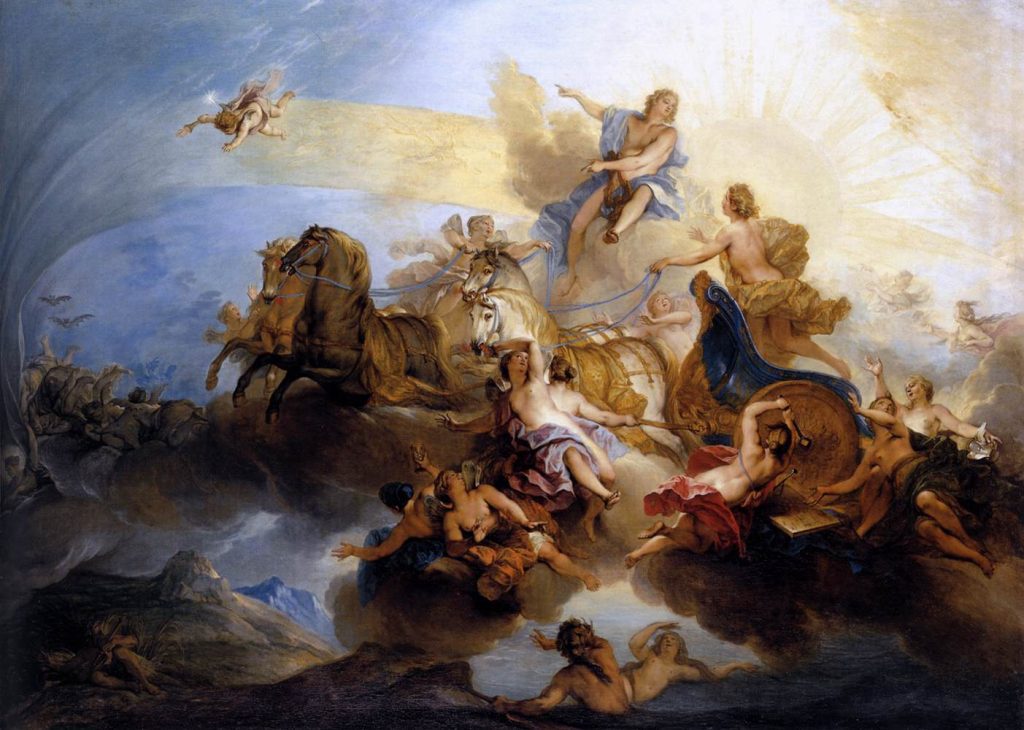
The horses knew immediately that the hands on their reins were not their master’s. Ovid describes this precisely: the weight was different, the yoke sat differently on their necks, the pressure of the hands was unfamiliar and uncertain. They broke their usual course.
Phaethon, terrified by the height — he could see the earth so far below that it made him dizzy, he could see the Scorpion approaching, he could see the arc of the sky that he had to cross and had no idea how to cross it — dropped the reins.
The horses went where they wanted. Some accounts, Ovid notes, say this created the Milky Way — the scorched track across the sky from the chariot’s out-of-control passage at the heights. Then the horses, freed from any guidance, plunged downward.
The earth caught fire. The forests burned. The rivers dried. The Nile hid its head. North Africa became a desert. The Earth herself was scorched brown. Ovid imagines the mountains smoking, the snow on the Alps melting, the Mediterranean boiling at its edges, Poseidon trying to raise his head above the water and immediately retreating from the heat.
The Earth cried out to Jupiter. She could not raise her arms — the heat had made moving impossible — but she spoke. She reminded Jupiter of what the earth had done for the gods, of the altars it maintained, of the sacrifices it sent up as smoke. She pointed out, with some justice, that if this continued there would be no earth left to worship anyone.
Jupiter surveyed the situation. The chariot was out of control, the earth was burning, and the god responsible for the sun’s daily crossing had bound himself by an unrevokable oath to a boy who had already dropped the reins. He took the thunderbolt that no other god used and threw it.
The Fall
The bolt hit the chariot and shattered it. The horses scattered. Phaethon fell, his hair on fire, his body a long arc of flame across the sky — Ovid compares him to a shooting star, the kind you see streak across the sky and wonder if it fell. He hit the river Eridanus in the far west, and the river absorbed him, and his fire went out.
The Naiads of the Eridanus buried him and inscribed his epitaph on his tomb: hic situs est Phaethon, currus auriga paterni, quem si non tenuit, magnis tamen excidit ausis — here lies Phaethon, who drove his father’s chariot; if he did not hold it, he fell from a great attempt. The epitaph is carefully balanced — it does not condemn him. It acknowledges both the failure and the scale of what he tried.
The Mourning
Phaethon’s sisters, the Heliades — daughters of Sol who had watched their brother fall — came to the Eridanus and wept. They wept for four months without stopping. Their feet rooted themselves into the ground. Bark grew up their legs, up their torsos, over their faces. Their arms became branches. They became poplar trees, weeping amber tears into the river below — which is the myth’s explanation for the Baltic amber that the ancient world prized and that actually does wash up on river shores.
Cycnus, Phaethon’s friend — in some versions his cousin, in some versions his closest companion — also stood at the river and wept, but his grief took a different form. He refused to go near fire or the sun. The gods, pitying him, turned him into a swan — which is why swans avoid the sun and prefer river banks and still water, and why their songs are traditionally mournful.
Sol himself hid his face. The day Phaethon fell, the light did not return. The earth sat in darkness and cold until the other gods persuaded Sol that his grief could not be permitted to destroy the world a second time. He went back to the chariot. He resumed his daily crossing. But his face, when he does his work, carries the grief still — which is why you cannot look at the sun directly without being damaged by it.
What the Myth Means
Ovid’s Phaethon is not a simple cautionary tale about pride. It is a myth about the gap between desire and capacity, between knowing what you are and being able to do what that implies.
Phaethon’s problem was not arrogance in the simple sense. He was the son of a god. His lineage gave him a legitimate claim to something extraordinary. But lineage is not training, parentage is not competence, and the right to attempt something is not the same as the ability to accomplish it. The horses that Sol drove every day of his immortal existence could not be managed by someone who had never held their reins, regardless of whose blood was in his veins.
Sol knew this. That is why his warning was so detailed and so desperate. He was not trying to protect the world from his son’s ambition — he was trying to explain that the world was not at stake in his son’s identity question, but that making it at stake would end badly for everyone. Phaethon did not hear this because the question of his identity felt more urgent than the question of the world’s safety. That is a very human priority, and Ovid understood it as such.
The epitaph on the tomb is the key: magnis tamen excidit ausis — he fell from a great attempt. The myth does not endorse what he did. It does not condemn him either. It observes what happened and acknowledges that the attempt was genuinely great, even though it was genuinely catastrophic.
Phaethon in the Roman World
The Romans read the myth as Stoics and as poets. The Stoic reading emphasized cosmic order: the daily crossing of the sun was a fixed, necessary, divinely maintained process, and any deviation from that process — regardless of the reason for it — threatened the stability of the world. Jupiter’s thunderbolt was not punishment for pride but correction of a physical emergency. The world required the sun to move in its proper arc. When it did not, the world burned. The god responsible for correcting this had no choice.
The poetic reading emphasized the epitaph. To fall from a great attempt was not the worst fate. It was better than never having attempted anything. The amber tears of the Heliades, which washed down the river and were found on distant shores and made into jewelry worn by Roman women, were the physical legacy of Phaethon’s fall — grief transmuted into beauty, loss preserved as something precious. The metamorphosis at the end of the story was not punishment but the form grief took when it could not sustain itself any longer as grief.
Share This Page
Cite This Page
MLA
Editors of RomanMythology.com. "Phaethon and the Chariot of the Sun." RomanMythology.com, 2025, https://www.romanmythology.com/roman-myths/phaethon-chariot-sun/. Accessed June 4, 2026.
APA
Editors of RomanMythology.com. (2025). Phaethon and the Chariot of the Sun. RomanMythology.com. Retrieved June 4, 2026, from https://www.romanmythology.com/roman-myths/phaethon-chariot-sun/