The story of Daedalus and Icarus survives as a warning about ambition: fly too high, and you will fall. That is the version that lives on motivational posters and in casual reference, and it is not wrong.
But Ovid, who gave the myth its fullest and most lasting form, was after something more painful than a lesson about pride. He was interested in what it costs a father to be the cleverest man alive.
The Cleverest Man in Greece
Daedalus (DEE-duh-lus) was the master craftsman of the Greek world, an Athenian whose skill seemed to border on the divine. He was an architect, a sculptor, and an inventor, and the ancient sources credit him with everything from lifelike statues to the tools of the carpenter’s trade.
He did not come to the island of Crete by choice. He had fled there as a fugitive, an exile running from a crime committed in his own city, and he found refuge at the court of King Minos.
On Crete, his genius found its most famous commission, and also its trap. The same brilliance that made him indispensable to the king would soon make him a prisoner.
The Labyrinth and the King’s Prison
Minos had a problem he could not put on public display. His household concealed the Minotaur, a monstrous creature with the body of a man and the head of a bull, and the king needed somewhere to hide it away from human sight.
Daedalus designed the solution: the Labyrinth, a maze of winding passages so cunningly built that no one who entered could find the way out again. It was so intricate that Daedalus himself, its architect, could barely escape it once it was finished.
The trouble came when Daedalus helped the hero who came to kill the Minotaur slip free of the maze. Minos, enraged that his secret had been betrayed, shut the inventor and his young son Icarus away, determined that the man who knew the island’s deepest secret would never leave to tell it.
Wings of Wax and Feathers
Minos controlled the land, and he controlled the sea; every ship that left Crete was searched, and every road was watched. What the king did not control, Daedalus realized, was the sky.
“He may block the earth and the water,” the inventor reasoned, “but the air is open.” So he turned his mind to the one route his jailer could not guard, and he set about making it passable.
He gathered feathers of every size and laid them out in rising rows, binding the larger ones with thread and fixing the smaller with wax, then curving the whole into the gentle shape of a real bird’s wing. When he was done, he had built two pairs of wings, one for himself and one for his son.
The Warning
Before they flew, Daedalus fitted the wings to the boy’s shoulders and gave him a careful instruction. Icarus (IK-uh-rus) was to hold a middle course through the air, neither too low nor too high.
If he flew too low, the sea’s spray would soak the feathers and weigh him down. If he flew too high, the heat of the sun would soften the wax and the wings would come apart. Safety lay in the middle, between the water and the fire.
As he spoke, the father’s hands trembled, and his cheeks were wet. He fastened the last of the feathers, kissed his son, and did not know that he would never kiss him again.
The Flight and the Fall
They rose together from the island, and for a time it was glorious. Far below, a fisherman with his rod, a shepherd leaning on his crook, and a ploughman at his work all looked up and took the two figures in the sky for gods.
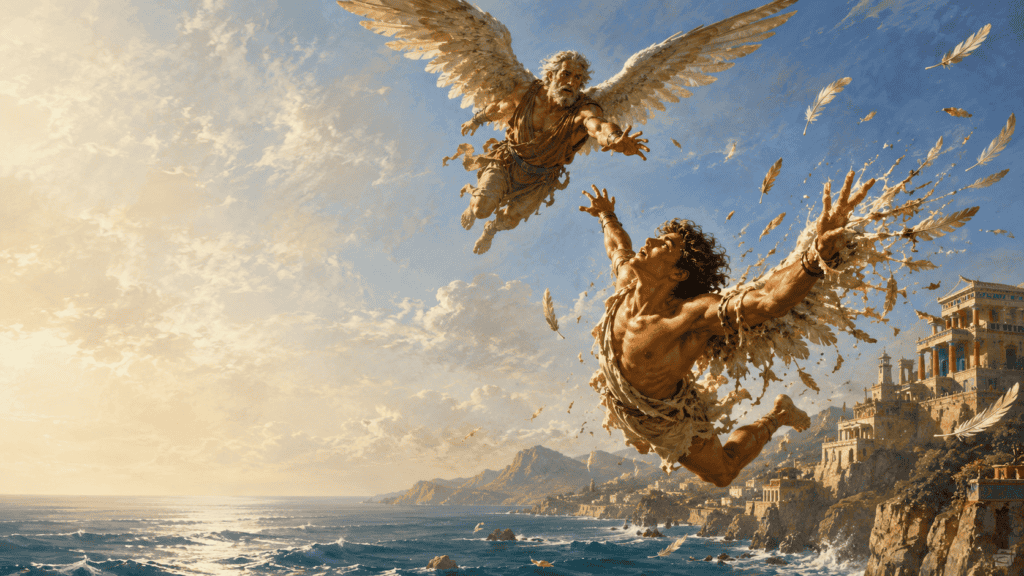
At first Icarus kept close behind his father, exactly as he had been told. Then the sheer thrill of flight took hold of him, and the warning slipped from his mind. He left his guide and climbed, drawn upward toward the open heavens and the sun.
The heat did its work. The wax that held his wings together softened and ran, the feathers loosened and scattered, and the boy was suddenly beating bare arms against empty air. He fell, crying out his father’s name, down into the sea that would carry his name forever after.
The Father’s Grief
Daedalus, flying ahead, called back for his son and heard no answer. Turning, he saw nothing but feathers drifting on the waves, and he understood at once what had happened.
He cursed his own art, the skill that had given his boy wings only to take him away. He searched the water until he found the small body, and he buried Icarus on a nearby island.
The land was called Icaria from that day, and the surrounding waters the Icarian Sea, so that the boy’s name outlived him in the geography of the world. It was the bitterest kind of memorial, a father’s invention turned into his son’s grave.
The Partridge in the Ditch
Ovid frames the whole tragedy with a darker, older story, and it is easy to miss. As Daedalus laid his son in the ground, a partridge watched from a nearby ditch and clapped its wings in what looked almost like joy, the one creature in the world that did not mourn.
That bird had once been a boy. Perdix (PUR-diks) was Daedalus’s own nephew, sent to learn the craft from his famous uncle, and he proved so gifted that he invented the saw and the compass while still a child. Consumed by jealousy that his apprentice might surpass him, Daedalus had thrown the boy from the height of the goddess’s temple in Athens.
Minerva, who favors the clever, caught the falling child and changed him into a partridge before he could strike the ground. To this day the bird remembers the fall: it never nests in high places and never flies far from the earth.
This is the crime that had driven Daedalus into exile in the first place. He had murdered one talented boy out of envy, and now he had lost another out of his own ingenuity, and Ovid lets that symmetry sit there without a word of comment.
The Trouble With the Middle Way
Read simply, the myth is about moderation: keep to the middle course and you will be safe, reach beyond your limits and you will be destroyed. The advice Daedalus gives his son is the advice of the via media, the prudent path between extremes.
But the framing makes that lesson harder to swallow. The man preaching the middle way had himself flown into a murderous extreme, hurling his nephew from a tower, and it was his own boundless cleverness that built the wings in the first place.
Icarus, by contrast, is guilty mainly of being young. His fault is not calculated pride but the simple, intoxicating joy of doing something no boy had ever done, and the punishment for that joy is death. The myth pairs naturally with the story of Phaethon, another boy who reached toward the sun and fell, and who was likewise undone less by wickedness than by youth and a father who could not save him.
Daedalus and Icarus in Later Art
The image of the falling boy has haunted artists for centuries. The painting long attributed to Pieter Bruegel, often called Landscape with the Fall of Icarus, places the disaster almost out of frame: a ploughman works his field, a shepherd gazes at the sky, ships sail on, and only a pair of pale legs disappearing into the sea betrays that anyone has died at all.
That painting inspired W. H. Auden’s famous reflection on how suffering happens while the rest of the world looks calmly away. The myth has become shorthand for that idea, the private catastrophe that the indifferent world barely notices.
The names themselves have entered the language. To call something Icarian is to call it gloriously, fatally overreaching, while Daedalus has become a byword for the inventor whose brilliance carries its own danger inside it.
Final Take: Daedalus and Icarus
The myth is remembered as a warning against flying too high, and that reading holds. Icarus ignored the limit his father set, and the limit was real.
Yet Ovid’s telling is sadder and more honest than the moral allows. It is the story of a father whose genius could outwit a king and conquer the sky but could not protect the one person he loved, and who buried a son killed by the very gift that set them both free.
The partridge clapping in the ditch is the detail that lingers. It is the past Daedalus thought he had flown away from, watching him at last receive the grief he once inflicted, and reminding us that the cleverest man in the world could engineer everything except a way to undo what he had done.
Share This Page
Cite This Page
MLA
Editors of RomanMythology.com. "Daedalus and Icarus: The Inventor and the Boy Who Fell." RomanMythology.com, 2026, https://www.romanmythology.com/roman-myths/daedalus-and-icarus/. Accessed June 4, 2026.
APA
Editors of RomanMythology.com. (2026). Daedalus and Icarus: The Inventor and the Boy Who Fell. RomanMythology.com. Retrieved June 4, 2026, from https://www.romanmythology.com/roman-myths/daedalus-and-icarus/