For a god of prophecy and healing, Apollo is strikingly unable to protect the people he loves. The story of Hyacinthus (hy-uh-SIN-thus) is the clearest case of all: a god who could see the future and cure the dying, undone by an ordinary afternoon of sport.
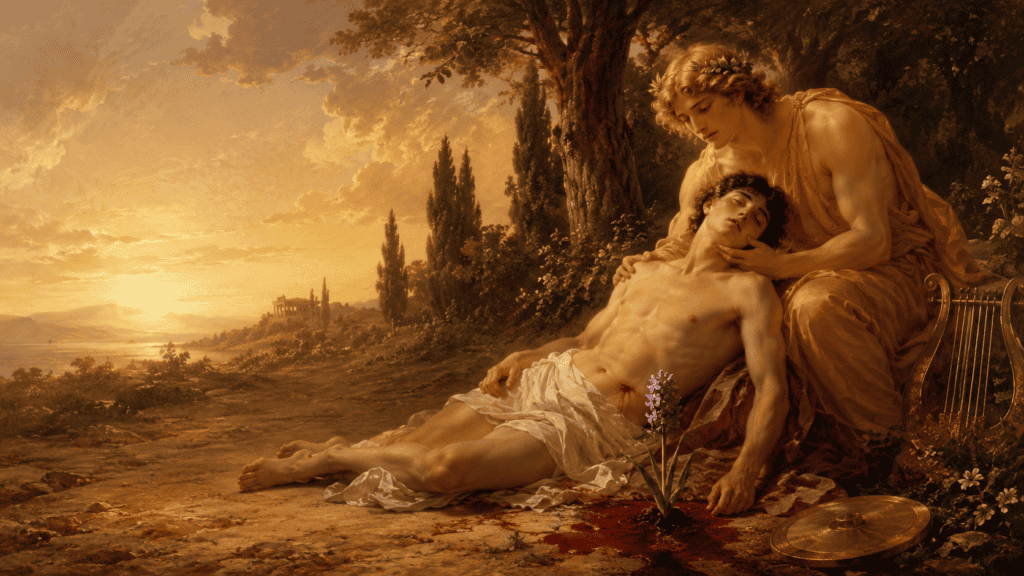
It is a small myth with a long reach, and the poet Ovid made it one of the most quietly devastating tales in the Metamorphoses.
The Beautiful Youth
Hyacinthus was a prince of Amyclae (uh-MIK-lee), near Sparta, famed for a beauty that drew the eyes of the gods themselves. Apollo loved him and set aside the dignity of Olympus to be near him.
The god worshipped across the Greek world followed the young man through the hills, carrying his nets and minding his hunting dogs, forgetting his lyre and his oracle for the sake of his company. For a while, the great divinity of light lived almost like an ordinary companion.
Apollo was not Hyacinthus’s only divine admirer, and that detail would prove fatal. The west wind, Zephyrus (ZEF-ih-rus), desired the youth too, and burned with jealousy that Hyacinthus had given his heart to the god instead.
The Discus
One day the two competed at throwing the discus, a favorite test of strength and grace among the Greeks. Apollo hurled it high and far, and Hyacinthus, eager and laughing, ran beneath it to catch it as it fell.
The heavy bronze struck him full in the face and felled him. In Ovid’s telling, it is a pure accident — the discus rebounds from the hard ground and drives into the boy before either of them can react.
In a darker tradition, it was murder. Zephyrus, enraged at being spurned, caught the spinning discus on a gust of wind and steered it into Hyacinthus, killing his rival’s beloved out of pure spite.
The God Who Could Not Heal
Apollo reached him in an instant, and here the myth turns its knife. The god of medicine, who had taught mortals the healing arts and fathered Aesculapius himself, gathered the dying youth in his arms and could do nothing.
He tried every remedy and every herb he knew, and not one of them held back death. The god who governed the boundary between sickness and health stood helpless on the wrong side of it.
It is the same wound that runs through Apollo’s love for Daphne, returning here in its cruelest form. The master of a divine art is powerless at the single moment he most needs it, and for once a god grieves the way mortals do, holding a body that all his power cannot call back.
The Flower of Mourning
Unable to save Hyacinthus, Apollo did what he so often does with loss: he made it permanent. From the spilled blood he raised a flower, so that the youth would bloom again each spring rather than vanish from the world entirely.
On its petals, the myth says, the god traced the letters of a cry of grief — a written sob, pressed into the living plant, so that the flower would repeat his lament every time it opened. A private sorrow became something the whole earth could read.
It is the same gesture Apollo makes for Daphne, whose laurel became his crown. When the god cannot keep what he loves, he transforms it into a lasting emblem — devotion preserved precisely because possession failed.
The Question of the Flower
The bloom the Greeks called the hyacinth was not the modern flower of that name. Scholars have long argued over what plant they really meant, with the leading guess being a kind of larkspur whose dark markings can be read as the grief-letters of the myth.
The same scratched petals appear in a second story, where the flower springs from the blood of the hero Ajax, its markings spelling the opening of his name. The ancients clearly delighted in a plant whose natural veining looked like writing, and built more than one tale of mourning around it.
What matters is the idea rather than the botany. Here was a living thing that seemed to carry an inscription, and the myth-makers turned that accident of nature into a permanent record of a god’s grief.
An Older God Beneath the Story
The myth carries a trace of something far older than Apollo himself. At Amyclae, Hyacinthus was honored with a major annual festival, the Hyacinthia (hy-uh-SIN-thee-uh), that opened in solemn mourning for the youth before turning to days of joyful celebration of Apollo.
His tomb was said to lie beneath the great statue of Apollo at the sanctuary, and offerings were made to him there as to a hero of the underworld, not merely a character in a story. He was, in other words, still being worshipped.
His very name points to the explanation. It belongs to a pre-Greek layer of language, the same ancient stratum that gave Greece words like labyrinth, which suggests Hyacinthus was once a local god in his own right — most likely a spirit of vegetation that died and returned with the turning year.
If so, the story of his death preserves a real religious history. Apollo, the incoming god, absorbed an older one, and the myth of a beloved youth dying in his arms remembers that takeover as an act of love rather than conquest.
A Pattern of Loss
Hyacinthus was not an exception in Apollo’s life but a rule. Almost every story of the god’s love ends the same way, with the beloved lost and the god left holding only a memorial.
Daphne fled him and became the laurel rather than be caught. Coronis, the mother of his healing son, betrayed him and died for it. The Trojan princess Cassandra accepted his gift of prophecy and then refused the god, who answered by cursing her so that her true predictions would never be believed.
Even another youth he loved, Cyparissus (sip-uh-RISS-us), was turned in grief into the cypress, the tree of mourning, after accidentally killing his own tame stag. Time and again Apollo’s affection ends in flight, death, or transformation — and time and again the god responds by changing the one he loved into a living thing that will outlast them both.
Seen against that pattern, the flower of Hyacinthus is not a single tragedy but Apollo’s signature. The god of foresight never seems to see these losses coming, and the god of healing can never undo them; all he can do is make them permanent and beautiful.
The Myth in Roman Hands
Romans met the story above all through Ovid, who placed it in the great song of Orpheus in the Metamorphoses, among tales of gods who loved mortals and lost them. In that setting the death of Hyacinthus becomes one more proof that even divine love is no shield against grief.
Ovid’s version downplays the jealous wind and dwells instead on Apollo’s tenderness and helplessness, which is what gives the Roman telling its peculiar ache. The reader is left not with a villain to blame but with a god holding a boy he cannot save.
That emphasis is why the tale outlived its Spartan origins. Stripped of its old festival and its local cult, it survived as a pure study of loss, the kind of story a sophisticated Roman audience could turn over for its sorrow alone.
Final Take: Apollo and Hyacinthus
The tale of Hyacinthus is brief, but it concentrates everything uneasy about Apollo. He is radiant, gifted, and adored, and yet loss follows him with a regularity no amount of power can break.
Roman readers, steeped in Ovid, found in it both consolation and a hard truth. The flower returning each spring offered the comfort that love can outlast death, while the cry written on its petals admitted that even a god cannot undo the moment the discus falls.
That is why the myth endured. It let people believe that grief could be made beautiful, without pretending for a single line that beauty made the grief any smaller.
Share This Page
Cite This Page
MLA
Editors of RomanMythology.com. "Apollo and Hyacinthus: Myth of the Flower." RomanMythology.com, 2026, https://www.romanmythology.com/roman-myths/apollo-and-hyacinthus-myth-of-the-flower/. Accessed June 4, 2026.
APA
Editors of RomanMythology.com. (2026). Apollo and Hyacinthus: Myth of the Flower. RomanMythology.com. Retrieved June 4, 2026, from https://www.romanmythology.com/roman-myths/apollo-and-hyacinthus-myth-of-the-flower/