QUICK SUMMARY
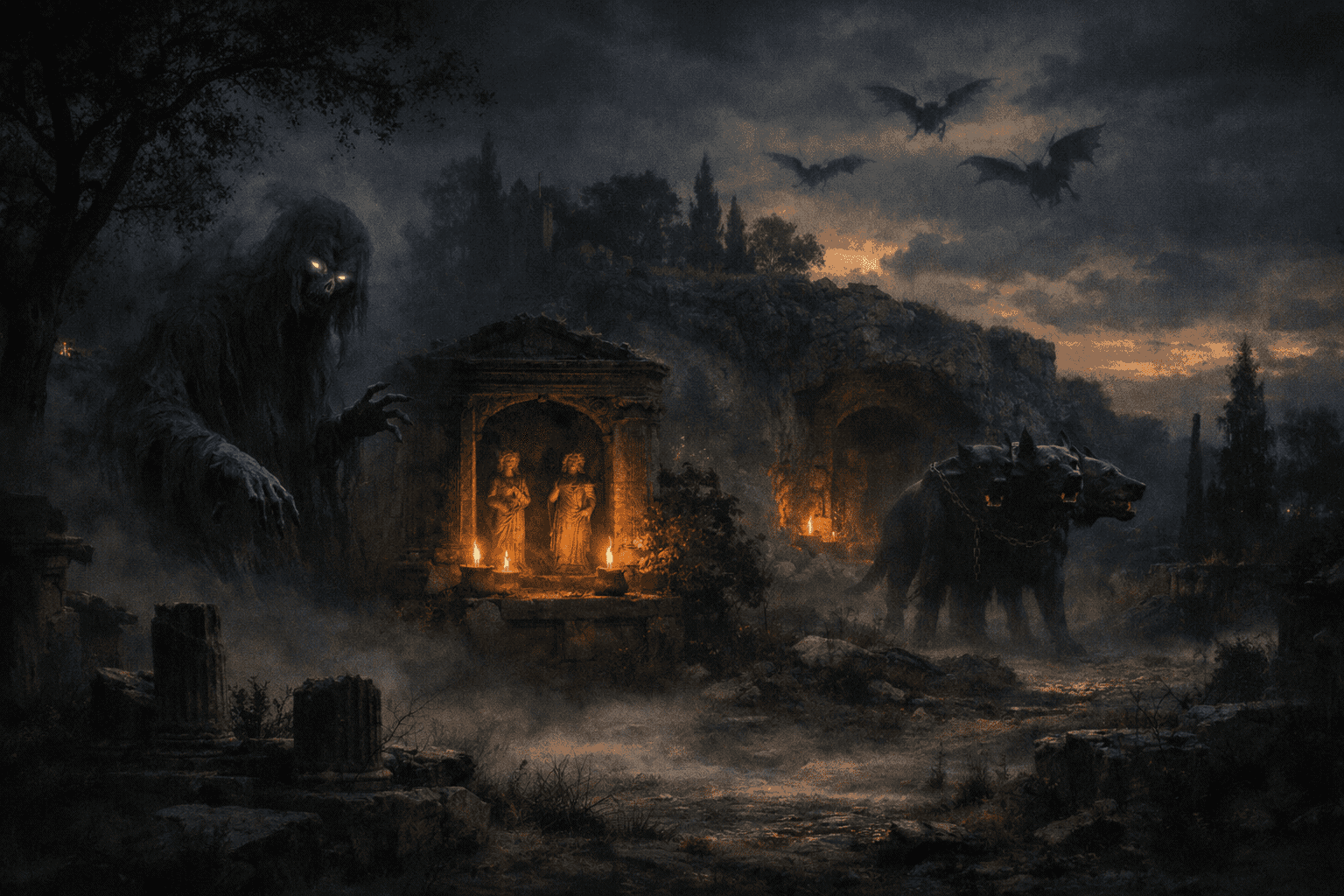
Roman mythology includes far more than gods and heroes. It also contains spirits of the dead, household guardians, underworld beings, monsters, and divine presences tied to places, boundaries, and everyday life. Together, these creatures and beings reveal a Roman world that was crowded with unseen forces, where protection, danger, memory, and fear were never far away.
What Are Creatures and Beings in Roman Mythology?
When most people think of Roman mythology, they think first of the major gods: Jupiter with his thunderbolt, Mars with his warlike power, Venus with her beauty and influence. That is understandable, but it is also incomplete. The Roman mythological world is not shaped only by great deities ruling from above. It is also filled with lesser spirits, strange beings, guardians, monsters, and invisible presences that move much closer to human life.
These figures matter because they make Roman mythology feel inhabited. They fill the spaces between temple and household, between city and wilderness, between the world of the living and the world of the dead. Some are protective and familiar. Others are dangerous, unsettling, or impossible to fully understand. Many are not the center of dramatic narrative myths, yet they are essential for understanding how the Romans imagined reality itself.
Roman religion and myth were built on the idea that the world was not empty. Places had power. Homes required protection. The dead did not simply disappear. Boundaries had to be guarded. Rituals mattered because unseen forces were always present, whether benevolent, hostile, or uncertain. In that sense, Roman mythology includes not only stories about what the gods did, but also a broader sense of what kinds of beings shared the world with human beings.
A Mythological World Beyond the Olympian Gods
One of the most interesting things about Roman mythology is how layered it is. At the highest level, there are major gods whose power is tied to the state, public religion, war, the sky, fertility, law, and political identity. Beneath them, however, is a much wider landscape of beings who do not always fit neatly into the category of god, monster, or spirit.
Some are household guardians. Some are ancestral or restless dead. Some are inherited mythic creatures adapted from Greek tradition. Some are forces of place, threshold, or presence. Some exist in a gray area between belief, ritual, and superstition. This flexibility is part of what makes Roman mythology so rich. The Romans did not separate the sacred world into clean categories for the convenience of future readers making website taxonomies. Inconsiderate, really.
Instead, they allowed the supernatural world to overlap with daily life. A family might honor household spirits at a domestic shrine while also fearing malevolent ghosts. A person might revere the gods of the state while also believing that a certain grove, spring, or crossroads possessed a sacred presence. Roman mythology, then, was not a closed pantheon with twelve neat slots. It was an active, layered system in which many different kinds of beings had a place.
How the Romans Understood Supernatural Presence
To understand Roman creatures and beings, it helps to move away from the modern fantasy model, where every supernatural figure is expected to have a dramatic backstory, a visual design, and a fixed category. Roman belief did not always work that way. Some beings were sharply defined and vividly imagined, but others were known more through ritual function than through narrative detail.
This matters because not every Roman supernatural being existed to star in a myth. Many existed to explain experiences, to anchor ritual practices, or to give shape to invisible realities. A spirit could be important because it protected the home, haunted the night, guarded a boundary, or embodied the continuing presence of the dead. A being did not need a famous storyline to matter.
What unites many of these figures is not spectacle, but proximity. They are close. They appear in houses, tombs, roads, doorways, underworld passages, and local landscapes. They belong to a mythological imagination in which the unseen world presses continually against the visible one.
Quick Reference Table of Roman Mythology Creatures
Use this table as a fast overview of the major creatures, spirits, and supernatural beings in Roman mythology before exploring each one in more detail below.
| Name | Category | Role | Quick Reference |
|---|---|---|---|
| Manes | Spirits of the dead | Honored dead | Revered spirits of the deceased, associated with burial, remembrance, and ancestral continuity. |
| Lemures | Restless spirits | Unquiet dead | Malevolent or unsettled spirits believed to trouble the living if not properly appeased. |
| Larvae | Hostile spirits | Terrifying hauntings | Frightening supernatural beings connected with fear, disturbance, and harmful spiritual presence. |
| Lares | Household guardians | Protectors of home and family | Benevolent guardian spirits honored in the home and connected with domestic protection. |
| Penates | Household guardians | Guardians of food and well-being | Domestic spirits linked to the pantry, nourishment, and the continued stability of the household. |
| Charon | Underworld being | Ferryman of the dead | The underworld boatman who carries souls across the waters that separate the living from the dead. |
| Cerberus | Underworld guardian | Guardian of the threshold | The fearsome hound of the underworld who guards its entrance and prevents escape. |
| Cyclopes | Mythic creatures | Strength and divine craftsmanship | One-eyed giants associated with immense power, fire, and the forging of divine weapons. |
| Harpies | Monstrous beings | Agents of disorder | Winged creatures linked to sudden destruction, defilement, and chaotic intrusion. |
| Giants | Mythic beings | Rebels against divine order | Powerful beings whose conflicts with the gods symbolize resistance to divine rule. |
| Genius | Personal spirit | Guiding spiritual presence | A protective or generative spirit attached to a person, place, or group. |
| Numen | Divine presence | Sacred force | An invisible divine power or presence believed to inhabit places, actions, and sacred realities. |
Spirits of the Dead and the Unquiet Afterlife
The Roman world of the dead was not silent, abstract, or safely sealed away. It remained connected to the living through ritual memory, burial practice, and fear. This is one of the reasons spirits of the dead occupy such an important place within Roman thought. Death did not erase presence. It changed its form.
The Manes
The Manes were spirits of the deceased, often understood as the honored dead who continued to exist in the unseen world. They were not necessarily terrifying or malicious. In many cases, they represented a dignified continuation of the dead, provided they were properly buried and remembered. Roman funerary language often invokes them with a tone of reverence, suggesting that the dead remained part of the moral and spiritual structure of family and society.
The importance of the Manes reveals something central about Roman belief: memory was not merely emotional. It was ritual. The dead required acknowledgment. To forget the dead was not just unkind. It risked disturbing the order that should exist between the living and those who had passed beyond.
The Lemures
If the Manes represent the honored dead, the Lemures represent a darker possibility. These were restless spirits, often imagined as troubled or malevolent dead who had not found peace. They belonged to the fearful side of Roman afterlife belief, the side that suggested the dead could return in unsettling ways if not properly addressed.
The Lemures were not distant symbolic figures. They were treated as a real threat within ritual life. The festival of Lemuria was meant to drive them away from the home and protect the household from their influence. This alone tells us how seriously such spirits were taken. Roman religion was not only about attracting divine favor. It was also about preventing supernatural disturbance.
Lemures help show how Roman mythology understands the afterlife morally and ritually. A dead person who is remembered, honored, and properly placed remains within order. A dead person who is not may return as a problem.
The Larvae
Closely related to the Lemures, the Larvae are usually treated as even more frightening spirits. Ancient sources do not always draw perfectly clean boundaries between these terms, but Larvae are often associated with more terrifying forms of haunting, punishment, or madness. They belong to the imagination of the hostile dead, not the honored dead.
Their presence in Roman belief reveals that mythology did not end where social order failed. It continued there. The dead could reflect disruption just as much as peace. Roman myth and ritual are deeply invested in maintaining boundaries, and few boundaries mattered more than the one between the living and the dead.
Household Spirits and the Sacred Life of the Home
If some Roman spirits inspired fear, others were welcomed daily. One of the most distinctive features of Roman religion is the importance of domestic sacred life. Religion did not happen only in temples or public festivals. It happened in the home, around the hearth, in acts of offering and remembrance. That is where household spirits become essential.
The Lares
The Lares were protective spirits associated with the household and, in some cases, with local spaces or communities. They were among the most familiar and intimate supernatural beings in Roman life. Families honored them regularly, and household shrines gave them a visible place within domestic religion.
What makes the Lares so important is that they show Roman mythology at its most immediate. These are not distant gods whose concerns lie only with empire or cosmic power. They are guardians of everyday continuity. Their presence says that the household itself is sacred territory and that ordinary life requires supernatural protection.
The Penates
The Penates were closely tied to the preservation of the household, especially in relation to food, storage, and domestic well-being. If the Lares protect the family and its space, the Penates reinforce the idea that sustenance itself is sacred. The home survives not only through human labor, but also through proper relationship with unseen protectors.
Together, the Lares and Penates reveal a deeply Roman truth: stability begins at home. The sacred order of the state rests upon the sacred order of the family. Roman mythology does not reserve divine presence for the grand and dramatic. It places it beside the table, near the fire, and within the routines of daily life.
Underworld Beings and Guardians of the Threshold
Roman mythology is especially powerful when it imagines boundaries: between city and wilderness, mortal and divine, living and dead. The underworld is one of the most important of these boundary zones, and it is populated by beings whose function is to guard, ferry, or enforce its order.
Charon
Charon, the ferryman of the dead, is one of the most recognizable underworld figures in classical mythology. Though strongly inherited from Greek tradition, he becomes part of the Roman mythological landscape as well. His role is clear and unforgettable: he carries souls across the underworld waters, but only under the proper conditions.
Charon matters because he turns death into a process rather than a disappearance. There is passage, but the passage is regulated. Burial rites matter because transition matters. The dead do not simply drift into another realm. They must be conveyed, recognized, and placed.
Cerberus
Cerberus, the great guardian hound of the underworld, represents a different aspect of the same principle. If Charon enables passage, Cerberus enforces separation. He guards the threshold between realms, preventing the dead from escaping and the living from trespassing freely.
Cerberus is one of those mythic beings whose symbolic power is immediate. He is not subtle. He exists to make a point about boundaries. Roman mythology repeatedly insists that certain lines cannot be crossed without consequence, and Cerberus embodies that truth in monstrous form.
Monsters and Mythic Creatures of Chaos and Power
Roman mythology, especially in its interaction with Greek tradition, includes a range of creatures that embody danger, disorder, punishment, or raw force. These beings often appear in stories of heroes and gods, but they also help define what the Roman mythological order stands against.
The Cyclopes
The Cyclopes are among the most famous mythic creatures associated with classical antiquity. In Roman tradition, they are linked not only to brute strength but also to divine craftsmanship, especially through Vulcan’s forge. They are massive, one-eyed beings connected to fire, metalwork, and the making of powerful objects.
What makes them interesting is that they are not simply monsters to be destroyed. They also contribute to divine order by forging weapons for the gods. This duality matters. Roman mythology does not always treat strange beings as merely chaotic. Some are dangerous and productive at once.
The Harpies
The Harpies belong to the darker edge of mythological imagination. They are often represented as winged creatures associated with storm, seizure, contamination, or punishment. Their presence in myth is disruptive. They descend suddenly, consume, steal, or defile, and leave behind a sense of disorder.
They matter because Roman mythology needs beings that represent not stable power, but invasive chaos. The Harpies do not govern. They interrupt. That makes them useful figures in a mythological system where order must constantly defend itself.
The Giants
The Giants are not merely oversized creatures. They are symbolic rebels against divine order. Their struggle against the gods reflects one of the oldest and most persistent mythological patterns: the challenge to rightful cosmic rule. In Roman imagination, as in Greek tradition, their defeat confirms the legitimacy of divine hierarchy.
What they represent is not just size or violence, but failed resistance. Roman mythology repeatedly returns to the idea that power must be properly ordered. The Giants dramatize what happens when raw force rises against sacred authority.
Personified Forces and Invisible Powers
Not every Roman mythological being is a creature in visual terms. Some are presences, powers, or personified realities that shape life from within rather than appearing in monstrous form. This is where Roman belief becomes especially interesting, because it shows how willing the Romans were to treat abstractions as real components of the sacred world.
Genius
A Genius was a personal spirit or guiding presence attached to an individual. It represented something like a person’s generative force, protective counterpart, or inner divine pattern. The concept is subtle, but important. A person is not spiritually alone. Human life has an accompanying unseen dimension.
The Genius shows how Roman mythology can move inward as well as outward. It is not only about gods in the sky or monsters at the gate. It is also about the sacred structure of personhood itself.
Numen
Numen is even more elusive and, for that reason, deeply revealing. It refers to divine presence, will, or sacred force within an object, place, action, or being. It is not always personified, yet it is no less real in religious imagination.
This concept matters enormously because it shows that Roman mythology is not limited to named figures. The world can be sacred not only because a god physically appears, but because divine power inhabits or marks a place. A grove, a ritual, a threshold, or a sacred object may carry numen. The unseen world is therefore not only populated by beings, but infused into reality itself.
Nature Spirits, Boundaries, and Local Presences
The Roman religious imagination was highly sensitive to place. Fields, springs, groves, roads, and boundaries were not simply physical locations. They could be inhabited, protected, or marked by sacred presence. Some of these local forces had names and cults. Others remained more diffuse, known primarily through practice or inherited caution.
This matters because it makes Roman mythology geographical. Sacred power does not hover only in heaven or beneath the earth. It exists in landscapes and transitions. Boundaries are especially important. Doorways, crossroads, gates, and territorial lines all carry symbolic weight in Roman life, so it makes sense that mythological and spiritual thought would gather there as well.
In this broader sense, Roman creatures and beings are not just characters. They are ways of imagining that the world is occupied, watched, and structured from within. The land itself is never entirely neutral.
Why These Beings Matter in Roman Mythology
It would be easy to dismiss many of these figures as secondary because they are not always the stars of famous myths. That would be a mistake. Without them, Roman mythology loses texture, immediacy, and depth. The great gods explain power at the highest level, but creatures, spirits, and lesser beings explain how mythological reality touches ordinary life.
They tell us what happens after death and why burial matters. They explain why the home is sacred and why ritual protection is necessary. They help define the underworld as a real and structured realm. They embody danger, punishment, disorder, and divine enforcement. They also reveal that Roman religion is not purely abstract or political. It is personal, domestic, haunted, and local.
Most of all, these beings matter because they create atmosphere. They turn mythology from a set of stories into a world. A world with only major gods can feel distant. A world with household spirits, restless dead, underworld guardians, sacred presences, and lurking creatures feels inhabited.
Roman Mythology as a Crowded Sacred World
One of the clearest impressions left by Roman mythology is that the visible world is only part of the world. There are gods above, dead below, guardians at thresholds, spirits in houses, presences in places, and creatures that appear when order is threatened. This layered vision helps explain why Roman religion was so attentive to ritual precision, memory, and observance. If the world is full of unseen realities, then careless living becomes dangerous.
This does not mean the Romans lived in constant fear. It means they lived within a sacred structure where fear, reverence, gratitude, and caution all had their place. Supernatural beings were not random decorations. They were woven into how Romans understood safety, identity, continuity, and the limits of human control.
Final Thoughts
Roman mythology includes far more than its famous gods and heroic legends. It also includes the spirits who guard homes, the dead who linger beyond burial, the creatures who enforce the boundaries of the underworld, the monsters who embody disorder, and the invisible presences that make places sacred.
Taken together, these beings reveal a mythology that is dense, layered, and close to human life. They make the Roman world feel spiritually inhabited at every level, from the hearth to the tomb, from the city gate to the underworld river.
That is what makes Roman mythology creatures and beings so important. They remind us that, in the Roman imagination, the world was never empty. It was shared.