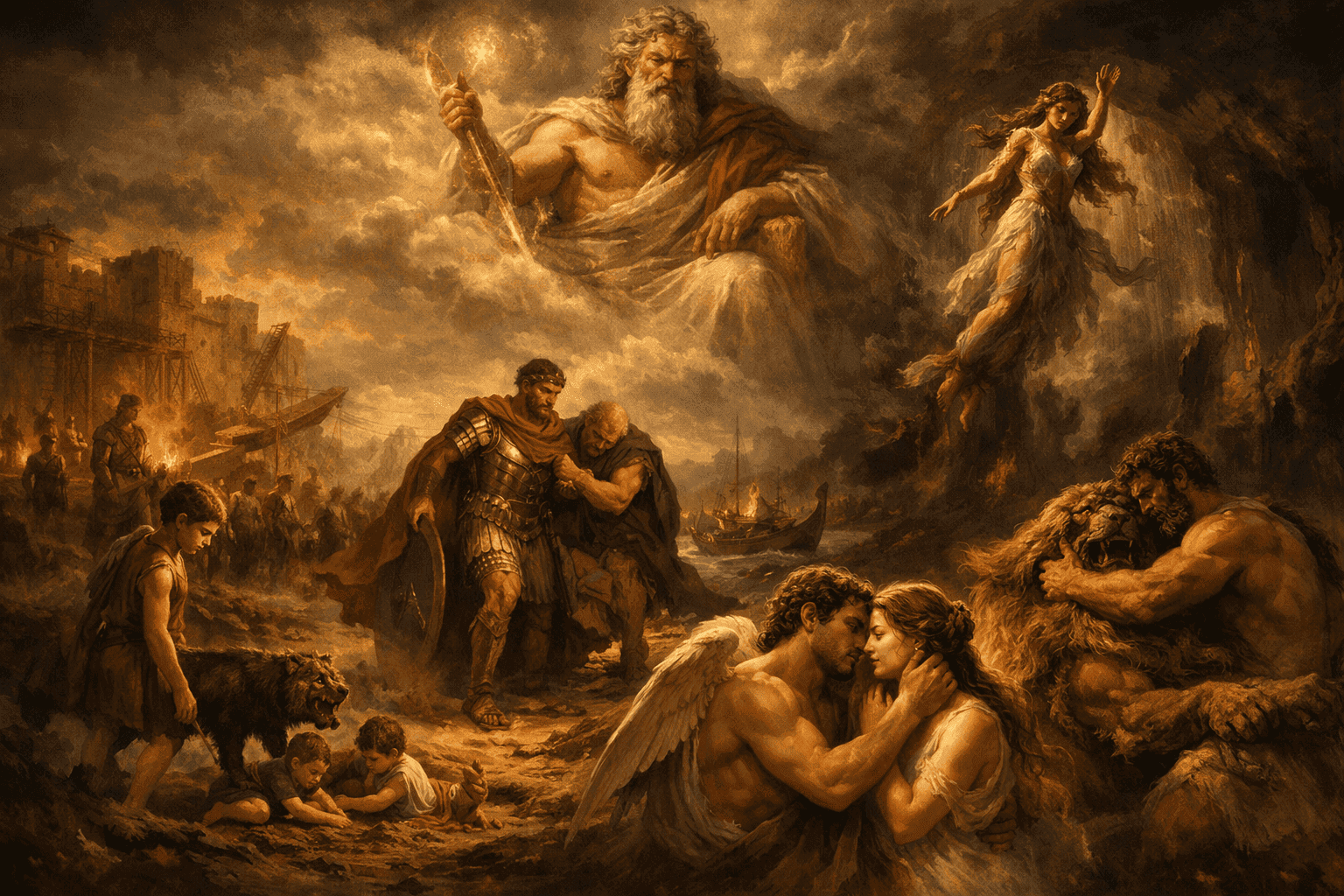
Roman mythology is a system, not a collection. Each story connects to the others, reinforcing a shared understanding of how the world works, what the gods want, and what it costs to defy both. The myths span creation and destruction, love and betrayal, divine justice and human ambition — but they consistently return to the same questions: Who deserves to survive? What does duty require? What happens when you reach for more than fate has assigned you?

This guide collects the major Roman myths and explains what each one actually meant — not just what happens in the story, but why Romans told it and what they understood it to say.
The Creation of the World
Before Rome, before the gods as Romans knew them, there was Chaos — formless, undifferentiated, neither earth nor sea nor sky but all of them compressed into a single undivided mass.
The Creation of the World and the Rise of the Gods tells how that mass was separated into its parts. Earth settled at the center. Water surrounded it. Air rose above. Fire climbed highest. The regions were assigned their proper inhabitants: fish to the sea, birds to the air, beasts to the land. Humans came last, formed either from divine clay or — in one tradition — from the earth still warm with traces of the sky it had just been separated from.
Then came the divine generations: the Titans, their overthrow by Jupiter and his brothers, the establishment of the Olympian order. The world moved from Chaos to Cosmos — from formlessness to structure — and that movement was understood as the foundational act that made everything else possible.
The Golden Age of Saturn
Before Jupiter’s rule, Saturn’s Golden Age was an era without conflict, labor, or injustice. The earth gave its fruit freely. There was no need for law because no one violated natural order. There was no need for war because there was nothing to defend.
The myth served as a permanent contrast to the present — not as a program to return to but as a standard against which the current world was measured. Saturn’s festival, the Saturnalia, briefly reversed the social order each December: masters served slaves, rules were suspended, the Golden Age was enacted in miniature for a few days before ordinary Roman hierarchy reasserted itself. The myth acknowledged that what Rome had achieved came at a cost that the Golden Age had not required.
The Great Flood: Deucalion and Pyrrha
Deucalion and Pyrrha survived the great flood that Jupiter sent to destroy a corrupt human race. The only survivors of their kind, they landed on Mount Parnassus and received an oracle: throw the bones of your mother behind you. After initial confusion — how could they throw the bones of the dead Earth? — they understood: stones, the bones of the earth. They threw stones over their shoulders and the stones became people, soft and human-shaped from the mud.
The Roman flood myth is notably less morally loaded than similar stories in other traditions. Deucalion is saved not for exceptional virtue but because he is the son of Prometheus, who warned him. The myth’s focus is on what comes after destruction — not judgment but renewal, the matter-of-fact repopulation of an empty world from the earth itself.
The Founding of Rome
No mythology was more important to Romans than the story of how their city came to exist. These were not idle origin tales — they were the theological and political foundation of Roman identity, told and retold in public ceremony, commemorated in monuments, and invoked by emperors to legitimize their rule.
Mars and Rhea Silvia: The Birth of Romulus and Remus
Before the founding, there was a conception. Mars and Rhea Silvia tells the story that made Romulus and Remus possible: a Vestal Virgin, forced into the priesthood by her usurping uncle to prevent her from producing heirs, visited by the god of war in his sacred grove. Whether the encounter was willing, divine compulsion, or something in between, the myth does not resolve cleanly. What it establishes is the theological fact: Rome’s founder was the son of Mars, and the Roman people carried divine military blood from their very origin.
Romulus and Remus
Romulus and Remus is the founding myth, and it is harsher than most readers expect. The twin sons of Mars, abandoned at birth, suckled by a she-wolf, raised by a shepherd — the brothers survive against every odd and return to found a city. Then Romulus kills Remus. The city is born from fratricide, which the Romans did not try to soften or explain away. Rome’s greatness was purchased with blood from the very beginning, and the myth said so plainly.
The Sabine Women
In the early days of Rome, the new city lacks women and stability. The Sabine Women tells how Roman men seize Sabine women at a festival, leading to war between the two groups. The conflict reaches its breaking point before the women intervene, standing between their fathers and their husbands, refusing to let either side destroy the other. The resolution is not simple reconciliation but integration. Rome grows by absorbing others, even through conflict, and the myth made no pretense otherwise.
Tarpeia: The Price of Betrayal
The Fall of Tarpeia is Rome’s founding anti-myth. During the Sabine war, a Roman woman opens the city gates to the enemy in exchange for what she expects to be gold. The Sabines bury her under their shields instead. The Tarpeian Rock — from which Rome’s worst traitors were thrown — took her name. Every generation of Romans knew that the city’s gates had been betrayed once, and knew what happened to those who betrayed them.
The Apotheosis of Romulus
Romulus did not die an ordinary death. The first king of Rome disappeared during a military review in a sudden storm — taken to the gods, according to the tradition that prevailed. A senator named Proculus Julius reported that Romulus had appeared to him and declared that he had become the god Quirinus and would watch over Rome forever. The Apotheosis of Romulus established a template: extraordinary Romans could cross the boundary between human and divine, not by claiming it but by earning it through service to the city. Augustus invoked this template when he arranged the posthumous deification of Julius Caesar, and later emperors used it to manage the boundary between imperial power and divine status.
The Trojan Origins of Rome
Rome’s mythological ambitions extended beyond Italy. In the Trojan cycle, the Romans found a way to connect their city to the great civilizations of the ancient Mediterranean, making Rome not a newcomer but the inheritor of a tradition that stretched back to the Bronze Age.
The Judgment of Paris and the Trojan Lineage
The Judgment of Paris and the Trojan Lineage is where it begins. Paris chooses desire over wisdom, awards Venus the golden apple, and sets in motion the Trojan War. For Romans this story mattered not as a tale about Greek heroes but as the origin point of Aeneas — the Trojan who would carry civilization’s seed to Italy. The Trojan catastrophe was the necessary precondition for Rome.
Aeneas and the Journey to Italy
Aeneas and the Journey to Italy is Rome’s equivalent of the Odyssey — the long, difficult, divinely guided journey of the Trojan refugee who becomes Rome’s ancestor. Aeneas carries his elderly father on his shoulders out of burning Troy. He leaves Dido, queen of Carthage, who loves him, because fate demands it. He endures storms, a descent into the underworld, and years of war in Italy before his destiny is finally accomplished. Where Greek heroes are celebrated for ingenuity and glory, Aeneas is celebrated for pietas — duty, endurance, and the willingness to sacrifice what he wants for what is required of him.
Aeneas and Dido
The most emotionally powerful episode in the Aeneid is not a battle or a divine visitation but a love story that cannot be allowed to continue. Aeneas, sheltered in Carthage after storms scatter his fleet, falls in love with Dido, its queen. They live as husband and wife. He considers staying. Mercury arrives with a blunt message from Jupiter: this is not your destiny, you have obligations to your descendants and to the future city of Rome. Aeneas leaves. Dido, abandoned, builds a funeral pyre and kills herself with his sword as his ships disappear over the horizon. The myth established a theological argument that Rome was built on necessary loss — that its founding required a sacrifice that could not be undone and that no subsequent relationship between Rome and Carthage would ever be free of.
The Abduction of Proserpina
The Abduction of Proserpina is the Roman myth most deeply embedded in religious practice. Proserpina, daughter of Ceres, is seized by Pluto while gathering flowers and taken to rule the underworld as his queen. Ceres’s grief withdraws her gifts from the earth — crops fail, famine spreads, humanity faces extinction. Jupiter negotiates Proserpina’s partial return: she will spend part of each year above with her mother, part below with her husband.
The seasons are the myth’s most obvious meaning, but not its deepest one. The story was at the theological center of the Eleusinian Mysteries, the ancient initiatory rites that promised their participants a better afterlife. When Romans underwent initiation — and many of the most educated did, including Cicero and Augustus — they engaged with this myth at a level far beyond its surface narrative.
Myths of Love, Desire, and Transformation
Love in Roman mythology is rarely gentle. It is powerful but unstable, often leading to transformation or tragedy, and the gods who govern it — Venus, Cupid — are no more immune to its consequences than the mortals they affect.
Cupid and Psyche
Cupid and Psyche is the most elaborate love story in Roman mythology and the only one with a genuinely happy ending. Psyche is a mortal girl of such extraordinary beauty that Venus, jealous, sends Cupid to make her fall in love with something terrible. Cupid falls in love with her instead. He hides her in his palace and visits only in darkness, forbidding her to look at him. Her sisters convince her to betray that trust. She lights a lamp while he sleeps, sees him, and drops hot oil on him. He flees. She must complete a series of impossible tasks set by Venus — including a descent to the underworld — before she can be reunited with him, and ultimately earns immortality.
Venus and Adonis
Venus and Adonis places the goddess of love in the position every mortal lover knows: helpless to protect the person she loves from death. Adonis, beautiful beyond measure, is killed by a wild boar while hunting despite Venus’s warnings. From his blood springs the anemone flower. The myth gave the Romans a way to speak about the specific grief of losing someone to a preventable death — the boar that Venus had warned him about — and connected that grief to the natural cycle through the flower that marks where he fell.
The Transformation of Daphne
The Transformation of Daphne is Ovid’s most characteristic myth: a story of rescue and loss simultaneously. Daphne is a nymph pursued by Apollo — himself struck by Cupid’s arrow — who prays to her father the river god to save her as Apollo’s hand reaches her. Her father transforms her into a laurel tree. Apollo, unable to possess her, adopts the laurel as his sacred plant. She is saved but no longer human. The god of prophecy did not foresee his own rejection; the god of healing could not cure his own desire. Roman mythology treats transformation honestly — as ambiguous, neither simply rescue nor simply punishment.
The Abduction of Europa
The Abduction of Europa shows Jupiter’s power exercised through disguise. He transforms himself into a magnificent white bull, gentle enough that the Phoenician princess Europa approaches him and climbs onto his back — then carries her across the sea to Crete. She becomes the mother of Minos, the great Cretan king and future underworld judge. The continent of Europe takes her name. The myth is characteristic of Jupiter’s mythology: divine power exercised without consent, with consequences that ripple through generations.
Baucis and Philemon
Baucis and Philemon is the gentlest myth in the Roman canon. Jupiter and Mercury, traveling in disguise through Phrygia, are turned away from every house in a wealthy region until they reach the humble cottage of an elderly couple who receive them with everything they have. The gods reveal themselves, destroy the inhospitable region in a flood, transform the cottage into a temple, and ask what gift the couple wants. Baucis and Philemon ask only to die together, so neither has to grieve the other. They are granted this, and at the end of their lives are transformed into two trees growing from the same root.
Myths of Heroism and Endurance
Some myths define entire stages of existence or elevate individuals beyond mortality through what they endure rather than what they achieve.
Hercules: Strength, Trial, and Apotheosis
Hercules was the most widely worshipped hero in the Roman world — not just admired but given actual cult worship at specific altars across Italy and the empire. His Twelve Labors forced him to confront monsters, chaos, and his own limits in service of a world that never fully acknowledged what it owed him. His eventual apotheosis — the burning of his mortal flesh on a pyre while his divine nature ascended to Olympus — gave the Romans a myth about how extraordinary human achievement could cross the boundary into divinity.
Orpheus and Eurydice
Orpheus and Eurydice is the Roman myth most concerned with the limits of love. Orpheus, the greatest musician who ever lived, loses his wife Eurydice to a snakebite on their wedding day. His grief drives him to descend to the underworld alive, where his music moves Pluto and Proserpina to agree to release her — on the condition that he not look back at her until they reach the surface. At the final moment, he looks back. She returns to the dead. The myth is not simply about love failing. It is about the difference between what love wants and what reality permits.
The Death of Orpheus
The Death of Orpheus does not resolve into consolation. After losing Eurydice a second time, Orpheus withdraws from the world and is eventually killed by the Maenads — torn apart as Pentheus was, his body scattered. His severed head, floating down the river Hebrus, goes on singing. Even death cannot silence what he expressed. The myth ends not in redemption but in fragmentation, reinforcing the limits of human power against the forces that govern existence.
Myths of Hubris and Divine Limits
Roman mythology repeatedly returns to the idea that limits exist, and crossing them has consequences that are rarely proportionate in any human sense — because the gods are not operating on human scales of justice.
Phaethon and the Chariot of the Sun
Phaethon and the Chariot of the Sun is the myth of ambition exceeding competence. Phaethon is the son of Sol who demands proof of his divine parentage and receives it in the worst possible form: his father’s promise to grant him anything. He asks to drive the solar chariot for one day. Sol warns him against it. Phaethon insists. He cannot control the horses. The chariot veers, scorching the earth. Jupiter strikes him down before the damage becomes permanent. His sisters, grieving on the riverbank, are transformed into poplar trees still weeping amber tears. Phaethon is not wicked — he simply cannot do what he has claimed the authority to do, and the world nearly burns for it.
The Punishment of Marsyas
The Punishment of Marsyas concerns what happens when a mortal challenges a god at the god’s own art. Marsyas found Minerva’s discarded flute and became so extraordinarily skilled that he challenged Apollo to a musical contest. Apollo won. He had Marsyas flayed alive. The harshness is the point. Marsyas was not lacking in skill — he was lacking in the judgment to recognize that some contests cannot be entered without accepting the full cost of losing.
The Judgment of Midas
The Judgment of Midas is a portrait of failed judgment at every level. Given a wish by Bacchus, Midas asks that everything he touches turn to gold. This works exactly as requested and is immediately catastrophic. He begs relief, is told to wash in the river Pactolus, which runs with gold ever after. The myth’s second act finds him judging a musical contest between Apollo and Pan in Pan’s favor. Apollo gives him the ears of a donkey. Midas hides them under a hat. His barber, sworn to secrecy, whispers the truth into a hole in the ground. Reeds grow there, and when the wind blows, they speak it aloud. Material greed, aesthetic misjudgment, and the impossibility of keeping shameful truths permanently hidden — the myth covers all three.
The Rape of Lucretia
The Rape of Lucretia is the myth that ended the Roman monarchy. Lucretia, a Roman noblewoman of exemplary virtue, is violated by Sextus Tarquinius, son of the king. She reports the crime to her father and husband, demands they avenge her, and then kills herself, declaring that no unchaste woman shall ever use her as a precedent. The Romans, led by Lucius Junius Brutus, use her death as the catalyzing event to expel the Tarquin kings and establish the Republic. The myth made Lucretia the founding martyr of Roman republican values: the private virtue of one woman became the public foundation of the entire system of government. Her name and story were invoked for centuries whenever Roman liberty was perceived to be under threat.
Shakespeare made her story the subject of his narrative poem The Rape of Lucrece, one of the most sustained literary engagements with her myth in the English language.
Myths of Justice, Fate, and the Underworld
Several major Roman myths concern what happens after death — the geography of Pluto’s realm, the judgment of souls, and the exceptional cases in which the living crossed into the underworld and returned.
The Descent of Aeneas
The descent of Aeneas into the underworld — Book 6 of Virgil’s Aeneid — is the fullest and most theologically developed account of the Roman underworld. Guided by the Sibyl of Cumae and admitted through the gate at Avernus, Aeneas crosses the Styx, passes the judgment halls, sees the punishment of Tartarus from outside its gates, and reaches the Elysian Fields where his father Anchises waits. Anchises shows him the souls of Rome’s future heroes waiting to be reborn — a parade of the Republic’s great men, the emperors, the generals — and explains the doctrine of metempsychosis: souls are purified, forget their previous lives, and return to the world of the living in new bodies. The descent is not simply a journey to the dead. It is a vision of Rome’s entire future compressed into a single night underground.
The Cyclopes and the Forge of Vulcan
The Cyclopes in Roman mythology are not the savage cave-dwellers of the Odyssey but master craftsmen — the forge workers of Vulcan who produced the weapons of the gods. They made Jupiter’s thunderbolts, Neptune’s trident, and the helmet of invisibility that Mercury and Perseus borrowed. Their blindness in one eye was explained as the cost of staring too long into the divine fire of their forge. When Apollo killed them in grief and rage after Jupiter struck down Asclepius with their thunderbolt, he was murdering the craftsmen who had made the weapon used against his son — an act of displaced grief that the myth presented honestly, without excusing it.
What These Myths Have in Common
Roman myths were not a random collection. They expressed a coherent worldview.
Fate operates above everything. The gods themselves are bound by it, and humans even more so. The major myths — Aeneas’s journey, Romulus’s fratricide, Orpheus’s failure — all unfold within structures that cannot be overridden by desire or cleverness alone. You can work within fate, as Aeneas does, or against it, as Phaethon does. The consequences differ accordingly.
The gods are neither good nor evil but enormously powerful and possessed of opinions. They reward pietas — duty, reverence, right relationship — and they punish hubris, ingratitude, and the specific Roman failure of claiming authority you have not earned. The punishments are often disproportionate by human standards. The disproportionality is deliberate. It expresses the actual scale of the power difference between gods and humans.
Transformation is rarely pure improvement. Daphne is saved but becomes a tree. Callisto is preserved but becomes a bear. Marsyas is killed for his skill. The transformed figures retain something of what they were while losing the form that made them human. Roman mythology treats transformation honestly — as ambiguous, neither simply rescue nor simply punishment.
The myths that last are the ones that tell difficult truths. Romulus kills Remus. Orpheus fails at the last moment. Lucretia has to die for the Republic to be born. The Romans did not construct a mythology of reassurance. They constructed one that looked at the world clearly and tried to make sense of what they saw.
Share This Page
Cite This Page
MLA
Editors of RomanMythology.com. "Major Roman Myths: The Complete Story Collection." RomanMythology.com, 2026, https://www.romanmythology.com/roman-myths/major-roman-myths/. Accessed June 11, 2026.
APA
Editors of RomanMythology.com. (2026). Major Roman Myths: The Complete Story Collection. RomanMythology.com. Retrieved June 11, 2026, from https://www.romanmythology.com/roman-myths/major-roman-myths/