Mars was Rome’s most politically charged god. Jupiter may have been supreme, Venus may have been the divine ancestress of the ruling dynasty, but it was Mars who stood at the intersection of Roman identity, military power, and civic religion in the most immediate and continuous way. He was the father of Romulus. His month opened the year. His campus — the Field of Mars — was where armies assembled and citizens voted. And his temples, scattered across Rome’s sacred geography, were among the most significant religious buildings the city ever produced.
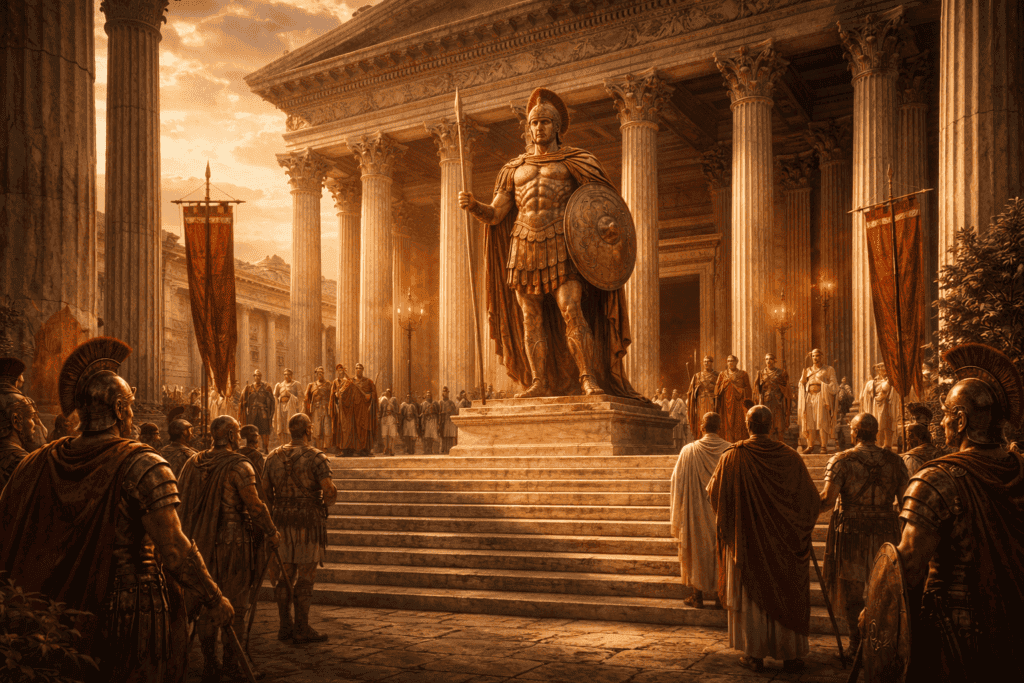
Understanding those temples means understanding not just where Romans went to worship Mars, but how the god was understood to function in Roman civic life — and how successive generations of Roman leaders used the construction and dedication of Martian temples to frame their own authority within a divine narrative.
The Campus Martius and Its Ancient Altar
Before there were temples, there was the Field of Mars itself. The Campus Martius — the great flat plain between the Capitoline Hill and the bend of the Tiber — was sacred to Mars from the earliest period of Roman history, its very name expressing the god’s ownership of the space. Here, by ancient tradition, the armies of Rome assembled before campaigns and the censors conducted the great ritual lustration of the Roman people at the end of each census. Here the comitia centuriata — the assembly organized on military lines — gathered to elect magistrates and pass laws. The sacred and the military and the civic were inseparable in this space.
Within the Campus Martius stood one of Rome’s most ancient altars to Mars — the Ara Martis, whose precise location is uncertain but whose existence is attested in ancient sources. This altar, predating any permanent temple structure, was the site where generals performed the opening sacrifices before campaigns and where the suovetaurilia — the great triple sacrifice of pig, sheep, and bull — was offered to Mars as part of the census lustration. For much of early Roman history, an altar in the open air was sufficient for a deity whose domain was the open sky and the open field. The altar on the Campus Martius was Rome’s primary point of contact with its martial god before the great temple-building programs of the late Republic and early Empire.
The Temple of Mars Outside the Porta Capena
The oldest temple specifically dedicated to Mars within the Roman sacred landscape stood outside the Porta Capena — the gate in the Servian Wall through which the Via Appia began its long journey south. The temple’s founding date was disputed even in antiquity, with some sources attributing it to a vow made during the Latin War of 388 BCE and others placing it earlier. What is clear is that it was old enough to have accumulated considerable religious authority by the Republican period, and its location was significant.
The temple stood just outside the city’s sacred boundary — the pomerium — a placement that was not accidental. Roman religious law prohibited the stationing of armed troops within the pomerium, making the space outside the city’s sacred boundary the natural location for military religion. Generals who were preparing to depart on campaign came to this temple to perform their preliminary rites. It was here that the spear of Mars — the sacred lance kept in the Regia in the Forum — was brought in its case, and here that generals performed the ritual of shaking the sacred weapons while calling out Mars vigila — Mars, awake. Only after this ceremony was an army considered properly dispatched under Mars’s protection.
The Via Sacra — the Sacred Way — began its route through Rome near this temple, connecting the gate to the Forum and the Capitoline in a processional axis that linked the god of war to the civic heart of the city. Triumphal processions that entered through the Porta Triumphalis and wound through Rome toward the Capitoline were passing through a sacred geography that the temple helped define.
Mars Ultor and the Forum of Augustus
The most magnificent temple ever built to Mars — and one of the most significant religious buildings in the history of Rome — was the Temple of Mars Ultor, the Avenger. Its construction was the fulfillment of a vow made by Octavian on the eve of the Battle of Philippi in 42 BCE, in which he and Mark Antony defeated the forces of Brutus and Cassius, the assassins of Julius Caesar. Octavian promised that if Mars granted him victory over the men who had killed his adoptive father, he would build the god a temple worthy of the vengeance delivered.
The vow was made when Octavian was twenty-one years old, barely known, and facing the most dangerous military crisis of his young career. He won. And forty years later, in 2 BCE, the Temple of Mars Ultor was dedicated at the center of the Forum of Augustus — the great public space that Augustus had spent decades planning and building, a project so ambitious that it could not be completed in a single lifetime and that required the displacement of existing neighborhoods through private purchase, negotiation, and the patient accumulation of land over decades.
The temple was enormous by any standard. It stood on a podium approximately three and a half meters high, reached by a broad staircase of twenty steps. The podium itself measured roughly 50 by 115 meters. Eight massive columns of Carrara marble stood across the front, each approximately eighteen meters tall — columns so large that three of them, still standing in the northeastern corner of the forum, remain among the most impressive architectural survivals of the ancient world. The temple’s cella was decorated with marble revetment, and the cult statues within depicted Mars in full armor alongside Venus and possibly Divus Julius — the deified Julius Caesar — completing a dynastic religious tableau that made the temple simultaneously a place of military worship and an assertion of Augustan legitimacy.
What made the temple politically extraordinary was what Augustus placed inside it. The military standards lost by Crassus at the disaster of Carrhae in 53 BCE — when a Parthian army had destroyed a Roman force and captured the sacred aquilae, the eagle standards of the legions — had been recovered through diplomacy in 20 BCE, twenty-two years after their capture. Augustus presented this diplomatic achievement as a military triumph, and the recovered standards were housed in the Temple of Mars Ultor as proof of Rome’s eventual vindication. The standards that Crassus had lost in the worst Roman military catastrophe since the Punic Wars now rested in Mars’s temple, framed as trophies of Augustan justice.
The Forum of Augustus also institutionalized the temple’s role in Roman military and political life in ways that outlasted the Augustan era. The Senate was mandated by Augustus to meet in the temple’s precinct when deliberating on war and peace — connecting the decision-making process to the god of war in the most direct architectural way possible. Generals departing for provinces met here to receive their military standards and their formal commission. Returning generals who had been voted triumphal ornaments dedicated their insignia here. Young men receiving the toga virilis — the toga of adult manhood — were encouraged to make their first offerings at the Temple of Mars Ultor, connecting the rite of passage into civic life to the martial deity who had shaped Rome’s destiny.
The temple thus functioned as the nodal point of Roman military religion in the imperial period: the place where war was decided, campaigns were launched, victories were returned to the god, and the next generation of soldiers was initiated into the system.
Mars Gradivus and the Temple Beyond the City
Alongside the Temple of Mars Ultor, the cult of Mars Gradivus — Mars the Strider, Mars who marches into battle — had its own sacred space outside the city walls. The epithet Gradivus derived from gradior, to step or march, and described Mars in his function as the god who led armies forward into engagement. He was Mars in motion, Mars at the moment of committed action, Mars as the divine force that drove men across the boundary from preparation into battle.
The precise location of the Temple of Mars Gradivus is debated in the scholarship, with ancient sources placing it outside the Porta Capena in the vicinity of the older Martian sanctuary already described. What is clear from the ancient sources is its function: it was a departure temple, a threshold sanctuary where the act of leaving Rome for war was ritually marked. The geography expressed the theology. Mars Gradivus stood outside the pomerium because that is where his domain began. Inside the sacred boundary, armies could not assemble and generals could not exercise their military command. Outside it, war was possible — and Mars Gradivus presided over the crossing.
The statue of Mars Gradivus was kept in the Regia, the ancient religious building in the Forum, alongside the sacred shields and the spear of Mars. When a general was departing for a campaign, he would come to the Regia, take up the sacred spear and the shields, and shake them in the ritual invocation — Mars vigila — before proceeding to the Campus Martius and eventually leaving the city. The act connected the god in his Forum manifestation to the god at his threshold temple to the god of the open field, a chain of divine presences marking the general’s passage from civic to military life.
The Campus Martius Temples and Altar
Beyond the great Augustan temple, Mars maintained several additional sacred presences within the Campus Martius itself. Ancient sources mention a templum Martis — a temple or sacred precinct of Mars — within the Campus, distinct from the outdoor altar, though the precise relationship between these structures and their physical location has been the subject of ongoing scholarly investigation. The Campus as a whole was understood as Martian space, its various sacred buildings forming a religious landscape dedicated to the values the god represented: military preparation, civic assembly, physical training, and the organized deployment of Roman power.
The altar of Mars in the Campus served as the focus of the great census lustration — the lustratio exercitus performed after the census when all Roman citizens had been registered in their military capacity. The suovetaurilia was driven around the assembled people before being sacrificed to Mars, and the ritual enclosed the citizen body within a purificatory circuit that renewed their collective religious fitness for military service. This ceremony, performed once every five years, was among the most solemn in the Roman religious calendar, and the altar of Mars on the Campus Martius was its center.
Agrippa, Augustus’s great general and administrator, built extensively in the Campus Martius as part of the broader Augustan urban program. Among his contributions was work on the area near the older Martian sacred sites, and some ancient sources suggest a rebuilding or elaboration of Martian cult spaces in this period. The Augustan transformation of the Campus Martius from a relatively open field into a densely built monumental landscape incorporated the older Martian sacred geography into a new urban design that honored the god while expressing the new imperial order.
Mars in the Regia and the Forum
The Regia — one of the oldest buildings in Rome, situated at the eastern end of the Forum on the Sacred Way — was not a temple to Mars in the traditional sense but was perhaps the most intimate point of contact between the god and Roman civic life. The Regia served as the headquarters of the pontifex maximus and the rex sacrorum, and it housed Rome’s most sacred objects, among which the weapons of Mars held pride of place.
The sacred ancilia — the oval shields that the Salii carried in their March processions — were stored in the Regia. So was the hasta Martis, the spear of Mars, which ancient sources describe as moving spontaneously at moments of great significance, particularly before the deaths of important figures or the outbreak of major wars. When Julius Caesar died in 44 BCE, ancient writers noted that the spear had moved in the days before the assassination. Whether this was genuine religious experience, retrospective interpretation, or deliberate propaganda, it reflects the living religious status of the object — it was not merely a relic but an active divine presence within the Forum.
The proximity of the Regia to the heart of Roman civic life — the Senate House, the Rostra, the major temples of the Forum — meant that Mars’s sacred presence was felt at the center of Roman public life every day, not only when the Salii processed or when generals came to shake the weapons before campaigns. The Regia embedded Mars in the daily fabric of the Forum in a way that a temple on the city’s periphery could never achieve.
Provincial Temples of Mars
Beyond Rome itself, Mars was honored in temples across the Roman empire wherever legions were stationed and Roman civic life had taken root. The imperial cult of Mars Ultor extended into the provinces as part of the Augustan religious program — provincial forum complexes often included a temple to Mars Ultor modeled on the Roman original, expressing the imperial divine order in colonial urban form.
In Britain, Mars was frequently identified with local warrior deities and honored in hybrid forms at military and civilian sites across the province. The altar to Mars Cocidius at Bewcastle in Cumbria, the dedications to Mars Camulos at various sites, the temples to Mars Rigonemetos — Mars of the Sacred Grove — in the Midlands all represent the remarkable capacity of Roman religious practice to absorb local divine traditions through interpretatio romana while maintaining the Martian identity as their organizing framework.
Along the Rhine and Danube frontiers — the great military zones that defined Rome’s northern boundaries for centuries — Mars was among the most widely worshipped gods, his altars appearing in virtually every fort and civilian settlement. Military units maintained their own cult of Mars alongside the imperial cult, and the birthday of the standards — the dies natalis aquilae — was an annual religious observance at which Mars received offerings in every legionary fortress across the empire.
This provincial dimension of Martian worship reveals the full extent of the god’s reach. The temples of Rome were the most magnificent expressions of his cult, but the religion of Mars was genuinely imperial — present wherever Roman soldiers went, wherever Roman civic life took root, wherever the values of discipline, military excellence, and civic order that Mars embodied were understood as the foundation of civilization.
What the Temples Reveal About Mars
Reading the temples of Mars together — the ancient altar on the Campus Martius, the threshold sanctuary outside the Porta Capena, the great Augustan monument in the Forum of Augustus, the weapons in the Regia, the provincial altars of the frontiers — reveals a picture of a god whose sacred geography was as complex and layered as his theological identity.
Mars was worshipped at the boundary between civic and military space, because that boundary was his domain. He was honored in the most ancient and archaic forms — the outdoor altar, the sacred weapons in the Regia, the Salii’s processions — and in the most modern and politically sophisticated — the marble temple that Augustus built as a monument to dynastic revenge and imperial legitimacy. He was present in the Forum at the heart of Roman civic life and on the frontier at the edge of the Roman world.
What unified all of these sacred spaces was the conviction that Mars’s favor was necessary for Rome’s survival, that his temples were not decorative additions to the city but functional components of the relationship between Rome and its divine patron, and that the correct maintenance of those temples — through sacrifice, through ritual, through the proper housing of the sacred objects associated with the god — was as essential to Roman security as the training of its armies.
Conclusion
The temples of Mars were not monuments to a single idea. They were a distributed sacred system that expressed the full complexity of what Mars meant to Rome: military discipline and agricultural vitality, archaic tradition and Augustan innovation, the threshold between peace and war, the connection between human achievement and divine favor.
Three columns of the Temple of Mars Ultor still stand in the Forum of Augustus, rising above the modern street level of Rome, their marble as white as it was on the day of the temple’s dedication in 2 BCE. They are the most tangible surviving remnant of the most important Martian sacred space Rome ever built — a physical connection across two thousand years to the god who held a unique place in Rome’s understanding of itself, its power, and its divine mandate.
Share This Page
Cite This Page
MLA
Editors of RomanMythology.com. "The Temples of Mars in Ancient Rome." RomanMythology.com, 2026, https://www.romanmythology.com/roman-religion/temples-of-mars/. Accessed June 14, 2026.
APA
Editors of RomanMythology.com. (2026). The Temples of Mars in Ancient Rome. RomanMythology.com. Retrieved June 14, 2026, from https://www.romanmythology.com/roman-religion/temples-of-mars/