Personifications

The Parcae: Rome’s Three Fates

Three women. One spun the thread of life, one measured it, one cut it. Not even Jupiter could undo the cut.

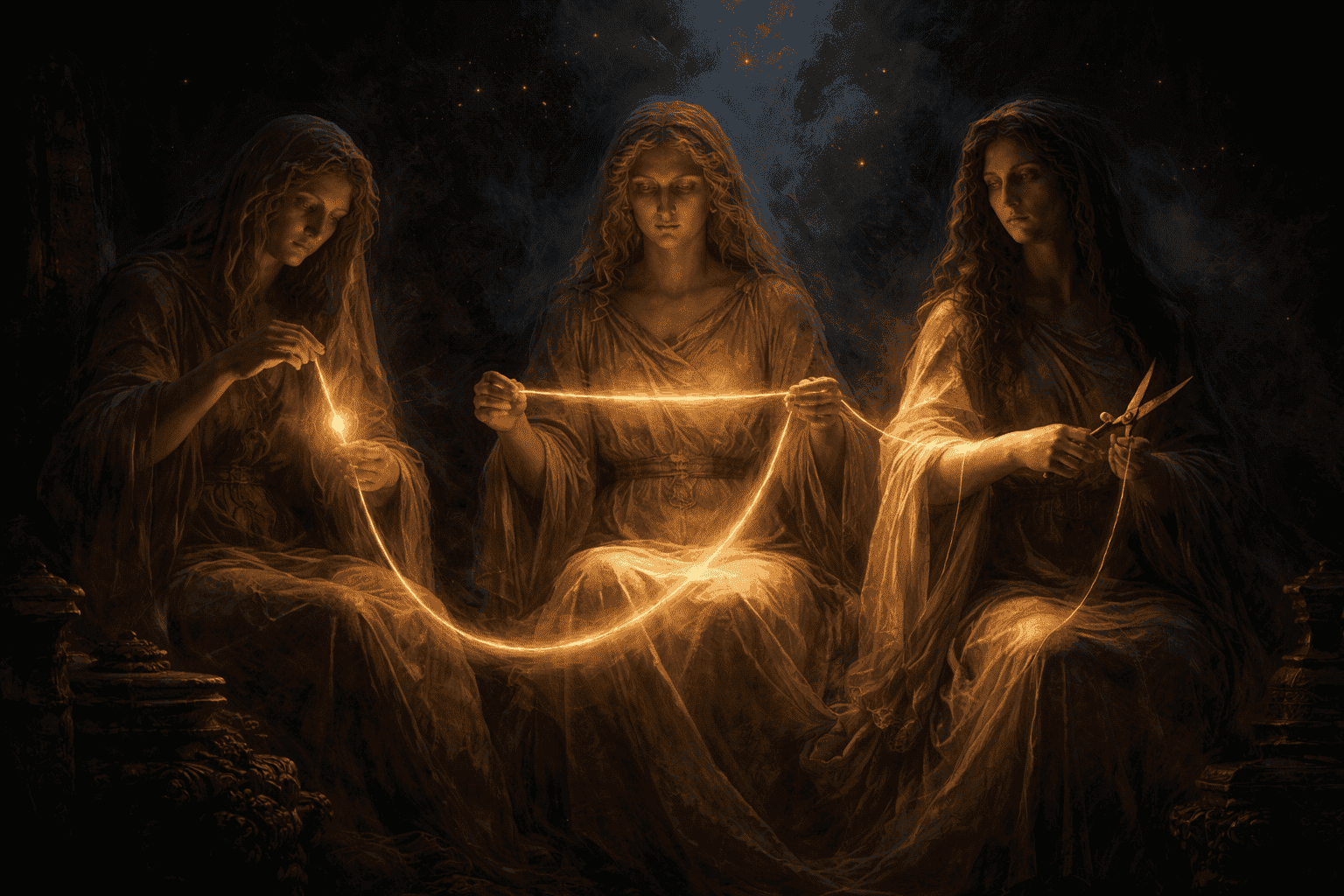
Three women sat at their work. One held the distaff, drawing out the raw fiber of existence. One held the thread between her fingers, measuring its length against a standard no mortal could see. One held the shears. When the thread was measured, she cut it. The work was never finished — there were always more threads beginning, more lengths to be measured, more cuts to be made — but each individual thread, once cut, was done. Nothing undid the cut. Nothing restored the thread.

The three Roman Fates, Nona, Decima, and Morta, controlling the thread of life in a symbolic scene

These were the Parcae — the Roman Fates — and their power was singular in the Roman divine system. Jupiter wielded the thunderbolt and could dissolve the Senate’s proceedings with an unfavorable omen. Neptune could raise storms that destroyed fleets. Venus could turn any heart toward desire. But none of them, not even Jupiter at the summit of divine authority, could uncut what the Parcae had cut. Their work was the framework within which all divine action took place, the structure that the gods themselves operated within rather than above.

The Names and What They Mean

The three Parcae were named Nona, Decima, and Morta — and the names encoded a specific understanding of human existence that the Roman religious imagination found precisely right.

Nona meant the ninth. Decima meant the tenth. In the Roman calendar of pregnancy, the ninth and tenth months were when birth became imminent — the ninth month bringing the child near to readiness, the tenth month being the expected term of delivery. The goddess who spun the thread of life was named for the ninth month, the moment when the new life was almost ready to enter the world. The goddess who measured the thread was named for the tenth month, the moment of delivery and beginning. The calendar of pregnancy was compressed into two of the three Fates’ names, connecting the beginning of life to the most intimate biological rhythm of Roman female experience.

Morta — the third name — meant death, from the Latin root mors. She was the most straightforwardly named of the three: the one who ended life was named with the word for ending life. The directness was characteristically Roman. The Parcae were not euphemistic figures who softened what they represented. They were named plainly for what they did.

The names were older and more distinctly Italian than the Greek names — Clotho, Lachesis, Atropos — that educated Romans also knew and used. The Italian names, encoded in the calendar of birth, expressed a tradition of fate belief that predated the Greek absorption and preserved something of the archaic Italian understanding of the divine forces that governed human life. Nona and Decima were not translations of the Greek names. They were a different way of thinking about the same divine reality, one rooted in the biology of birth rather than the metaphysics of thread.

The Work of the Fates: Spinning, Measuring, Cutting

The visual metaphor of the thread was not arbitrary. Thread — its spinning, its length, its cutting — was the most appropriate image available in ancient material culture for a process that had a specific beginning, a specific duration, and an irreversible end.

Spinning was the most fundamental domestic labor in the ancient world, the constant work of converting raw fiber into the thread from which cloth was made. Every household required thread; thread required spinning; spinning required constant labor from the women of the household. By assigning the spinning of life’s thread to a divine figure, Roman mythology connected the beginning of existence to the most familiar, most constant, most essential domestic activity. Life began the way cloth began — with the patient drawing out of raw material into structured form.

The measurement of the thread expressed a conviction fundamental to Roman religious thought: that life had a specific, predetermined length. Not an approximate range, not a general tendency — a precise measurement, already determined at the moment of birth, that no subsequent action could alter. Decima’s measuring rod — or her fingers measuring the thread against its own predetermined length — expressed the Roman understanding that fate was not a general tendency but a specific decree, a fatum (literally “what has been spoken”) that carried the finality of the spoken word in a culture that took spoken declarations with extraordinary seriousness.

The cutting was the most theologically significant of the three acts, because it was the most irreversible. Thread could be respun if it broke prematurely. Length was set before the measuring began but could theoretically be reconsidered before the measurement was taken. But once Morta’s shears had cut, the cut could not be undone. The completion of the thread was final in a way that its beginning and its length were not — the certainty of death encoded in the irreversibility of a physical act that every Roman who had ever seen a thread cut understood at the most immediate bodily level.

The Parcae and the Gods

The theological question of how the Parcae related to the other gods — specifically to Jupiter, whose supreme authority was otherwise uncontested — was one of the most genuinely contested issues in Roman religious thought, and ancient sources gave it several different answers.

The most straightforward interpretation was that the Parcae were subordinate to Jupiter — that they expressed his will rather than operating independently of it. In this view, what the Fates spun and measured and cut was what Jupiter had decreed, and their work was the administrative execution of divine decisions made at a higher level. Jupiter controlled fate; the Parcae implemented it.

The contrary view, expressed more forcefully in the mythological tradition, was that the Parcae operated independently — that even Jupiter was subject to their decrees, that fate was a principle older and more fundamental than the current divine order of which Jupiter was the supreme figure. When the Styx oath bound Jupiter to commitments he regretted, when Virgil’s Jupiter declared that each man’s day was fixed (stat sua cuique dies) in a way that even he could not alter, the mythological tradition was expressing this understanding: that fate constrained even the king of the gods.

The Stoic philosophical tradition offered a third position that dissolved the tension by identifying the two: Jupiter and fate were the same divine reality approached from different angles. Jupiter was the cosmic rational principle — the logos — that organized the universe; fate was the expression of that principle unfolding in time. The Parcae were not independent agents separate from Jupiter but the personified expression of Jupiter’s own rational will operating through the specific mechanism of individual human lives. To say that the Parcae determined a person’s fate was to say that the divine rational order had determined it — and the divine rational order was Jupiter.

This Stoic resolution was the most philosophically satisfying, and it was the one that Seneca, the most widely read Roman Stoic writer, elaborated most fully. In his tragedies, fate and divine will operated as aspects of the same cosmic necessity — the Parcae spinning what the universe’s rational order required, Jupiter presiding over a system whose structure was identical with his own nature.

Catullus and the Wedding Fates

The most vivid and most extended Latin literary description of the Parcae in action was not philosophical but lyrical — the great epyllion that Catullus embedded in poem 64, his longest and most ambitious work, describing the wedding of Peleus and Thetis and the prophecy the Fates delivered at it.

At the wedding feast, Catullus describes the Parcae — the white-robed goddesses with their spindles and their distaff — spinning the thread of destiny as they sing. Their song was a prophecy of what the thread they spun would contain: the birth of Achilles, his extraordinary martial gifts, his brief and glorious life, the great deeds he would accomplish at Troy, and the inevitable death that would follow from those deeds.

Catullus describes the spinning with specific technical precision that expressed both his poetic virtuosity and his understanding of the Fates’ work. The white fleece of the thread was the raw material of a life being spun into existence. The thread accumulated on the spindle as the prophecy accumulated lines. The gesture of their fingers, drawing out the fiber and twisting it into thread, was simultaneous with the words of their song — the spinning and the prophesying were the same act, the physical work and the verbal declaration identical expressions of the same fate being determined.

The Fates’ refrain — currite ducentes subtegmina, currite, fusi — “run on, run on, pulling out the threads, spindles, run on” — was repeated at intervals through the prophecy, the spinning motion expressed in the imperative verb, the urgency of fate’s work pressed against the accumulating weight of what the thread contained. It was among the most effective deployments of a repeated refrain in Latin poetry, and it made the Parcae’s work viscerally present in a way that abstract description could not achieve.

The Moirai and the Parcae: What Rome Changed

The Greek Moirai — Clotho, Lachesis, Atropos — were the direct antecedents of the Roman Parcae, and the identification between them was universally accepted in antiquity. Both sets of three figures spun, measured, and cut the thread of life. Both were understood as operating independently of the other gods to some degree. Both expressed the conviction that fate was a cosmic principle rather than simply the sum of divine decisions.

But the Roman tradition inflected the inheritance in specific ways that expressed Roman rather than Greek values. The Greek names — Clotho (the Spinner), Lachesis (the Assigner of Lots), Atropos (the Inflexible) — were descriptive of function but philosophical in register, abstract nouns of divine action. The Roman names — Nona, Decima, Morta — were rooted in biology and plain speech, the calendar of birth and the word for death.

The Greek tradition gave the Moirai more narrative presence — specific mythological episodes in which they appeared and spoke and made specific decisions about specific lives. The Roman tradition made the Parcae more systematically integrated with the concept of fatum — the spoken decree, the legally binding pronouncement — that gave Roman fate its specifically juridical character. Where the Greek Fates were mythological characters who occasionally appeared in stories, the Roman Parcae were expressions of a theological and legal principle about the nature of the spoken decree.

The Parcae in Roman Funerary Art

The symbols of the Parcae — the spindle, the distaff, the shears — appeared extensively in Roman funerary art, their presence at burial sites and on sarcophagi serving the same theological function as the Parcae themselves: acknowledging the completion of the thread without denying the reality of what had been spun.

The spindle on a woman’s tombstone was not simply a marker of domestic identity — the woman who had spent her life spinning. It was a statement about the relationship between the life being commemorated and the Fate who had spun it. The shears on a funerary monument expressed the same acknowledgment: the thread had been cut, the measurement had been fulfilled, the Parcae’s work at this particular life was complete.

Roman funerary culture was generally unsentimental about death in a way that makes modern readers uncomfortable. The D.M. formula — Dis Manibus, to the divine Manes — on every Roman tombstone acknowledged the dead person’s transformation into a divine presence. The Parcae’s symbols, appearing alongside this formula, expressed the parallel acknowledgment: the thread had run its course; the divine order had done what it always did; the appropriate response was not denial but recognition.

Conclusion

The Parcae stood at the intersection of Roman religion’s two most fundamental convictions: that the cosmos was ordered rather than chaotic, and that order extended beyond what any individual divine power could simply override. They were not the most celebrated of Roman divine figures — they had no dramatic myths, no romantic entanglements, no battles. They simply worked.

That work was the foundation on which everything else rested. The thread Nona spun at a person’s birth had already been measured by Decima before the first breath was drawn. By the time Morta cut it, the measurement had been fulfilled precisely. The Roman universe was not a place where anything could happen. It was a place where everything that happened had already been determined — and the three women at their spindles were the theological expression of that determination, patient and implacable and entirely without sentiment, doing their work as they had always done it and would always do.

Share This Page

Cite This Page

MLA

Editors of RomanMythology.com. "The Parcae: Rome’s Three Fates." RomanMythology.com, 2026, https://www.romanmythology.com/roman-gods/personifications/roman-fates-parcae/. Accessed June 15, 2026.

APA

Editors of RomanMythology.com. (2026). The Parcae: Rome’s Three Fates. RomanMythology.com. Retrieved June 15, 2026, from https://www.romanmythology.com/roman-gods/personifications/roman-fates-parcae/

Leave a Comment