Proserpina is the goddess Rome set on both sides of the line between the living and the dead. The daughter of Ceres, goddess of the grain, she was carried below the earth by its ruler and rose again as its queen — at once the maiden of the returning spring and the formidable sovereign of the dead.
Her name is pronounced proh-SUR-pih-nuh, and Roman writers heard inside it the verb proserpere, “to creep forth,” the slow motion of a shoot pushing up through soil. That single image holds her whole meaning: she is the goddess of what goes down into the dark and comes back. The story of how she was taken has its own telling; this is an account of the goddess herself.
Who Proserpina Was
Proserpina was the daughter of Ceres and, in most accounts, of Jupiter. The Greeks called her Persephone, and before she received the dark title that fixed her in memory she was simply Kore, “the girl” — the unmarried daughter, the maiden. Rome met her largely through the Greek cities of southern Italy and Sicily, where mother and daughter had been worshipped together for centuries; the Etruscans, who passed so much of their religion northward, knew her as Phersipnai.
The Latin name carried its own freight. Cicero, trying to explain it, tied Proserpina to proserpere, the creeping growth of the planted seed. Whether or not the etymology is sound, it tells us how Romans wanted to understand her: not first as a captive of the underworld but as the principle of emergence, the grain that vanishes into the ground and returns as the harvest.
By Rome’s own formal reckoning, she ranked among the minor deities — she held no flamen of her own and no seat among the twelve Dii Consentes. It is one of the clearest cases of how little that official ranking has to do with weight. Few gods Rome called “major” reached as deeply into how ordinary people imagined death.
Maiden and Queen
The defining fact about Proserpina is that she is two goddesses held in one body, and Rome never resolved the tension because the tension was the point.
As the maiden she belongs to the upper world: the girl in the meadow, the flower, the green of the year’s beginning. As Proserpina the Queen she belongs below, enthroned beside the lord of the dead and presiding over every soul that crosses into the underworld.
Most divinities of death are simply grim. She is not. She is the one figure in the Roman imagination who has stood in the sunlight and also worn the crown of the grave, and who therefore understands both — the goddess who knows that the same earth which feeds the living receives them in the end.
That doubleness is why the grain metaphor fits her so exactly. A seed buried in the dark looks like a death and is in fact the condition of next year’s life. Proserpina is that seed made a goddess.
The Marriage to Dis and the Divided Year
The narrative behind her crown is told in full elsewhere, but its outcome defines her. Dis Pater — Pluto, the lord of the dead — seized her as she gathered flowers and carried her below. Ceres searched the world in grief and let the fields go barren until her daughter was found.
The settlement Jupiter brokered turned on a single detail: because Proserpina had eaten in the house of the dead — in Ovid’s Metamorphoses she swallows seven seeds from a pomegranate — she could not be wholly released.
So the year was divided. For half of it she rises to her mother and the world turns green; for the other half she returns below and the fields go cold. The seasons themselves became the rhythm of her coming and going.
But notice what the bargain also did: it made her a permanent resident of the underworld, not a guest. The maiden who was carried down became, by the very terms of her release, its queen.
Proserpina in Roman Worship
Romans approached Proserpina in two very different registers, and kept them largely apart.
Libera and the Aventine Triad
In one of the oldest plebeian cults of the city — the temple on the Aventine dedicated in 493 BCE — Ceres was worshipped alongside Liber and Libera. In time Libera was identified with Proserpina, which gave the queen of the dead a place inside a thoroughly agricultural and civic Roman institution, far from the underworld and at the heart of the plebeian community. Here she was the daughter, the grain’s renewal, honoured beside her mother.
The Tarentum and the Secular Games
The other register was chthonic and far darker. At a spot in the Campus Martius called the Tarentum stood an underground altar to Dis Pater and Proserpina, where Romans made nocturnal sacrifices to the powers below.
Those rites, performed at the direction of the Sibylline books in times of danger, grew into the Ludi Saeculares — the Secular Games, staged to close one age and open the next. To honour Proserpina at the Tarentum was to acknowledge the gods who hold the boundary every generation must finally cross.
Alongside these ran a women’s festival, the Sacrum Anniversarium Cereris, which reenacted Ceres’ search — a Roman echo of the Greek mysteries, in which the loss and recovery of the daughter became a rite the worshippers lived through themselves.
Queen of the Dead
It would be easy to read Proserpina as a perpetual victim, a girl trapped underground. The Romans did not. Once crowned, she is an authority in her own right, and the myths return to her again and again as the power who decides.
When Orpheus descended to beg for his wife, it was Proserpina who was moved by his song and granted the impossible — the release of Eurydice, on the one condition Orpheus then failed to keep. In Apuleius’s tale, the last and most dangerous of the trials set for Psyche is to go down into the underworld and ask Proserpina herself for a measure of her beauty, a thing only the queen below can give (Cupid and Psyche).
In another tradition she and Venus contend over the beautiful Adonis, and the youth is made to divide his year between the goddess of love in the light and the queen in the dark — a fate that quietly rhymes with her own.
Her authority reached into ordinary life as well. On thin sheets of lead folded into graves and dropped down wells — the curse tablets known as defixiones — Romans consigned their enemies to Dis and Proserpina, asking the rulers of the dead to take hold of a rival’s body, business, or tongue. To write her name was to call on the jurisdiction of the grave; the girl from the meadow had become a name people were careful not to invoke lightly.
Symbols and Image
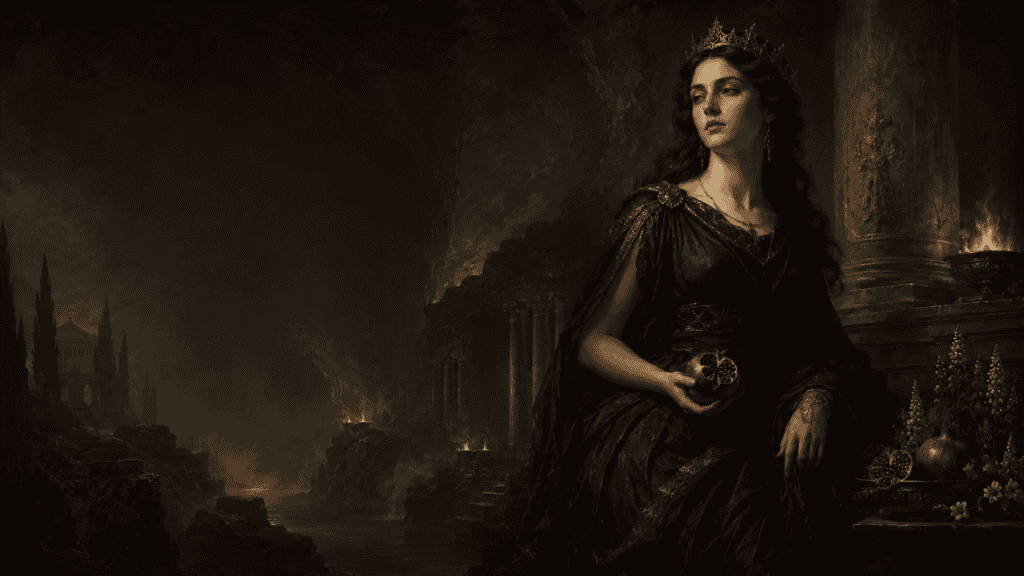
Proserpina’s attributes track her double life. The pomegranate is hers above all — the fruit whose seeds bound her below and split her year in two. She carries a torch, the light borne into darkness, recalling both Ceres’ nighttime search and the queen’s own dominion over a lightless world.
Sheaves of grain and the flowers she was gathering tie her to the upper earth; the throne and scepter mark her as sovereign of the lower one. In Roman art she appears in both keys at once — the wistful crowned queen, and the girl looking back over her shoulder as she is carried away.
Why Rome Needed Her to Be Both
Rome had no shortage of grim powers in the dark. What it had only in Proserpina was a goddess of death who had once been afraid of it.
The proserpere etymology turns out to be the whole theology in a word. The seed that disappears into the ground has not been destroyed; it is working, underground, toward a return. Proserpina is the divine form of that conviction — the proof, written into the turning of the year, that a descent can be a beginning rather than an end.
A culture as clear-eyed and practical as Rome’s kept her not in spite of her contradiction but because of it. The same field that fed them would one day take them, and they wanted the power over that field to wear a face that had been dragged into the dark, had bargained there, and had come back up into the light with its authority intact.
Proserpina is the queen who remembers being the girl — and that memory, more than any throne, is why Rome trusted the dark to give back what it took.
Share This Page
Cite This Page
MLA
Editors of RomanMythology.com. "Proserpina: Queen of the Underworld." RomanMythology.com, 2026, https://www.romanmythology.com/roman-gods/minor-deities/proserpina/. Accessed June 3, 2026.
APA
Editors of RomanMythology.com. (2026). Proserpina: Queen of the Underworld. RomanMythology.com. Retrieved June 3, 2026, from https://www.romanmythology.com/roman-gods/minor-deities/proserpina/