Deep in the Alban Hills, beside a still volcanic lake, stood the oldest and strangest of all Diana’s shrines. Its priest was not chosen by birth or by election. He was a runaway slave who had killed the priest before him, and who would hold the office only until a stronger fugitive came to kill him in turn.
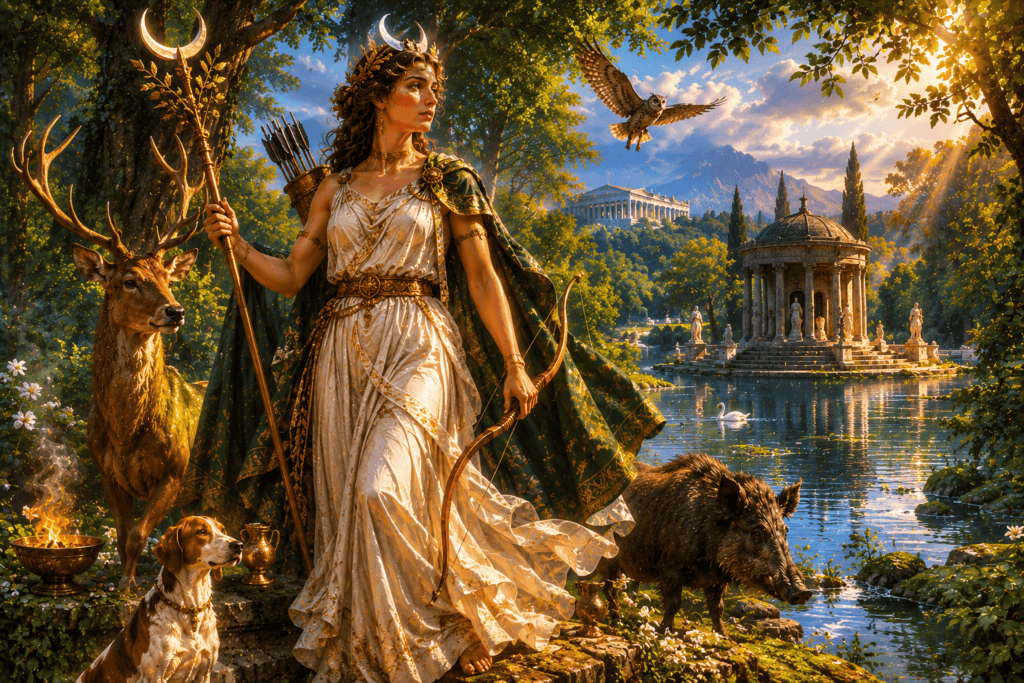
This was the cult of Diana Nemorensis (nem-oh-REN-sis), Diana of the Wood, and the title of her priest was the Rex Nemorensis, the King of the Wood. It is one of the eeriest survivals in all of Roman religion, and it has haunted the imagination of the modern world as much as the ancient one.
The Mirror of Diana
The sanctuary lay above Lake Nemi (NEM-ee), near the town of Aricia, a short distance south of Rome. The lake fills the crater of an extinct volcano, a near-perfect circle of dark water ringed by steep wooded slopes, and the Romans called it the Speculum Dianae, the Mirror of Diana.
On its shore stood a sacred grove and a temple, the center of Diana’s worship among the Latin peoples long before Rome rose to dominate them. Worshippers came across the water by torchlight, and votive offerings have been pulled from the lakebed in the centuries since, evidence of a cult that drew the devotion of generations.
It was a place of beauty and unease in equal measure, a goddess of the wild honored in one of the wildest and most enclosed landscapes in central Italy. The setting suited her, and so did the violence at the heart of her rite.
The King of the Wood
The priest of this shrine held his strange royal title under a rule that has no real parallel in the ancient world. To become the Rex Nemorensis, a man first had to be a runaway slave, an outlaw with nothing to lose.
He would make his way to the grove and break off a particular bough from a particular sacred tree, an act that no one was permitted to prevent. Having taken the branch, he earned the right to challenge the reigning priest to single combat, and if he killed him, he took his place as king.
From that moment he lived under sentence. He was a priest and a king, served and honored, but he could be challenged and killed at any hour by the next desperate man who tore a branch from the tree. He had to guard the grove sword in hand, sleeping little, watching always, knowing that his reign would end exactly as it had begun.
The Branch and the Endless Succession
The logic of the cult was a closed and merciless circle. Each king had murdered his predecessor; each king would be murdered by his successor. The office passed not by inheritance or merit but by an unbroken chain of killings, stretching back beyond memory.
No ancient writer fully explains why the cult worked this way, and that silence is part of its power. The rite seems to preserve something far older than the civilized religion of the Roman state, a fragment of a world in which the sacred and the savage were not yet separated.
What is clear is that the king embodied the goddess’s own nature. Diana was the deity of the wild edge, of the boundary defended by force, and her priest lived that role literally, a man holding a line at the cost of his life until the line was crossed.
Egeria and Virbius
Diana did not hold the grove alone. Beside her was honored Egeria (eh-JEER-ee-uh), a nymph of the spring that fed the sanctuary, a goddess of water and of childbirth who shared in Diana’s care for women in labor. Roman tradition also made Egeria the divine counselor of King Numa Pompilius, who was said to have met her in a sacred grove and received from her the laws of Roman religion.
The grove was also linked to Virbius (VUR-bee-us), a shadowy male figure identified with the Greek hero Hippolytus. According to the story, Hippolytus had been torn apart by his own horses and then restored to life, and the gods hid him in Italy under a new name, where he became the first priest and consort of Diana at Nemi.
Both figures deepen the meaning of the place. Egeria ties the wood to water, healing, and birth, while Virbius ties it to death overcome, a man who crossed the final threshold and came back, in a grove ruled by the goddess of every threshold.
The Festival of Torches
Once a year, on the thirteenth of August, the cult held its great festival, the Nemoralia (nem-oh-RAY-lee-uh), the Festival of Torches. Women walked in procession from Rome to the lake, carrying lighted torches and candles, and the whole dark bowl of the crater glowed with their flames reflected in the water.
They came to thank the goddess and to ask her favor, above all in matters of childbirth and the safety of their households. Hunting dogs were garlanded and allowed to rest, and the day was kept as well as a holiday for slaves, who shared in Diana’s special protection.
It was a scene of beauty laid directly over the cult’s darker core. The same goddess whose priest killed and was killed in the grove was honored, on this one night, with light, prayer, and the hopes of women for the children they carried.
A Cult Older Than Rome
The shrine at Nemi was never merely local. It was a federal sanctuary, shared by the cities of the Latin League, a gathering place for the Latin peoples in the centuries before Rome subdued them all. To worship Diana of the Wood was, in part, to assert a shared Latin identity older than Roman power.
That antiquity is exactly why the cult preserved such archaic features. The rule of the murderous priesthood, the sacred branch, the grove by the water — these were the survivals of a religion that predated the temples and the orderly priesthoods of the city, and the Romans kept them intact even as they built a very different cult of Diana on the Aventine.
The Golden Bough
The cult of Nemi has had an afterlife far larger than its ancient footprint. In 1890 the Scottish scholar James Frazer opened his vast study of myth and religion, The Golden Bough, with the puzzle of the King of the Wood, and built from it an entire theory of sacred kingship and the dying and reviving god.
Frazer linked the sacred branch of Nemi to the golden bough that Aeneas plucks before descending into the underworld in Virgil’s epic, reading both as tokens of passage between the worlds of the living and the dead. His interpretation has been much disputed since, but its reach was enormous, shaping a century of writing about myth, ritual, and literature.
Whatever one makes of his theory, Frazer was right about one thing: the image will not let go. A priest-king in a dark grove, waiting sword in hand for the man who will kill him, is one of the most haunting pictures the ancient world has left us.
Final Take: Diana Nemorensis
The grove at Nemi shows Diana stripped of every softening. There is no civic dignity here, no marble decorum, only a goddess of the wild honored by a rite of killing in a wood beside a black lake.
The Rex Nemorensis was the perfect priest for such a goddess, a man who lived the meaning of her worship in his own body. He held a boundary by force until a stronger force broke through, which is precisely what Diana herself did at every edge she ruled.
That is why the cult endured, and why it endures still in the modern imagination. It is the oldest face of Diana, the one the city never quite managed to tame, and it reminds us that beneath the elegant huntress of the statues was something far more ancient and far less safe.
Share This Page
Cite This Page
MLA
Editors of RomanMythology.com. "Diana Nemorensis: The King of the Wood at Lake Nemi." RomanMythology.com, 2026, https://www.romanmythology.com/roman-religion/diana-nemorensis/. Accessed June 14, 2026.
APA
Editors of RomanMythology.com. (2026). Diana Nemorensis: The King of the Wood at Lake Nemi. RomanMythology.com. Retrieved June 14, 2026, from https://www.romanmythology.com/roman-religion/diana-nemorensis/