Romulus was Rome’s founder and its first king. He built the city, organized its legions, populated it by abducting Sabine women, fought and won its first wars, and then disappeared in a storm — taken up to heaven, the Romans said, or torn apart by the senators, depending on which account you preferred. Either way, after thirty-seven years of Romulus, Rome was a functioning military machine with almost no religious infrastructure.
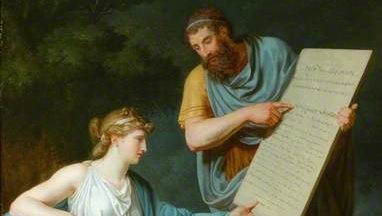
Numa Pompilius, the second king, built that infrastructure. He reigned for forty-three years — longer than Romulus — and in that time he created the institutions that would define Roman religious life for the next eight centuries. The priestly colleges, the Vestal Virgins, the office of the Pontifex Maximus, the reformed calendar, the major religious festivals — the claim that Numa founded all of these may be historically simplified, but it reflects a genuine Roman understanding that the state religion as it developed had its conceptual origin in the work of the second king.
The Choice of Numa
After Romulus’s disappearance, the Romans needed a new king. The Interrex — the provisional ruler between kings — and the Senate went through a period of deliberation. The situation was complicated by the fact that Rome had two founding peoples, Latin and Sabine, and the choice of a king from one group would inevitably favor that group. The solution they arrived at was to choose a Sabine, but not just any Sabine — one who was known throughout the region for his wisdom, piety, and virtue, who had specifically chosen to live quietly rather than seeking power, and who was, by the time the Senate came looking for him, living in retirement in the Sabine city of Cures.
That man was Numa Pompilius. He was, according to Plutarch and Livy, deeply learned — he had studied under Pythagoras, according to some traditions, though this is chronologically impossible and Livy himself notes the problem and sets it aside. He had been married to a daughter of Tatius, the Sabine king who had briefly ruled alongside Romulus after the peace that ended the Sabine War. His wife had died. He lived alone, studying, spending time in groves and by rivers, cultivating the philosophical retirement that Romans called otium at its most serious.
When the Senate’s envoys arrived to offer him the throne, he initially refused. His reasons were not false modesty. He said — and Livy records the argument with some respect — that changing his way of life would be dangerous, that he had made himself suited for peace and learning and was unsuited for the management of a violent and recently formed city. The Senate persisted. The augurs were consulted. The omens were favorable. Numa eventually accepted, on terms: he would govern as he saw fit, and the means he would use to govern would be religion rather than force.
The Nymph Egeria
The most mythologically distinctive element of Numa’s reign was his relationship with the nymph Egeria. Numa claimed to receive divine guidance from her through nightly meetings at a sacred grove near Rome — the grove of the Camenae, female divinities associated with springs and prophecy, near the Porta Capena on the south side of the city.
The meetings with Egeria were how Numa justified his religious reforms. He was not inventing institutions out of his own head, he claimed. He was receiving divine instruction from a supernatural source and translating that instruction into practical institutional form. This was a standard ancient Near Eastern and Greek rhetorical strategy — the lawgiver who receives his laws from a god — and Numa’s Roman contemporaries appear to have accepted it. His laws and religious reforms carried the authority of divine revelation.
Whether the Romans believed Numa literally met a nymph in a grove, or whether the story was understood as a conventional way of expressing that his reforms were divinely inspired, is impossible to determine from the sources. Livy is skeptical — he notes that Numa was shrewd enough to realize that a rough and violent people would not accept a legal and religious code simply because a man told them it was good, and that the fiction of divine guidance was necessary to make them accept what they would otherwise have rejected. This is a distinctly Roman analysis: the successful lawgiver needs authority beyond himself, and religion is the most effective available source of that authority.
After Numa’s death, Egeria grieved inconsolably in the grove until Diana transformed her into a spring — a transformation Ovid records in the Metamorphoses. The spring associated with Egeria near the Porta Capena was considered sacred into the imperial period and continued to be visited by worshippers.
The Religious Institutions
The specific institutions Numa was credited with creating or systematizing constituted the backbone of Roman state religion.
The Pontifices — the college of pontiffs — were the primary interpreters and guardians of Roman religious law. They maintained records of ritual, determined the proper form of sacrifices and ceremonies, and advised magistrates on religious questions. The Pontifex Maximus, their head, was one of the most powerful religious offices in Rome. Julius Caesar held it. Augustus held it and made it effectively permanent in the imperial family. The title was eventually transferred to the Christian emperors and then to the bishops of Rome, which is why the Pope is still called the Pontifex Maximus today.
The Flamines were the dedicated priests of specific deities — the fifteen flamens each serving a single god, with the three major flamens serving Jupiter, Mars, and Quirinus. Numa was credited with establishing at least the major flamens and their elaborate ritual restrictions.
The Salii — the leaping priests — were a college of twelve priests of Mars who performed elaborate ritual dances through the city at the beginning of the military season each March, carrying the sacred shields (ancilia) and singing the Carmen Saliare, an ancient hymn in a Latin so archaic that even the Romans of the classical period could no longer understand all of it.
The Vestal Virgins were perhaps Numa’s most distinctive institutional creation. The Vestals were six priestesses charged with maintaining the sacred fire of Vesta in the Forum. They served for thirty years — ten of learning, ten of practice, ten of teaching — and lived under strict rules including mandatory chastity. A Vestal who violated her chastity was buried alive. The fire they tended was understood to be Rome’s sacred flame, the fire whose extinguishing would mean Rome’s death. It burned continuously for over a thousand years.
The Calendar
The Roman calendar that Numa received — the calendar traditionally attributed to Romulus — had ten months and left approximately sixty days of winter unaccounted for. This was not usable as a civil or religious instrument. Numa added two months, January and February, and reorganized the year on a lunar basis with a total of 355 days, with a system of intercalary months to keep the calendar roughly aligned with the solar year.
The calendar reform was not only practical. The calendar was itself a religious document — it specified which days were fas (permitted for legal and public business) and which were nefas (prohibited), which were sacred to which gods, and when each festival and sacrifice was to be performed. By reorganizing the calendar, Numa was also organizing Rome’s relationship with the divine across the entire year. Every day had a specific character and a specific obligation.
He also divided the year into alternating dies fasti and dies nefasti, created the concept of the Kalends, Nones, and Ides that structured each month, and established the major annual festivals that would persist through the Republic and into the Empire.
The Janus Argument
One of the most politically significant acts attributed to Numa was his use of the Temple of Janus. The temple — or more precisely, the Ianus Geminus, a passageway with gates at each end — stood in the Forum. By Roman custom, its gates were open during wartime and closed during peace. Since Rome spent most of its early history at war, the gates were almost always open.
Numa kept them closed for his entire reign. This was not a passive fact but an active statement: the gates of Janus stood closed for forty-three years, meaning that for forty-three years Rome was officially, ceremonially, and in the view of the gods at peace. This was an extraordinary claim and an extraordinary achievement. Whether it was literally true — whether Rome fought no wars under Numa — is historically uncertain. But the tradition was accepted, and it formed the basis of Numa’s reputation as the king who proved that peace was not weakness.
Augustus, at the end of the civil wars, closed the gates of Janus and made much of the fact. He was invoking Numa deliberately, claiming to have restored the Numaic peace after a period of the Romulean violence that the civil wars represented. The connection was understood by every Roman who heard it.
Numa’s Books
When Numa died, he was buried near the Janiculum Hill, and his books — records of his religious laws and philosophical teachings — were buried with him. The Pythagorean influence on Numa’s thought was reflected in the ancient tradition that he had left written records of his wisdom, and the Romans told a story about what happened to those records.
In 181 BCE, a stone coffin was found near the Janiculum during construction, and inside it were books — some in Latin, some in Greek, dealing with religious law and Pythagorean philosophy. The praetor Quintus Petronius Nonius had them burned. The reason given was that the books contained teachings that might undermine Roman religious tradition — which is an interesting explanation, since they were supposedly Numa’s own teachings and therefore the source of that tradition. The burning of the books may reflect actual anxiety about the Pythagorean content, or it may be a later invention. But the story was told and believed, and it reflects the Roman understanding that Numa’s religious wisdom was genuinely powerful and genuinely dangerous if mishandled.
Numa in the Roman World
The Romans who came after Numa remembered him as the proof that Rome was not only a military civilization. Every general who came home from a successful war and built a temple was, in a sense, performing the gesture Numa had institutionalized: the acknowledgment that Roman power required divine cooperation, and that divine cooperation required proper ritual maintenance.
Numa had given Rome the tools for that maintenance. The Pontifices who preserved the ritual law, the Vestals who tended the fire, the flamens who served their specific deities, the calendar that organized the year’s sacred obligations — these were the instruments through which Rome maintained its relationship with the gods, and they lasted because Numa had designed them to be maintained. He built institutions that could survive their founder, which is the most durable thing a lawgiver can do.
Romulus gave Rome its existence. Numa gave Rome its character. The Romans remembered both, and they were right to — a city that was only Romulus would have been a war band that got lucky. A city that was only Numa would have been a philosophy seminar. Rome was both, which is why it lasted.
Share This Page
Cite This Page
MLA
Editors of RomanMythology.com. "Numa Pompilius: Rome’s Second King and the Founder of Roman Religion." RomanMythology.com, 2025, https://www.romanmythology.com/roman-mortals/numa-pompilius/. Accessed June 2, 2026.
APA
Editors of RomanMythology.com. (2025). Numa Pompilius: Rome’s Second King and the Founder of Roman Religion. RomanMythology.com. Retrieved June 2, 2026, from https://www.romanmythology.com/roman-mortals/numa-pompilius/