Tarpeia is one of the few figures in Roman mythology whose story is told entirely without sympathy. She is not a tragic heroine undone by divine cruelty, not a mortal caught between competing obligations, not a woman destroyed by forces beyond her control. She is, in the Roman telling, simply a traitor — and the Romans were precise about what that meant and what it required.
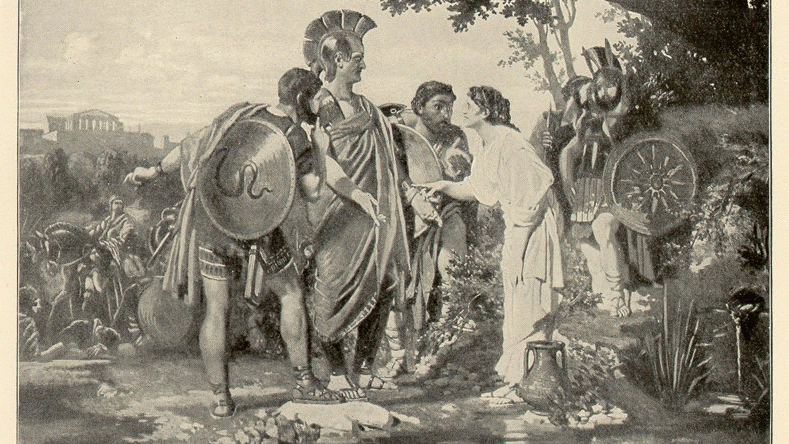
Her legend belongs to the earliest layer of Roman foundational myth, set during the war between Romulus’s Romans and the Sabines in the days immediately after Rome’s founding. It is a story about a gate opened in the night, a bargain made in bad faith, and a death that the Romans considered not punishment but justice. What makes it worth examining closely is not its drama but its function: Tarpeia exists in Roman tradition to define, by negative example, exactly what Roman loyalty meant and what its absence cost.
The War That Produced Her
To understand Tarpeia’s story, it is necessary to understand the conflict it belongs to. Rome in its earliest days was a city of men — mostly exiles, wanderers, and the displaced whom Romulus had welcomed into his new asylum on the Capitoline Hill. The city filled quickly but almost entirely without women. Romulus’s solution was the abduction of women from the neighboring Sabine people, an event the Romans called the Rape of the Sabine Women, which produced exactly the war it might have been expected to produce.
The Sabine king Titus Tatius led his army against Rome with the specific purpose of recovering the women and punishing the Romans for their audacity. The problem he faced was geographic. The Capitoline Hill was steep, fortified, and defensible from almost every approach. Direct assault was not a realistic option. The Sabines needed another way in.
They found one. Her name was Tarpeia.
Who She Was
The ancient sources do not entirely agree on Tarpeia’s identity. The most common account makes her the daughter of Spurius Tarpeius, the Roman commander responsible for the Capitol’s defense — which means she grew up inside the fortress she would eventually betray, with full knowledge of its gates, its pathways, and the places where its defenses were thinnest. Some later versions call her a Vestal Virgin, a detail that may be a later addition designed to deepen the sacrilege of what she did, since a Vestal’s betrayal would compound treachery against the state with a violation of sacred obligation.
What all versions agree on is the essential detail: she had access, and she used it.
The Bargain
The terms of Tarpeia’s arrangement with the Sabines were simple and, in retrospect, fatally ambiguous. She would open a gate in the Capitol’s defenses and allow the Sabine army entry. In exchange, she asked for what the Sabines wore on their left arms.
She meant their gold bracelets. The Sabine soldiers wore heavy golden armlets on their shield arms — conspicuous, valuable, and apparently the object of whatever desire or calculation had brought Tarpeia to make the approach in the first place. The ancient sources differ on whether she acted from greed alone, from some more complex political motive, or from a kind of naïve ambition that did not fully reckon with what she was setting in motion. The dominant tradition is straightforward: she wanted gold, and she was willing to sell Rome to get it.
One night she opened the gate. The Sabine army entered the Capitol that Romulus’s men believed impregnable.
The Death
When the Sabines came to pay what they owed, they paid it literally. She had asked for what they wore on their left arms. They gave her their shields.
Each soldier in turn hurled his shield onto her. The weight of them crushed her. She died beneath a pile of bronze and wood on the hill she had betrayed, and the Romans recorded this outcome without any apparent grief on her behalf. The Sabines had not violated the terms of the bargain — they had simply interpreted them in the way that suited them, which was also the way that punished her. Whether this was premeditated justice or opportunistic contempt, the effect was the same.
Tarpeia had been used as an instrument and then discarded. That, in the Roman view, was the appropriate end for someone who had made herself available for that purpose.
The Rock
The place where Tarpeia died — a sheer cliff on the southwestern face of the Capitoline Hill, overlooking what would become the Roman Forum — was named after her. The Tarpeian Rock became one of the most institutionally significant places in Roman civic life, though not in any way Tarpeia would have chosen.
From the earliest period of the Republic onward, the Tarpeian Rock was the place from which Rome executed its traitors. Those convicted of treason, of betraying the state, of violating the sacred obligations that held Roman civic life together, were brought to the edge and thrown. The drop was not always fatal immediately, but that was beside the point. The location was chosen deliberately — the place of Rome’s first betrayal became the permanent site of betrayal’s punishment.
The proverb that circulated in Roman tradition captured the logic precisely: the Tarpeian Rock is close to the Capitol. Power and ruin occupy the same ground. The height that makes a fortress defensible is the same height from which the disloyal are destroyed.
What the Ancient Sources Did With Her
Roman writers returned to Tarpeia repeatedly, and not all of them told exactly the same story. The poet Propertius wrote about her at length and introduced a version in which her motive was not greed but love — she had become infatuated with the Sabine king Titus Tatius and opened the gates for him out of passion rather than avarice. In this reading she is less a mercenary than a woman destroyed by desire, which places her in a different moral category without exactly making her sympathetic.
A small number of ancient accounts went further and suggested she may have been acting as a double agent — that she asked for the Sabines’ shields specifically because she intended to disarm them and thereby protect Rome, not betray it. In this version, she is a patriot who miscalculated and paid for it. These interpretations were minority positions in antiquity and have generally been treated as such. The dominant Roman tradition was not interested in rehabilitating Tarpeia. Her function in the cultural memory was to represent betrayal, and that function required her guilt to be clear.
Livy, whose account is the most influential, presents her straightforwardly as someone who wanted gold and made a catastrophically foolish bargain to get it. There is no sympathy in his telling and no ambiguity about what she deserved.
What Her Story Was For
Roman mythology did not preserve Tarpeia’s story because it was unusual. Traitors exist in every culture’s foundational narratives. It preserved her story because it was useful — because it named, with permanent specificity, the thing Rome most feared and most condemned.
The Roman civic virtues that the Republic organized itself around — loyalty to the state, subordination of personal interest to collective obligation, the understanding that Rome’s survival depended on the fidelity of everyone inside it — required their opposite to be named and condemned. Tarpeia named it. She was not a goddess or a hero or even a fully developed character in the way that later mythological figures would be. She was a lesson, crystallized into a person, attached to a cliff, and repeated for as long as Rome stood.
In a civilization that understood the greatest threats to come from within rather than from outside the walls, Tarpeia was the permanent reminder of what the inside looked like when it failed. Her name meant treachery. The rock meant consequence. And the proximity of one to the other was the point — because in Rome, as in the proverb, the two were never far apart.
Share This Page
Cite This Page
MLA
Editors of RomanMythology.com. "Tarpeia: The Betrayer of Rome." RomanMythology.com, 2025, https://www.romanmythology.com/roman-mortals/tarpeia/. Accessed June 2, 2026.
APA
Editors of RomanMythology.com. (2025). Tarpeia: The Betrayer of Rome. RomanMythology.com. Retrieved June 2, 2026, from https://www.romanmythology.com/roman-mortals/tarpeia/