The myth of Tarpeia is one of the shortest in Rome’s foundational cycle and one of the most institutionally consequential. A gate opened in the night, a bargain fulfilled in bad faith, a death by crushing on the hill she betrayed — the story itself takes less time to tell than almost any other in the tradition. What it produced, however, was not simply a cautionary tale but a permanent feature of the Roman legal and physical landscape: a cliff from which traitors were thrown for as long as Rome maintained the practice of executing them at all.
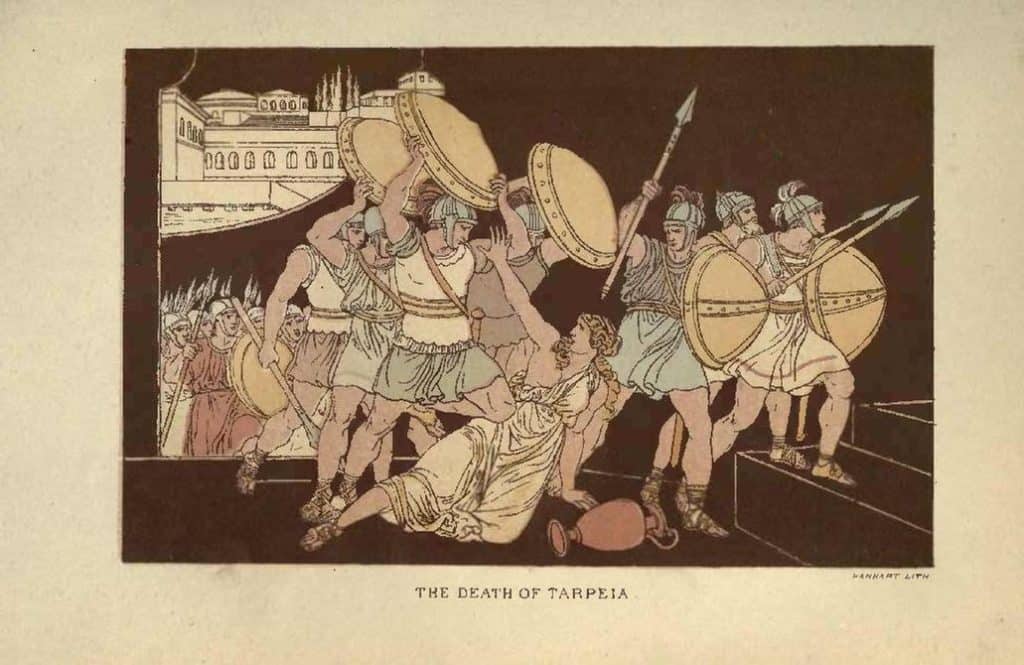
Most foundational myths produce heroes. The myth of Tarpeia produced a place. That is worth examining — because the Romans were deliberate about what they chose to commemorate in stone, and the decision to name a killing site after Rome’s first traitor rather than erase her from memory entirely says something specific about how Roman civic culture understood the relationship between betrayal and law.
The Context of the Betrayal
The Sabine war in which Tarpeia plays her role was not an ordinary military conflict. It was a direct consequence of Rome’s founding act of demographic desperation — the abduction of Sabine women to populate a city that had filled almost entirely with men. The Sabines had not accepted this. King Titus Tatius assembled his forces and marched on Rome with the explicit purpose of recovering the women and punishing Romulus’s city for what it had done.
The strategic problem facing the Sabines was the Capitoline Hill. It was steep, fortified, and defensible from almost every approach. A frontal assault carried unacceptable costs. The Sabines needed another method of entry, and Rome’s defenses needed to have a weakness that Sabine intelligence could locate and exploit.
The weakness, it turned out, was human rather than architectural.
Tarpeia was the daughter of Spurius Tarpeius, the Roman commander responsible for the Capitol’s defense. She had grown up inside the fortress. She knew its gates, its pathways, and the points where its defensive arrangements were thinnest. Some versions of the story make her a Vestal Virgin — a detail that, if accurate, would have compounded the treachery with a violation of sacred obligation, since the Vestals’ fidelity to Rome was understood as inseparable from their religious function. All versions agree on the essential fact: she had access that the Sabines needed, and she was willing to sell it.
Whether she approached the Sabines or they approached her, the tradition does not consistently report. What it does report is the terms of the transaction.
The Bargain and Its Fulfillment
Tarpeia asked for what the Sabine soldiers wore on their left arms. She meant their gold bracelets — heavy armlets of Sabine manufacture, conspicuous enough that she had noticed them from a distance and specific enough that her request was unambiguous in its intent. She wanted gold. She was willing to open the gate of Rome’s citadel to get it.
One version of the tradition suggests she may have intended something more complicated — that she asked for the shields specifically because shields were the soldiers’ primary offensive weapons, and that by gaining them she intended to disarm the Sabines and thereby protect Rome rather than betray it. Livy, whose account became the dominant one, has no patience for this interpretation. In his telling, she wanted gold, and the attempt to construct a patriotic reading of the bargain is special pleading on behalf of someone who does not deserve it.
She opened the gate. The Sabines entered. Then they paid what they owed.
They gave her their left arms — all of what they wore on them. The soldiers in turn hurled their shields onto her. The weight accumulated with each one. She died beneath the pile on the slope of the Capitoline, crushed by the literal fulfillment of what she had asked for.
The Romans recorded this outcome without any suggestion that justice had miscarried. Tarpeia had asked for what soldiers carried on their left arms. Soldiers carry shields on their left arms. The Sabines had honored the precise terms of the agreement. That the terms destroyed her was her problem, not theirs, and the Romans regarded the result as appropriate regardless of whether it was premeditated or opportunistic. She had made herself into an instrument. She had been used as one. The instrument was then discarded.
What the Ancient Sources Did With It
Roman writers returned to Tarpeia with some regularity, and not all of them were content with Livy’s clean verdict. The poet Propertius introduced a version in which the motive was not greed but love — Tarpeia had seen Titus Tatius and had been seized by an infatuation that overwhelmed her civic loyalty. She opened the gates for him, not for his gold, and died when he rejected her. This reading makes her a tragic figure in the Dido mold: a woman destroyed by a passion she could not govern, whose misfortune is real even if her transgression is not excusable.
A smaller number of sources took the double-agent interpretation seriously — that the shields were the point, that she was attempting to disarm rather than admit the enemy, and that what the tradition remembered as treachery was in fact a failed act of patriotism. These readings were minority positions and remained so. Roman tradition was not primarily interested in what Tarpeia intended. It was interested in what she did and what followed from it, because the Roman legal and moral imagination was organized around consequences in a way that made intention a secondary consideration when the consequences were sufficiently severe.
Livy’s verdict stood: she wanted gold, she sold the gate, she died. The city did not owe her the charity of a more generous interpretation.
The Rock and Its Function
The cliff on the southwestern face of the Capitoline Hill that bore Tarpeia’s name was not simply a memorial. It was an instrument of ongoing civic governance. From the early Republic through the late imperial period, the Tarpeian Rock was the standard site of execution for treason — the place where those convicted of betraying the Roman state were brought and thrown.
The choice of location was not incidental. Rome could have executed traitors anywhere. It chose to execute them at the place associated with the city’s first betrayal, on the hill that was simultaneously Rome’s religious and political center — the site of the Temple of Jupiter Optimus Maximus, the destination of triumphal processions, the symbolic heart of Roman civic identity. Traitors did not die at the edge of the city or in an obscure prison. They died at the center, at the place where Rome’s founding vulnerability had been exploited, in view of the temples that represented everything they had violated.
The proverb that circulated in Roman tradition — the Tarpeian Rock is close to the Capitol — was an observation about physical proximity that encoded a moral claim. The height that made the Capitoline defensible was the same height from which the disloyal were destroyed. Power and ruin occupied the same ground. The fall from Roman civic standing to the Tarpeian Rock was not a long journey in distance; it was a short step in the wrong direction from the highest point Rome had.
What the Story Was Actually About
The myth of Tarpeia’s fall was not primarily a story about one woman’s greed or love or miscalculation. It was a story about what civic loyalty actually requires — and what the community must do when that requirement is violated.
Roman civic culture was organized around the understanding that the city’s survival depended on the fidelity of everyone inside it. The walls were not simply stone. They were the physical expression of the agreement among citizens to defend each other, to subordinate private interest to collective obligation, to maintain the integrity of the boundaries that separated Rome from everything outside it. Romulus had consecrated those boundaries with the blood of his brother. They were not figuratively sacred. They were literally sacred — their violation was a religious transgression as well as a military one.
Tarpeia violated them for personal gain. The specific nature of her gain — gold, love, a strategic gambit, whatever version of the tradition one accepts — was less important to the Romans than the structure of what she had done: she had placed something she wanted above the obligation she owed. She had made herself available to Rome’s enemies. She had used her position inside the walls to undermine the walls themselves.
The crushing by shields was the appropriate punishment not because it was particularly proportionate in any arithmetic sense but because it was carried out by the people she had let in — the beneficiaries of her betrayal, who paid her with the same instrument she had asked for, in the same literal spirit in which Rome intended its own laws to operate. The punishment came from inside the act itself. It was not imposed from outside but produced by the internal logic of what Tarpeia had set in motion.
And the Rock ensured that the lesson did not end with her. Every traitor thrown from it afterward was paying the same debt she had established — the debt owed by anyone who opened Rome’s gates to its enemies and expected to profit from it. The cliff was Rome’s permanent reminder that the city remembered its first betrayal and had organized its response to betrayal into the landscape itself, into the very ground on which the Republic stood.
Share This Page
Cite This Page
MLA
Editors of RomanMythology.com. "The Fall of Tarpeia: Treachery, Punishment, and the Law of the City." RomanMythology.com, 2025, https://www.romanmythology.com/roman-myths/fall-of-tarpeia/. Accessed June 2, 2026.
APA
Editors of RomanMythology.com. (2025). The Fall of Tarpeia: Treachery, Punishment, and the Law of the City. RomanMythology.com. Retrieved June 2, 2026, from https://www.romanmythology.com/roman-myths/fall-of-tarpeia/