Minerva was the Roman goddess of wisdom, craft, strategic warfare, and every discipline that required trained intelligence applied to a practical end. She was the third member of the Capitoline Triad alongside Jupiter and Juno, which made her one of the three supreme gods of the Roman state. She was the patron of doctors, teachers, poets, sculptors, weavers, dyers, shoemakers, musicians, and actors — essentially every professional guild in Rome organized its religious life around her.
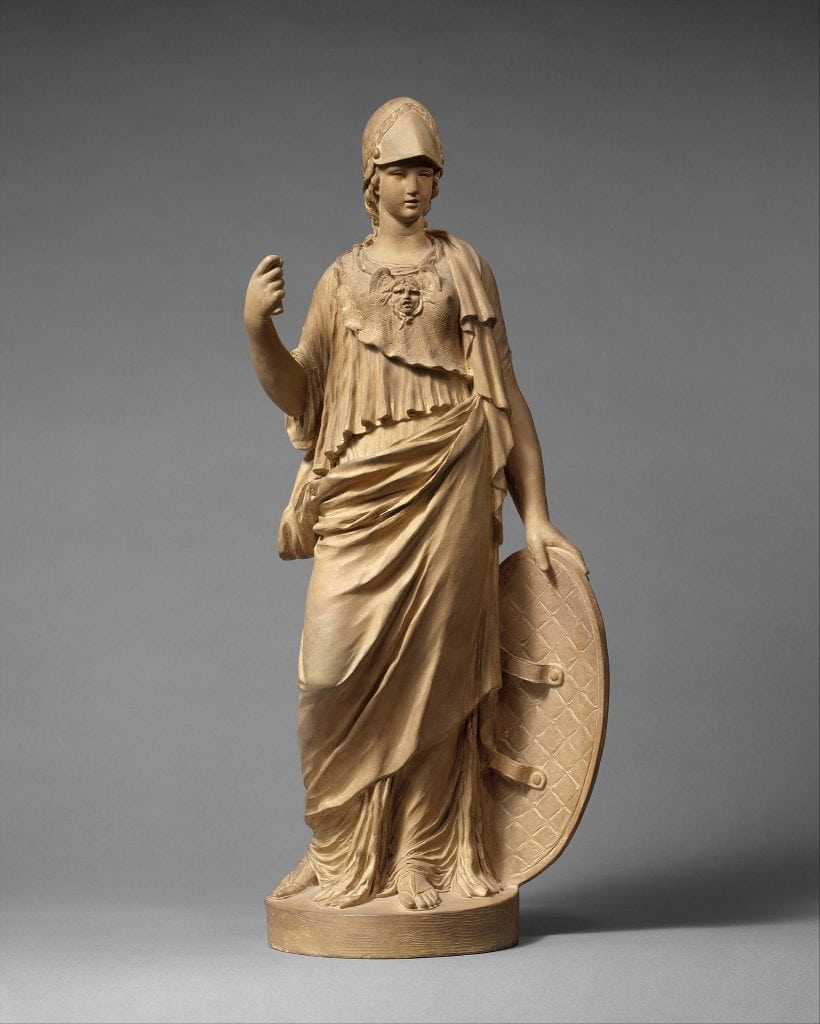
She was the Roman counterpart of the Greek Athena, but Minerva had independent Italic roots that predated Rome’s absorption of Greek mythology. Understanding both her native Roman identity and her later Hellenized form explains why she was simultaneously a goddess of war and a goddess of handicrafts — domains that seem unrelated until you recognize that both require the same thing: disciplined skill applied with intelligence.
Minerva Before Athena
Minerva’s oldest form came not from Greece but from Etruria. The Etruscans worshipped a goddess called Menrva who was associated with craft, wisdom, and the arts — including the art of war understood as strategy and discipline rather than brute force. When Rome absorbed Etruscan religious culture in the period of the Tarquin kings, Menrva came with it.
Her name in Latin connects to the root mens — mind, intelligence — the same root that gives Latin mentis (of the mind), memoria (memory), and through various paths the English words “mental,” “mention,” and “mind” itself.
This native Italic Minerva was primarily a goddess of craft and professional skill. She was not yet the warrior goddess of Greek mythology. When Rome subsequently absorbed the Greek Athena — through the interpretatio romana that identified corresponding deities across cultures — Minerva gained Athena’s martial dimension, her birth myth, and much of her mythology. But she never lost the craft dimension that had been her original Roman identity. The result was a goddess whose domains spanned a wider practical range than either Athena or the original Menrva alone.
The Capitoline Triad
Minerva’s most important institutional role was as the third member of the Capitoline Triad — the three gods whose shared temple on the Capitoline Hill formed the spiritual center of the Roman state.
Jupiter occupied the central cult space, the largest and most prominent position. Juno was on his left. Minerva was on his right. The arrangement expressed the theological relationship: Jupiter provided supreme authority, Juno provided the protective power of Rome’s continuity, and Minerva provided the wisdom and skill through which that authority and continuity were practically exercised.
This placement made Minerva not merely a goddess of intellectual life but a goddess of governance. Every major state ceremony at the Capitoline involved all three deities. The consuls who swore their oaths of office were swearing before Minerva as much as before Jupiter and Juno. The generals who ended their triumphs with sacrifice on the Capitoline were honoring her alongside the other two.
The Capitoline Temple was traditionally said to have been begun under the Tarquin kings — who brought Etruscan religious culture to Rome — and dedicated in 509 BCE, the year of the Republic’s founding. Minerva’s presence in this founding monument of Roman civic religion from the very beginning placed her at the structural heart of Roman public life.
The Birth from Jupiter’s Head
Minerva’s birth myth — inherited from Athena’s but accepted fully into Roman religious culture — was one of the most striking in all of ancient mythology.
Jupiter, warned by a prophecy that any child born of his union with Metis would eventually surpass him, swallowed Metis whole when she was pregnant. Some time later Jupiter developed an agonizing headache. Vulcan, or in some versions the Titan Prometheus, split Jupiter’s skull open with an axe or a hammer. From the wound emerged Minerva, fully grown, fully armored, already shouting her war cry.
The myth encoded her essential nature with economy. She had no childhood, no education, no gradual development. She emerged from divine intelligence itself — from the mind of the king of the gods — already complete. She was not a god who had acquired wisdom. She was a god who was wisdom, born from its purest source.
The myth also established her perpetual virginity. Having emerged directly from Jupiter’s head rather than from any union between two beings, she had no mother in the ordinary sense and no origin in desire or sexuality. She was self-sufficient from her first moment of existence, which expressed her identity as pure intellect — a force that required no external completion.
What Minerva Governed
Minerva’s domains were the broadest of any Roman goddess, because skilled intelligence applies to an almost unlimited range of human activities.
She governed strategic warfare — not the raw aggression of Mars but the calculated application of military knowledge. Generals sought her counsel, not Mars’s energy. She was the goddess you invoked when you needed to outthink an enemy rather than overpower one.
She governed medicine and healing — the application of systematic knowledge to the restoration of health. Her sanctuary near the Esquiline Hill was associated with healing, and doctors and surgeons offered to her.
She governed all the manual crafts that required trained skill: weaving, pottery, metalworking, shoemaking, dyeing, carpentry. The faber — the skilled maker — of any kind was under her patronage.
She governed the intellectual arts: philosophy, rhetoric, poetry, music, drama. Actors and musicians were under her protection alongside weavers and surgeons.
She governed teaching. Roman schoolteachers took holidays during her festival and received gifts from their students in acknowledgment of her patronage of education.
The organizing principle across all these domains is the same one that connects strategic warfare and handicraft: applied intelligence. Every skill that requires systematic learning, practice, and the disciplined application of knowledge to a practical end belonged to Minerva.
The Quinquatria
The Quinquatria (kwin·KWAH·tree·a) was Minerva’s primary festival and one of the most widely observed in the Roman calendar, lasting five days from March 19 to 23.
The name derived from quinque — five — referring to the festival’s length. It fell immediately after the Ides of March and the conclusion of the main Salii ceremonies for Mars, positioning Minerva’s festival at the transition point between the opening martial ceremonies of the military year and the resumption of civilian professional life.
The first day was the most solemn — no blood could be shed, and the day was given to quiet ceremonies. The subsequent four days involved gladiatorial contests and performances, connecting the festival to both its martial and artistic dimensions simultaneously.
What made the Quinquatria socially significant was its adoption by virtually every professional guild in Rome. Weavers and fullers, doctors and surgeons, teachers and students, painters and sculptors, musicians and actors, shoemakers and dyers — all observed the festival as their own. Students gave their teachers gifts and received a holiday from lessons. Artisans dedicated their tools and their completed work to Minerva. Doctors made offerings for the success of their treatments.
This breadth of observance gave the Quinquatria a social reach that few other Roman festivals matched. It was not a state ceremony conducted by priests on behalf of the community. It was a professional community observance conducted by every skilled worker in Rome, acknowledging that their skill was divinely sourced and that Minerva was its patron.
A smaller Quinquatria Minusculae was held in June, specifically for flute players — musicians who had their own particular relationship with Minerva through the myth of the flute’s invention.
The Myth of Arachne
Ovid’s telling of the contest between Minerva and Arachne (a·RAK·nee) in the Metamorphoses is the most fully developed of Minerva’s Roman myths and one of the most artistically rich stories in Latin literature.
Arachne was a Lydian girl of humble birth who had become so extraordinarily skilled at weaving that people said she must have been taught by Minerva herself. Arachne denied this — she had taught herself, she claimed, and she would prove her skill surpassed even the goddess’s.
Minerva appeared disguised as an old woman and warned Arachne to be more respectful of the gods. Arachne dismissed her. Minerva revealed herself. The contest began.
Minerva wove a tapestry depicting the gods in their power and dignity — the founding of Athens, the contests of the Olympians, the punishments visited on mortals who had challenged divine authority. Around the border she wove images of those punishments as a warning.
Arachne wove a tapestry depicting the gods in their worst moments — Jupiter’s seductions and deceptions, Neptune’s violations, Apollo’s pursuit of Daphne, every instance of divine misconduct she could recall — all rendered with perfect, devastating artistry.
Ovid is explicit: Arachne’s tapestry was flawless. Minerva, examining it, could find no fault in the work itself. She struck it — and struck Arachne — not because the weaving was inferior but because it was insolent. Arachne, overcome by the goddess’s anger and her own shame, hanged herself. Minerva, taking pity, transformed her into a spider so that she could continue weaving forever.
The myth is more complex than a simple warning against pride. Ovid stages it as a genuine contest between two weavers of equal technical skill, with Arachne’s subject matter expressing a legitimate critique of divine behavior. Minerva’s response is emotional rather than rationally justified — she destroys what she cannot fault, then partially relents. The myth examines the limits of divine authority when confronted with uncomfortable truth expressed through perfect art.
The Aegis and Medusa’s Head
One of Minerva’s most distinctive attributes was her aegis — a breastplate or cloak made of goatskin, fringed with serpents, and bearing in its center the severed head of the Gorgon Medusa.
Medusa’s head turned anyone who looked at it directly to stone. Perseus, with Minerva’s guidance, killed Medusa by using a polished shield as a mirror so he never looked at her directly. He gave the head to Minerva, who fixed it to her aegis as permanent armor. The goddess of wisdom wore the face of the thing that killed by being looked at — the power of the gaze weaponized and placed under rational control.
The combination was theologically precise. Minerva represented intelligence that had mastered what was most dangerous and placed it in service of order. The Gorgon’s head on her armor was not a trophy but a tool — irrational, deadly power incorporated into the armament of disciplined wisdom.
In Roman art Minerva was frequently depicted with the Gorgoneion — the Gorgon face — on her breastplate, a visual reminder that her wisdom was not merely contemplative but capable of wielding the most lethal force when required.
The Myth of the Flute
One of the smaller Minerva myths — told by Ovid and others — explains how the flute came into the world and why Minerva, having invented it, abandoned it.
Minerva made the first flute from the bones of a deer and played it at a banquet of the gods. She was delighted with the music until she caught sight of her reflection in a river and saw how her cheeks puffed out and her face distorted when she played. Displeased by the undignified appearance, she threw the flute away.
It landed in Phrygia, where the satyr Marsyas found it, learned to play it with extraordinary skill, and challenged Apollo to a musical contest — with the consequences told in the Marsyas myth.
Minerva’s abandonment of the flute expressed something about her character: she was unwilling to pursue an activity, however skillful, that compromised her dignity or required a posture she found undignified. This was not vanity in the ordinary sense but a kind of intellectual self-respect — the recognition that wisdom must be consistent across all its expressions.
Minerva and the Aventine Temple
Separate from the Capitoline Temple, Minerva had a significant sanctuary on the Aventine Hill that served a different social function.
Where the Capitoline Temple was the center of state religion and patrician ceremony, the Aventine sanctuary was associated with artisan guilds, writers, and performers. It sat in a district with a more plebeian and commercial character, and it was here that the professional guilds of Rome — the collegia of various trades — maintained their particular relationships with the goddess.
This gave Minerva an institutional presence on both hills of Roman religious life: the Capitoline, where she governed alongside Jupiter and Juno as a supreme state deity, and the Aventine, where she presided more intimately over the practical working life of Rome’s skilled classes.
Minerva and the Owl
The owl was Minerva’s sacred bird, and its symbolic association with wisdom is one of the most enduring connections between a deity and an animal in all of ancient religion.
The association originated with Athena and was fully adopted into Minerva’s Roman identity. Owls see in darkness — they possess a kind of perception that operates when ordinary sight fails. They are also quiet, still, and observant before they act, then devastatingly precise when they do. These qualities mapped directly onto the intellectual virtues Minerva embodied: the ability to perceive what others miss, to observe without being observed, and to act with precision when action was required.
The Little Owl (Athena noctua) was particularly associated with her — a small, direct-gazing bird that was common in the Mediterranean and was often depicted perched on Minerva’s shoulder or helmet. Its scientific name preserves the Athena connection into modern taxonomy.
In Rome, owls were treated with respect in Minerva’s honor. An owl calling near a public building was interpreted as a potentially significant omen — either warning or approval, depending on the context and the augurs’ reading.
Domitian and Minerva
Of all the Roman emperors, Domitian had the most intense personal devotion to Minerva, and his relationship with her illuminates how the goddess’s patronage could function for an individual rather than an institution.
Domitian built a new forum — the Forum Transitorium, also called the Forum of Nerva — whose central temple was dedicated to Minerva. He reportedly kept a private shrine to her in his bedroom and consulted her through dreams. Before making significant decisions he sought her divine guidance. He included her image on his personal seal.
This devotion was partly political — Domitian was presenting himself as governed by wisdom rather than mere force, associating his rule with the intellectual virtue she embodied. But ancient sources suggest it was also genuinely personal. Minerva was, for Domitian, the divine intelligence he aspired to serve and be guided by.
The temple in his forum displayed elaborate sculptural reliefs showing the myth of Arachne and scenes from Minerva’s mythology — a public statement of theological identity expressed through one of Rome’s most ambitious building projects.
Minerva’s Place in Roman Religion
Minerva occupied a position in Roman religion that was simultaneously the most exalted and the most practically embedded of any goddess in the pantheon.
At the highest level she stood in the Capitoline Triad, participating in the supreme ceremonies of Roman state religion. At the most practical level she presided over every skilled worker in Rome through the Quinquatria, her festival that virtually every profession observed as its own.
This range — from the supreme state temple to the individual craftsman’s workbench — gave her a kind of democratic reach that the other Capitoline deities did not have. Jupiter was primarily the god of the state and its institutions. Juno was primarily the goddess of women’s life and marriage. Minerva crossed all social categories wherever skilled intelligence was exercised, which meant she crossed all social categories, full stop.
Final Take: Minerva
Minerva mattered to Rome because Rome was a civilization that valued what she represented: the application of trained intelligence to practical ends. Not wisdom as abstract contemplation — the Romans were generally suspicious of philosophy that didn’t connect to action — but wisdom as the force that makes skilled action possible.
Every doctor who healed, every engineer who built an aqueduct, every general who outmaneuvered a larger army, every teacher who passed on knowledge to the next generation — all of these were, in the Roman understanding, doing Minerva’s work. She was the divine rationale for the entire Roman project of building, governing, and maintaining the most complex civilization the Western world had yet produced.
She was born armed and ready, from the skull of the king of gods. She spent eternity teaching Rome how to use what she brought with her.
Share This Page
Cite This Page
MLA
Editors of RomanMythology.com. "Minerva: Goddess of Wisdom, Strategy, and the Arts." RomanMythology.com, 2025, https://www.romanmythology.com/roman-gods/major-gods/minerva/. Accessed June 4, 2026.
APA
Editors of RomanMythology.com. (2025). Minerva: Goddess of Wisdom, Strategy, and the Arts. RomanMythology.com. Retrieved June 4, 2026, from https://www.romanmythology.com/roman-gods/major-gods/minerva/