To the Romans, Mars was not a god you prayed to before a battle and forgot afterward. He was built into the structure of the city itself — its calendar, its priesthoods, its sacred objects, and its sense of who Romans were.
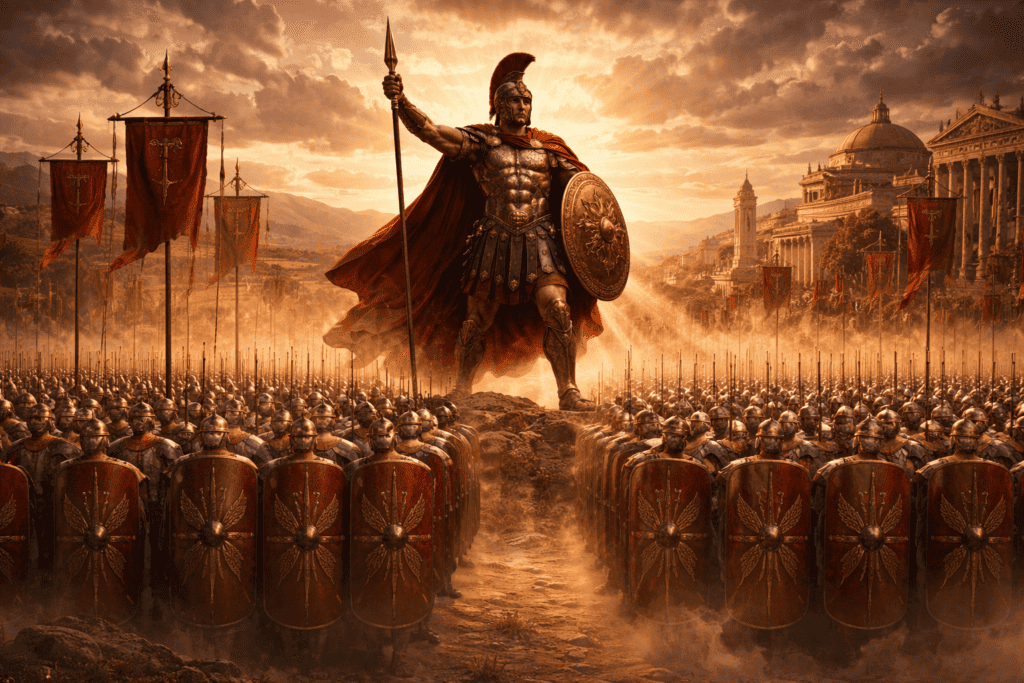
The Roman army was a religious institution as much as a fighting one. War opened and closed with rites, the soldiers who waged it were purified before and after, and the whole undertaking was understood to require the favor and even the physical waking of a god. Read that way, Mars stops being a generic war deity and becomes something more specific: the center of the machinery through which Rome made organized violence sacred, scheduled, and controllable.
Rome’s Divine Father
The deepest reason Mars mattered is that Rome believed it was descended from him. In the founding legend, Mars fathered Romulus and Remus on the priestess Rhea Silvia, which made the founder of the city the son of the war god. War was not an external misfortune that befell Rome; it ran in the city’s bloodline.
That status was reflected in the oldest layer of Roman religion. Before the famous Capitoline Triad of Jupiter, Juno, and Minerva, there was an Archaic Triad — Jupiter, Mars, and Quirinus — in which Mars held one of the three supreme places. He was also served by his own senior priest, the flamen Martialis, one of only three major flamens in the Roman state.
By the institutional measure Rome itself used to rank its gods, Mars was unambiguously major. The point is worth holding onto, because everything else in his military cult flows from this: the army did not borrow a convenient patron, it served the god from whom the city claimed to descend.
A Calendar That Told Rome When to Fight
Roman war had a season, and Mars’s festivals marked its opening and its close. Campaigning began in his month, March — Martius, named for him — and wound down in October, and the major rites of Mars cluster at exactly those two ends of the year.
March brought the Equirria horse races on the Campus Martius and the Tubilustrium, the purification of the war trumpets, on the twenty-third. October closed the season with the sacrifice of the October Horse on the fifteenth and the Armilustrium, the purification of weapons before they were stored for winter, on the nineteenth. War, in other words, was not a sudden eruption of disorder but a scheduled and sacred undertaking with a fixed beginning and end.
Each of those festivals has its own history, and they are worth reading in detail in the companion piece on the festivals of Mars. The point here is structural: the Roman calendar itself turned war into a seasonal, religious act, framed at both ends by the god who presided over it.
The Leaping Priests and the Shields from Heaven
Mars had his own order of priests, the Salii, and they are one of the strangest sights in Roman religion. Twelve patrician young men, each March, processed through the city in archaic warrior’s dress, beating their shields with staves, dancing in a measured three-step, and chanting the Carmen Saliare — a hymn so old that by the classical period even educated Romans could barely understand the words.
What they carried mattered as much as what they did. The Salii bore the ancilia, twelve bronze shields shaped like a figure eight. According to legend, one of them had fallen from heaven during the reign of Numa Pompilius, and eleven identical copies were made so that no enemy could ever steal the real one — because Rome believed that as long as the shield remained in the city, Rome would rule.
This was not decorative pageantry. The ancilia were counted among the pignora imperii, the sacred pledges on which Roman sovereignty was thought to rest, alongside the fire of Vesta and the Palladium of Troy. The god’s priests were, in effect, the custodians of one of the guarantees of empire.
“Mars, Wake Up”
The relationship between the army and the god is captured almost perfectly in a single rite. The sacred spears of Mars were kept in the Regia, the old royal hall at the heart of the city, and the god was understood to reside there in some real sense.
When a commander set out on campaign, he went to the shrine, took hold of the spears and shields, and shook them, saying “Mars vigila” — Mars, wake up. War did not simply begin; it began by rousing the god by hand. And if the spears were ever found to have moved on their own, that was a prodigy, an omen that conflict was coming whether Rome had chosen it or not.
It is hard to imagine a clearer statement of what Mars was to Rome. He was not an abstraction invoked for morale. He was a presence in the city that had to be physically awakened before the legions could march.
Washing the Blood Off
War polluted, in the Roman view, and the religion that surrounded it spent as much effort on cleansing as on victory. Armies were lustrated — led in ritual procession and purified — before and after they fought, frequently with the suovetaurilia, the joined sacrifice of a pig, a sheep, and a bull offered to Mars.
The geography reinforced the idea. The Campus Martius, the “Field of Mars,” lay outside the city’s sacred boundary, the pomerium, and it was there that armies mustered and trained and there that the census ended with a great purification of the entire citizen body. To go out to war and to come back was to cross a religious threshold, not merely to leave and return.
This is the substance behind the familiar claim that Rome treated war as part of a larger order. It was not a sentiment. It was a practice of bracketing violence with cleansing so that the state and its religion could absorb what the army did and remain intact.
The Two Faces of Mars
Romans divided the god into aspects that tracked the phases of war. Mars Gradivus, “the strider,” was the marching god who led armies out of the city; the quieter dimension of his cult, linked to Quirinus, belonged to the citizen body at peace.
Keeping his war rites and his great field outside the pomerium expressed the same instinct in physical form. Organized violence was necessary, but it was held at the city’s edge and admitted only on Rome’s own terms, at the appointed season, through the proper rites. The “balance” between war and stability that Romans prized was not a mood but a layout — a matter of where Mars was allowed to stand and when he was allowed to act.
The Just War
Rome insisted, at least in its own account of itself, that it never took up arms without cause. That claim was not left to rhetoric; it had a priesthood. The fetiales conducted the rituals of grievance and declaration that turned a conflict into a bellum iustum, a “just war” — formal demands for redress, a fixed waiting period, and a ritual declaration before fighting could legitimately begin.
The division of labor is revealing. The fetial rites governed whether a war could begin at all, while Mars governed the fighting once it had. Between them they expressed a single conviction: that force was legitimate only when it had been properly authorized, and that the difference between a just war and mere aggression lay in procedure that could actually be performed and witnessed.
Mars Ultor and the Emperors
Under Augustus, Mars became an instrument of the state in the most literal way. Having vowed a temple to Mars Ultor — “Mars the Avenger” — in exchange for vengeance on the assassins of Julius Caesar, Augustus dedicated it in 2 BC at the center of his new Forum of Augustus.
He then made it the ceremonial heart of Roman war. The legionary standards recovered from Parthia, whose earlier loss had been a national humiliation, were housed there. The Senate met in the temple to decide on wars and to vote triumphs, and commanders departing for the provinces set out from it. The ancient god of the leaping priests and the shields from heaven had been absorbed into the apparatus of imperial power.
Why Rome Made War Sacred
Behind all of this lay a single, hard problem: how a civilization can do organized killing on a large scale and still survive being the kind of society that does it. Rome’s answer was to wrap war in religion until it became a bounded, accountable, repeatable act rather than an open-ended descent into violence.
War was opened in March and closed in October, declared by priests and waged under a god, washed clean at both ends, and begun only by waking Mars with his own spears. The discipline the Romans were famous for was real, but it did not live in slogans about order and control — it lived in these institutions, in a calendar and a priesthood and a purification that gave force a shape.
And because their founder was the son of Mars, the Romans could tell themselves that war was not a betrayal of their identity but its fullest expression. That belief is what made them so effective at it, and so dangerous: a people convinced that disciplined violence is not merely permitted to them but sacred to them will rarely lack a reason, or a ritual, to march.
Share This Page
Cite This Page
MLA
Editors of RomanMythology.com. "Mars in Roman Military Culture." RomanMythology.com, 2026, https://www.romanmythology.com/roman-gods/major-gods/mars-in-roman-military-culture/. Accessed June 3, 2026.
APA
Editors of RomanMythology.com. (2026). Mars in Roman Military Culture. RomanMythology.com. Retrieved June 3, 2026, from https://www.romanmythology.com/roman-gods/major-gods/mars-in-roman-military-culture/