Most victims in Roman myth do something to earn their ruin. They boast, they steal, they break an oath, they reach for what is not theirs. Actaeon does none of these things.
He takes a wrong turn in the woods. That is the whole of his crime, and for it the goddess Diana turns him into a stag and lets his own hounds tear him to pieces. The story has unsettled readers for two thousand years precisely because it refuses to let him deserve it.
The Hunter of Thebes
Actaeon (ak-TEE-on) was a young nobleman of Thebes, a grandson of the city’s founder Cadmus and a skilled and passionate hunter. He had been trained by the centaur Chiron, and he ranged the mountains with a famous pack of hounds and a company of fellow huntsmen.
One morning he and his companions had hunted well, and by midday the slopes were hot and the nets were heavy with game. Actaeon called the day’s work finished and told his men to rest, promising to return to the chase the next dawn.
He himself wandered off alone, with no particular aim, letting his feet carry him through an unfamiliar part of the forest. It was the kind of small, idle choice that no one thinks twice about, and it killed him.
The Hidden Pool
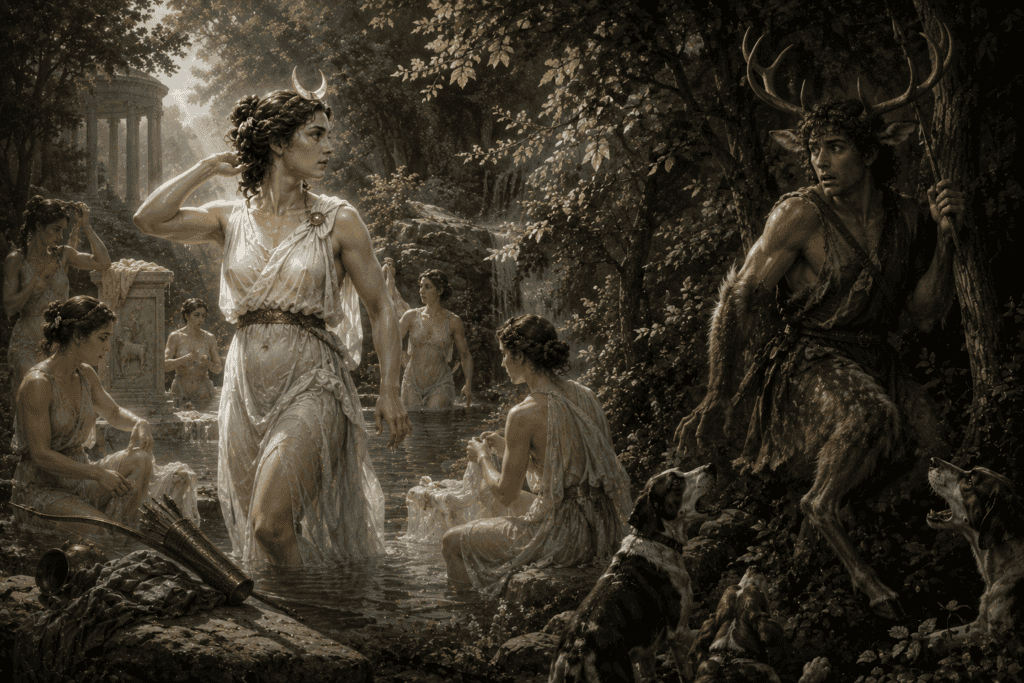
The valley he drifted into was sacred to Diana, though no sign marked it as such. At its heart lay a grotto of soft stone and living rock, with a clear spring that pooled into a basin at the foot of the trees, the kind of place that looked as though it had been shaped by art when in fact it had been shaped by nature alone.
Here Diana came to bathe after her own hunting, and on this day she had handed her bow and quiver and spear to one nymph, her robe to another, and stepped into the water while her attendants poured it over her. The goddess was at her most unguarded, stripped of the weapons and the distance that everywhere else protected her.
Into this scene Actaeon walked, parting the branches without knowing what lay beyond them. There was no warning and no barrier. He simply stepped through and found himself looking at a naked goddess.
The Goddess Discovered
The nymphs saw him first and cried out, rushing to crowd around Diana and shield her body with their own. But the goddess stood taller than all of them, and her face and shoulders rose above the ring of attendants for any eye to see.
A deep flush of anger colored her, the color of clouds lit red by a low sun. She reached for the bow that was not there, and finding no weapon in her hand, she used the only thing within reach. She scooped up a handful of the spring water and flung it into the young man’s face.
As she threw it she pronounced his doom in a few cold words: now go and tell, if he could, that he had seen Diana unrobed. It was less a curse than a dare, and she had already made certain he would never be able to take it.
The Change
The water struck him, and the transformation began at once. Antlers sprang from his brow and branched upward; his neck stretched long, his ears narrowed to points, his hands became hooves and his arms long legs, and a dappled hide spread across his skin.
Diana added one final cruelty to the shape: she filled him with fear. Where Actaeon the hunter had feared nothing in the forest, Actaeon the stag was made timid to his core, and he bolted in terror from the grove.
As he ran he caught sight of his own head and antlers reflected in the water and tried to cry out in horror. No words came. His mind was still entirely his own, trapped now inside the body of a beast, aware of everything and able to say none of it.
The Hunter Hunted
He did not run far before his own hounds found his scent. The pack he had raised and fed and loved came baying after him, and they did not know him; to their noses he was simply a stag, the very quarry they had been bred to bring down.
Actaeon fled across the slopes he had hunted that morning, and the dogs ran him exactly as he had taught them to run. He wanted to call out their names and his own, to tell them that their master was inside the deer they were chasing, but the man who could have spoken had no voice left to do it.
The first hounds reached him and fastened on, then the rest of the pack closed in. And in the cruelest stroke of all, his own companions came running up behind the dogs, cheering the kill, calling out for Actaeon to come quickly and see the fine stag his hounds had taken — not knowing that he was the stag, and that he could hear every word.
The Crime of Fortune
Diana’s anger was not satisfied until the last wound had been torn and the young man was dead. Only then, the old poets say, was the goddess content.
Ovid, who tells the story most fully, refuses to settle the question of justice. He reports that when the tale was known, opinion divided: some thought the goddess far too cruel for so small a fault, while others judged the punishment worthy of her strict and guarded virginity. He lets both verdicts stand.
What makes the myth so disquieting is the word Ovid himself reaches for — that Actaeon’s undoing was not guilt but bad luck, a crime of fortune rather than of intent. He had chosen nothing, planned nothing, desired nothing. This sets him sharply apart from figures like Niobe, who is destroyed for a deliberate boast. Actaeon is destroyed for being in the wrong clearing at the wrong moment, and the gods, the story insists, do not weigh intent.
The Hunter and the Hunted
Beneath the horror runs a grim and perfect symmetry. The master of the chase becomes the thing that is chased; the man who lived by tracking and killing wild animals dies as a wild animal, tracked and killed.
His hounds, the instruments of his skill and his pride, become the instruments of his death, and they do it through no fault of their own, simply by being what he made them. The expertise that defined Actaeon is turned without alteration into the means of his destruction.
That reversal is why the myth has always felt like more than a tale of one unlucky hunter. It carries a warning that runs deeper than any single act: that the line between the hunter and the hunted is thinner than the powerful like to believe, and can be crossed in an instant by a will greater than theirs.
Diana and Actaeon in Later Art
The story became one of the most painted of all classical myths, and for an obvious reason: it offered the chance to depict the goddess and her nymphs at the bath, the moment of shock, and the strange beauty of a man turning into a beast, all in a single charged scene.
Titian’s great canvases of the subject are the most famous, freezing the instant when Actaeon parts the curtain and Diana recoils, the catastrophe already certain but not yet begun. Painters returned to it again and again, drawn to the collision of beauty and dread at its center.
In every version the same tension holds. The viewer is placed, uncomfortably, in Actaeon’s position, seeing what he saw, and made to feel both the wonder of the forbidden sight and the terror of the price attached to it.
Final Take: Diana and Actaeon
Actaeon’s story is the clearest expression of who Diana is. She is the goddess of the guarded threshold, and the boundary around her own body was the most fiercely defended threshold of all.
His ruin was not a punishment in any sense a court would recognize, because there was no crime to punish. It was the raw assertion of a divine boundary, indifferent to whether the man who crossed it meant to or not, and that indifference is the whole point.
The image that lasts is the stag with a man’s mind, surrounded by the dogs that love him, hearing his friends call his name and unable to answer. It is one of the most frightening pictures in all of myth, and it is frightening precisely because Actaeon did nothing to deserve it — except see what he was never meant to see.
Share This Page
Cite This Page
MLA
Editors of RomanMythology.com. "Diana and Actaeon: The Hunter Who Saw Too Much." RomanMythology.com, 2026, https://www.romanmythology.com/roman-myths/diana-and-actaeon/. Accessed June 10, 2026.
APA
Editors of RomanMythology.com. (2026). Diana and Actaeon: The Hunter Who Saw Too Much. RomanMythology.com. Retrieved June 10, 2026, from https://www.romanmythology.com/roman-myths/diana-and-actaeon/