Amor is the Latin word for love, and it is also, in Roman literary and religious culture, a divine figure, a philosophical principle, and the organizing force of an entire poetic genre. The boundary between the word and the deity was deliberately blurred. When a Roman poet invoked Amor, he was simultaneously naming an emotion, addressing a god, and participating in a literary tradition that used the personification of love as a way to explore what desire actually does to a person and why.
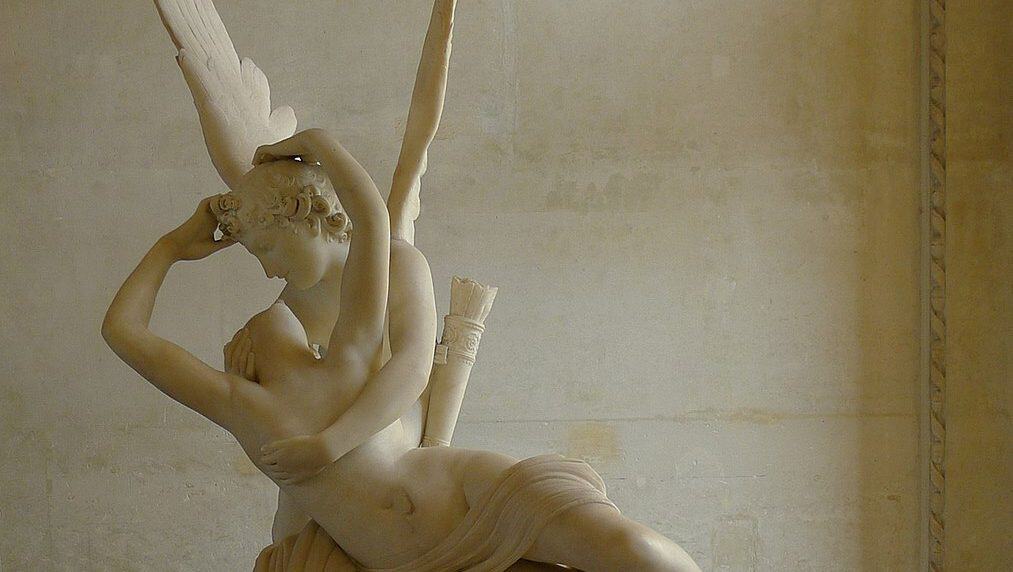
Amor was identified with Cupid — the winged son of Venus, the archer whose golden arrows caused irresistible attraction and whose lead arrows caused aversion — but the two names carried different registers. Cupid appeared in myth and narrative: he had a story, a mother, a wound from hot oil, a wife named Psyche, and a role in various divine and mortal entanglements. Amor appeared in lyric and elegiac poetry as an intimate presence: not a character in someone else’s story but the divine force the poet himself was directly subject to, arguing with, complaining about, and ultimately submitting to.
Amor as Cosmic Force: Lucretius
The most philosophically ambitious treatment of love as a cosmic principle in Latin literature is not in love poetry at all but in Lucretius’s De Rerum Natura — On the Nature of Things — an Epicurean philosophical poem written in the first century BCE.
Lucretius opens his poem with an invocation of Venus as the generative force underlying all of nature — the power that makes animals reproduce, that drives the renewal of spring, that sustains the entire biological world. The Venus he invokes is not the personal goddess of myth but something closer to what Lucretius calls alma Venus, nurturing Venus — the principle of attraction and generation that keeps matter combining rather than dispersing, that makes the universe productive rather than entropic.
This is Amor in its most cosmic form: not the winged boy with arrows but the fundamental creative force that the universe depends on to continue existing. Lucretius’s De Rerum Natura is a materialist text — he explicitly argues against supernatural intervention in natural processes — but he opens it with an invocation to the personified force of love because even a materialist account of the universe requires some explanation for why matter combines, why things attract rather than repel, why the world is populated rather than empty.
The identification of love with the generative force of nature had philosophical precedent stretching back to the Greek philosopher Empedocles, who had proposed Love (Philia) and Strife (Neikos) as the two fundamental cosmic forces — one drawing things together, one pulling them apart. Lucretius’s Venus was an heir to this tradition, and Roman poets who invoked Amor as a cosmic principle were drawing on the same philosophical background.
Amor in Latin Love Elegy
The Roman literary genre of love elegy — practiced by Tibullus, Propertius, and most extensively by Ovid in his Amores — built its entire structure around the personification of Amor as a character with whom the poet was in a specific and humiliating relationship.
The central conceit of Latin love elegy was servitium amoris — the slavery of love. The poet presented himself as Amor’s slave: subject to his commands, unable to resist his dictates, stripped of the rational self-governance that Roman culture valorized and reduced to a figure of helpless subjection. The irony was that this subjection was also a literary pose — a careful artistic construction — and the pleasure of the poetry lay partly in the tension between the poet’s claimed helplessness and the obvious skill with which he described it.
Ovid’s Amores opens with a statement of this condition. Ovid had been preparing to write epic verse — the most prestigious literary form, requiring the heaviest dactylic hexameter — when Amor stole a metrical foot from his verse, forcing it into the lighter elegiac meter. The god of love had physically intervened in the poet’s literary choices, demoting him from epic to elegy, from gravity to desire. Ovid complains, then submits. The poem that follows is the submission itself.
The Amor of Latin elegy was a demanding, often arbitrary, frequently cruel figure. He sent the poet to stand outside a locked door in the rain (paraclausithyron, the lament at the closed door, was a standard elegiac situation). He caused the poet to love someone who did not love him back, or who loved him inconsistently, or who loved his money rather than himself. He intervened in the poet’s attempts to maintain dignity, reputation, and rational self-command, and he always won.
This made Amor theologically interesting in a way that went beyond simple personification. The slave of Amor was not simply someone experiencing an emotion. He was someone whose rational faculty had been overridden by a divine external force — which raised real philosophical questions about free will, responsibility, and the relationship between divine power and human agency. Roman philosophers took these questions seriously, and the poets engaged with them through the vehicle of the personified Amor.
Amor and the Amores
Ovid’s Amores — a collection of elegiac poems addressed to a mistress named Corinna and to the experience of being in love — is the most sustained treatment of Amor as a literary character in Latin literature.
Ovid addresses Amor directly in several poems, sometimes as a tyrant, sometimes as a teacher, sometimes as a colleague in mischief. In Amores 1.2, he imagines Amor’s triumphal procession — the god riding in a chariot like a Roman general celebrating a military victory, with the poet himself among the captives being displayed. The military imagery was deliberate: Roman culture celebrated the triumph as the highest form of masculine achievement, and Amor’s triumph explicitly inverted this, making the captive not a foreign enemy but a Roman poet stripped of his dignity by the force of love.
In Amores 1.9, Ovid argues that the lover and the soldier are equivalent — militat omnis amans, every lover is a soldier — because both require endurance, watchfulness, the ability to bear hardship, and the willingness to undertake difficult expeditions in service of their objective. The argument was partly comic, partly serious: Amor as a general, the poet as his soldier, love affairs as campaigns. The personification allowed Ovid to explore a sustained metaphor about the parallels between martial and amatory subjection.
Amor and Psyche
The myth of Amor and Psyche, preserved in Apuleius’s Golden Ass (second century CE), is the most narratively complete story in which Amor appears as a genuine mythological character rather than a literary personification.
In this context Amor and Cupid are effectively the same figure — the son of Venus, bearer of bow and arrows — but the story’s philosophical dimension is expressed through the name: Amor (Love) united with Psyche (Soul). The allegorical reading, available from Apuleius’s own cultural moment and developed extensively by later Platonist thinkers, understood the myth as an account of the soul’s journey through trials toward union with divine love — the soul purified by difficulty, finally achieving the immortality that love makes possible.
The myth’s placement in the Golden Ass — a comic, picaresque, often bawdy novel — is itself significant. Apuleius embedded a philosophical allegory about the soul’s ascent to the divine within a story about a man transformed into a donkey by a magical accident, which is precisely the kind of structural irony that characterized the most sophisticated Roman literary culture. The high and the low, the cosmic and the ridiculous, existed in the same text because that was where they existed in Roman experience.
The Amor of Cupid and Psyche was eventually wounded by his own fire — a drop of hot oil from Psyche’s lamp burning his shoulder — which was read allegorically as love wounded by curiosity, by the soul’s desire to see what it loves rather than simply experiencing it in darkness. The healing of that wound, and the eventual reunion of Amor and Psyche on Olympus, expressed the Platonist idea that the soul’s relationship with divine love was essentially a story of loss, purification, and restoration.
Amor in Art
Amor appeared in Roman visual art in several distinct registers that expressed the different aspects of his identity.
In Roman funerary art — sarcophagi, tomb paintings, memorial objects — Amor appeared frequently alongside other figures associated with the soul’s journey: as one of the Erotes (the collective of winged love figures), carrying torches, driving chariots, harvesting grapes. The theological logic was Platonic: Amor’s wings expressed the soul’s capacity for upward movement, and his presence on funerary monuments expressed the hope that the deceased soul would rise rather than descend.
In domestic wall painting, most extensively preserved at Pompeii and Herculaneum, Amor appeared in scenes of divine mythology — the Amor and Psyche story, Amor with Venus, Amor among the Erotes — and also in the comic genre paintings of Erotes engaged in human activities at childish scale: Amor as a charioteer, as a goldsmith, as a cupbearer, as a gladiator. These images expressed desire as ambient, as present in every domain of life, as the divine principle underlying even the most ordinary human activities.
In philosophical and allegorical contexts — the visual culture of the Stoics and Neoplatonists — Amor appeared as a cosmic figure, often paired with Anteros (the god of reciprocal love or the avenger of unrequited love) in images that expressed the balance between love given and love returned.
The blindfolded Amor — the source of the modern “love is blind” image — was not a standard feature of Roman visual art. The blindfold appeared in medieval allegory and became standard in Renaissance painting, particularly after it was systematized in emblem books of the fifteenth and sixteenth centuries. Classical Roman Amor was typically sighted, which expressed a different understanding: love was not blind but arbitrary, striking without rational justification while remaining fully capable of seeing exactly what it was doing.
Amor and Anteros
Anteros — whose name means “love returned” or “counter-love” — was Amor’s brother and counterpart, depicted like him as a winged figure, sometimes in active opposition to Amor and sometimes as his complement.
The mythology of Anteros varied. In one tradition he was the avenger of unrequited love — the divine punishment inflicted on those who refused to return genuine affection. In another he was simply the personification of reciprocal love, the divine presence that made love mutual rather than one-sided. In philosophical discussion he was the principle that balanced Amor’s drive toward desire with the requirement that desire be deserved and returned.
The pairing expressed something Romans found genuinely interesting about love: that the experience of unrequited desire and the experience of mutual love were not simply different intensities of the same thing but qualitatively different conditions, each with its own divine character. Amor drove you toward someone. Anteros determined whether what you felt was deserved to be returned — or punished you when it wasn’t.
Amor After Rome
Amor’s survival after the decline of Roman religious culture was primarily literary and philosophical rather than cultic — he was never the object of formal worship in the way that major gods were, and his disappearance as a figure of cult was therefore unremarkable. What survived was the word, the concept, and the literary tradition built around his personification.
Medieval poets inherited the Latin love elegy tradition through Ovid above all others, and with it the personified Amor as a literary character. The Roman de la Rose, the allegorical dream-poem of thirteenth-century France, presents the God of Love as a central character governing the poet’s pursuit of the Rose — a direct inheritance of the servitium amoris tradition, transposed into the courtly love framework.
Dante placed Amor at the center of the Vita Nuova, his early collection of poems about his love for Beatrice, describing visions of a figure who calls himself Lord of Love and interprets the meaning of the poet’s experience. The Vita Nuova‘s Amor was simultaneously a mythological figure, a psychological reality, and a theological pointer — love as the force that ultimately oriented Dante toward the divine.
The word amor itself — retaining its Latin form — passed into Italian, Spanish, Portuguese, and French, carrying its ancient weight into the modern world. Every use of amour, amor, amore in the Romance languages is a continuation of the same Latin word that Roman poets used to address their divine tyrant, invoke their cosmic creative force, and name what they felt and could not explain.
Final Take: Amor
Amor mattered to Roman culture because love mattered, and because the Romans were serious enough about love as an intellectual and moral problem to build an entire literary genre around its personification. The question of what love does to a person — whether it enables or enslaves, whether it is a divine gift or a divine punishment, whether the soul’s desire for union is cosmically sanctioned or merely biologically driven — was one that Roman poets, philosophers, and mythographers engaged with for centuries.
Amor was the figure through whom those questions were addressed. Not an answer to them — the Latin love poets were too honest for easy answers — but the character in whose name the questions could be asked, the divine tyrant whose behavior made the problem of desire concrete and discussable.
The word survives. The question it contains has never been answered. Amor, as the Latin poets understood, is not the kind of force that submits to resolution.
Share This Page
Cite This Page
MLA
Editors of RomanMythology.com. "Amor: The Roman Personification of Love." RomanMythology.com, 2025, https://www.romanmythology.com/roman-gods/personifications/amor/. Accessed June 12, 2026.
APA
Editors of RomanMythology.com. (2025). Amor: The Roman Personification of Love. RomanMythology.com. Retrieved June 12, 2026, from https://www.romanmythology.com/roman-gods/personifications/amor/