Mercury was the Roman god of commerce, communication, travel, and the movement of souls between the living world and the dead. He was the divine messenger, the patron of merchants and thieves, the guide of the dead, and — across the Roman Empire — one of the most widely worshipped gods in the entire ancient world.
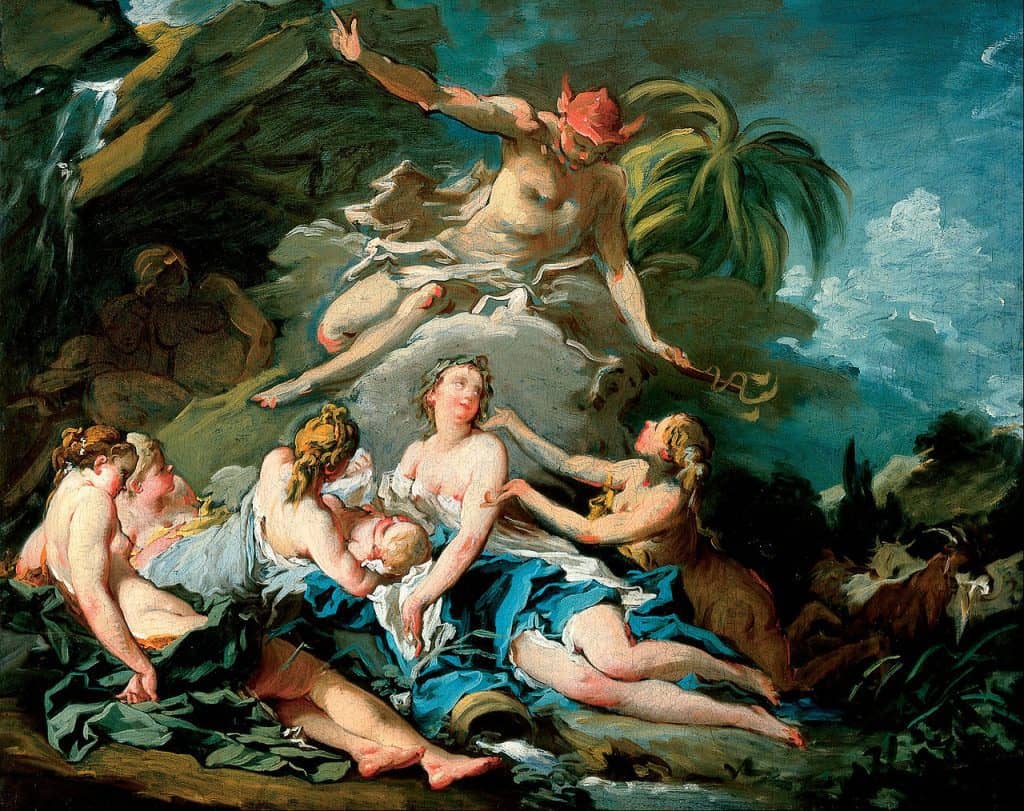
His name comes from the Latin merx, meaning goods or merchandise, and the same root gives English the words “merchant,” “market,” “commerce,” and “mercenary.” He was the counterpart of the Greek Hermes, and of all the Roman gods who were identified with Greek equivalents, Mercury-Hermes was one of the closest matches — the two gods’ mythologies merged almost seamlessly, because they governed the same domains and carried the same essential character: quick, clever, boundary-crossing, and impossible to pin down.
Mercury’s Late Arrival
Mercury was not one of Rome’s oldest gods. He arrived relatively late — his first temple was dedicated in 495 BCE, making him a newcomer compared to Jupiter, Mars, and Janus, whose cults stretched back to Rome’s earliest period.
The timing of that temple dedication was not incidental. It was connected to one of the sharpest political conflicts of the early Republic: the struggle between the plebeians and the patricians.
In the years around 495 BCE, Rome was experiencing serious social tension. The plebeians — the common citizens — were demanding recognition of their rights against the patrician aristocracy that dominated the Senate and the priesthoods. One of their demands concerned the grain trade. Grain merchants, who were predominantly plebeian, wanted official divine patronage that would both legitimize their commercial activities and give them religious standing independent of the patrician-controlled priesthood of Ceres.
The Temple of Mercury was built near the Circus Maximus, in a commercial district, and his festival — the Mercuralia on May 15 — became specifically associated with merchants. The temple and its priesthood were administered separately from the older Roman priestly colleges, giving the merchant class their own religious institution. Mercury thus arrived in Roman religion with a political dimension: a god for traders and commercial activity at a moment when the Romans who conducted that trade were asserting their place in the civic order.
What Mercury Governed
Mercury’s domains formed a coherent pattern around a single organizing principle: movement across boundaries.
He governed commerce — the movement of goods across the boundaries of ownership and geography. He governed communication — the movement of messages across the boundaries of distance and between parties who might not otherwise connect. He governed travel — the movement of people across the boundaries of place and safety. He governed the passage of souls — the movement of the dead across the boundary between the living world and the underworld.
He also governed thieves — people who moved property across the boundary of ownership without permission — which he did not govern judgmentally. Mercury was the patron of theft as well as trade, recognizing them as activities that shared the same fundamental skill: the ability to move things from one place to another that others would prefer to keep fixed.
This amoral flexibility was part of his character. Mercury did not take sides in the transactions he facilitated. He made exchange possible. Whether the exchange was fair was not his concern — that was Jupiter’s domain, the god of oaths and justice. Mercury’s job was to make things move.
The Myth of the Cattle Theft
The central myth of Mercury — inherited from Hermes and told in Roman literary culture primarily through Ovid and Horace — established his character in the first hours of his existence.
Mercury was born at dawn on the fourth day of the month. By evening of the same day he had invented the lyre, stolen fifty cattle from Apollo’s herd, and returned home to his cradle pretending to be an innocent sleeping infant.
The cattle theft was carried out with elaborate cunning. Mercury made the cattle walk backward so their hoofprints pointed away from the direction he was driving them, then drove them into a cave, sacrificed two of them to the twelve Olympian gods (including himself), and erased the tracks. When Apollo arrived, guided by a witness, the infant Mercury denied everything with complete composure.
Apollo brought the case to Jupiter, who found the whole situation amusing while making clear that the cattle needed to be returned. Mercury led Apollo to the cave. Apollo was furious until Mercury, on the way back, began playing the lyre he had made from a tortoise shell and gut strings. Apollo, the god of music, immediately wanted it. Mercury traded the lyre for the cattle herd and a golden shepherd’s staff — which became the caduceus — and Apollo additionally granted Mercury the gift of prophecy in its simpler forms.
The myth established Mercury’s essential nature: brilliant, boundary-ignoring, charming enough to turn his violations into gifts, and ultimately useful to the gods precisely because he operated outside their rules. The lyre he invented became Apollo’s defining symbol. The caduceus he received became his own. He had, on the first day of his existence, stolen his way into the divine order and left it better than he found it.
The Caduceus
The caduceus (ka·DOO·see·us) — the staff entwined with two serpents, sometimes topped with wings — is Mercury’s most recognizable symbol and one of the most misused images in modern culture.
Its origin in the myth was practical: it was the staff of a herald, a symbol of diplomatic immunity that declared the bearer was traveling under divine protection and should not be harmed. Heralds carried such staffs in the ancient world as a sign of their protected status during negotiations and the delivery of messages between warring parties.
The two serpents entwining the staff had various symbolic interpretations in antiquity, but the most consistent reading associated them with the mediation of opposites — the serpents moving in opposite directions but held together by the staff, expressing the balance that a messenger or mediator must maintain between competing parties.
Mercury’s caduceus should not be confused with the rod of Asclepius — a plain staff with a single serpent — which is the actual symbol of medicine and healing. The two-serpent caduceus was adopted by the United States Army Medical Corps in 1902 through a bureaucratic error that mistook Mercury’s herald’s staff for a medical symbol, and the mistake has propagated into widespread use. Medical organizations that pay attention to this distinction — including the World Health Organization — use the rod of Asclepius instead.
Mercury as Psychopomp
One of Mercury’s most solemn functions was as psychopomp (SY·ko·pomp) — guide of souls — the deity who conducted the newly dead from the world of the living to the underworld.
This role was absorbed from Hermes, who had performed it in Greek religion since the Homeric poems. In Roman religious practice and literary culture it was fully accepted as Mercury’s function. He was present at the moment of death, collected the shade of the deceased, and led it on the journey to Pluto’s realm.
Virgil shows Mercury carrying out Jupiter’s divine messages in the Aeneid — it is Mercury who appears to Aeneas in Carthage, where Aeneas has been staying with Dido, and delivers Jupiter’s command that he must leave immediately and continue to Italy. The scene is one of the most dramatically effective in the poem: Aeneas, having allowed himself to be diverted from his destiny by love, suddenly confronted by the divine messenger who tells him, without ceremony or sympathy, that the gods have not forgotten what he is supposed to be doing.
This Mercury is not the charming trickster of the cattle-theft myth. He is the efficient instrument of divine will, indifferent to human feelings, carrying messages that cause pain because they must be carried.
Both Mercuries — the cunning infant thief and the impersonal divine messenger — are the same god. The same quality that makes him useful for commerce and mischief makes him reliable for divine communication: he goes where he is sent, crosses whatever boundaries need crossing, and completes the transaction regardless of its emotional content.
Mercury Across the Empire
Julius Caesar, writing about the religion of the Gauls in his account of the Gallic Wars, made a striking observation: Mercury was the most widely worshipped god among the Celtic peoples of Gaul. The Gauls made more images of him than of any other deity, considered him the inventor of all arts, the guide of roads and journeys, and the presiding power over commercial transactions.
Caesar was applying Roman names to Gaulish deities as the interpretatio romana — the Roman practice of identifying foreign gods with their closest Roman equivalents — required. The Gaulish deity he was calling Mercury was probably Lugus, a god associated with crafts, eloquence, commerce, and the protection of travelers. The identification was apparently close enough that Roman Mercury and Gaulish Lugus were routinely merged in the religion of Roman Gaul, producing inscriptions and statues of Mercury with distinctly Celtic attributes.
This was not unique to Gaul. Mercury was identified with Thoth in Egypt, with Odin in Germanic religion, with various local messenger and commerce deities across the empire. His functional profile — movement, exchange, communication, boundary-crossing — translated readily into different cultural contexts because these functions exist in every complex society.
The result was that Mercury, who had arrived in Rome relatively late and without deep roots in native Italic religion, became one of the most geographically widespread divine identities in the Roman world. The fast-moving god of boundaries turned out to cross cultural boundaries as readily as any other kind.
The Mercuralia
The Mercuralia (mer·kyoo·RAH·lee·a), Mercury’s primary festival, was celebrated on May 15 — the anniversary of his temple’s dedication.
The central ritual was performed by merchants, who drew water from Mercury’s sacred spring near the Porta Capena, carried it in fumigating vessels, and sprinkled it on their heads, their merchandise, and their ships. As they did so they addressed prayers to Mercury asking for the washing away of past perjuries — false oaths sworn in business dealings — and for prosperity and eloquence in future commercial transactions.
The ritual is revealing about how Mercury’s patronage of commerce actually functioned. Merchants were not simply asking for profit. They were performing a purification rite that acknowledged the oaths they had broken in the course of doing business, and asking Mercury’s help in doing better. This connected Mercury’s commercial domain to Jupiter’s oath domain: successful trade required honest dealing, and when honest dealing had failed, ritual purification and renewed commitment were the prescribed responses.
The festival was conducted by and for merchants, not by state priests on behalf of the community. This maintained Mercury’s character as a god of the commercial class — practical, accessible, and concerned with the everyday transactions of economic life rather than the grand ceremonies of state religion.
Mercury’s Symbols
The winged sandals — talaria (ta·LAH·ree·a) — expressed his primary quality: speed. He moved faster than any other god, which was required by his function as messenger. The wings attached to his sandals and sometimes to his hat (petasus) were not merely decorative but expressed the divine character of his velocity.
The caduceus, as discussed, was his herald’s staff — the symbol of protected messenger status and the mediation of transactions between parties.
The rooster was sacred to Mercury because it announced the dawn, the transition between night and day — a boundary-crossing that aligned with Mercury’s nature as a god of transitions. Roosters were commonly offered to Mercury in sacrificial ritual.
The ram and the tortoise were also associated with him — the ram expressing wealth and the productive power of trade, the tortoise connecting to the lyre he had made from a tortoise shell on the first day of his life.
Hermae (HER·mee) — rectangular stone pillars topped with a head of Mercury (or Hermes) and with male genitalia carved at the appropriate point on the shaft — were placed at crossroads, boundaries, and the entrances to properties throughout the Roman world. They served as protective markers, divine presences at the points where boundaries were crossed, and as guideposts for travelers. The connection between Mercury, boundaries, and travel was made physically present in the landscape through these markers.
Mercury and Wednesday
Wednesday — Mercredi in French, Miércoles in Spanish, Mercoledì in Italian — is Mercury’s day, from the Latin Mercurii dies, the day of Mercury.
The Germanic peoples, when they adopted the Roman seven-day week, matched Roman gods to their closest Germanic equivalents: Woden (Odin) was identified with Mercury as a god of wisdom, communication, and the guidance of the dead. Woden’s day became Wednesday in English.
This means the English word “Wednesday” preserves, at several removes, the same Mercury-Hermes-Odin identification that Caesar observed in Gaul: a god of swift movement, eloquent communication, and boundary-crossing who wore different faces across different cultures but carried the same essential nature everywhere he appeared.
Mercury’s Place in Roman Religion
Mercury occupied an unusual position in Roman religion. He was a major god — included in the Dii Consentes, the twelve principal gods — but he lacked the deep institutional roots of Jupiter, Mars, or Juno. His temple was relatively late. He had no Flamen — no dedicated priest of the old patrician priestly colleges. His festivals were conducted by merchants rather than state priests.
This gave him a different kind of importance than the older gods. He was not embedded in the official machinery of Roman state religion in the same way. He was embedded in the practical commercial life of the Roman world — in markets, at crossroads, in the prayers of traders and travelers — and through that practical embedding he became, across the breadth of the empire, one of the most widely recognized divine presences in the ancient world.
The gods with the deepest official roots in Rome were sometimes the least portable. Jupiter Optimus Maximus was specifically Rome’s supreme god. Mars was specifically Rome’s divine military patron. Mercury crossed those specifics as readily as he crossed any other boundary. He was whoever you needed a fast, clever, morally flexible divine messenger and commercial patron to be — and every complex society needs one of those.
Final Take: Mercury
Mercury was the god Rome needed for its economy and its empire. As Rome’s commercial networks expanded and its communications required speed, reliability, and the ability to cross cultural as well as geographical boundaries, Mercury’s profile perfectly matched what was needed.
He was never a solemn or intimidating god. He was quick, practical, occasionally dishonest in ways that worked out well for everyone, and fundamentally useful. His myths celebrated cleverness over force, negotiation over domination, and the productive exchange of things — music for cattle, messages for safe passage — over the static possession of them.
Caesar was right to be struck by how widely Mercury was worshipped beyond Rome. The god of movement and exchange traveled well. That was, after all, the point.
Share This Page
Cite This Page
MLA
Editors of RomanMythology.com. "Mercury: Roman God of Trade, Messages, and Boundaries." RomanMythology.com, 2025, https://www.romanmythology.com/roman-gods/major-gods/mercury/. Accessed June 16, 2026.
APA
Editors of RomanMythology.com. (2025). Mercury: Roman God of Trade, Messages, and Boundaries. RomanMythology.com. Retrieved June 16, 2026, from https://www.romanmythology.com/roman-gods/major-gods/mercury/