When Octavian conquered Egypt in 30 BCE and stood before the tomb of Alexander the Great in Alexandria, he was asked if he wished to see the tombs of the Ptolemaic kings as well. He declined. He had come to see a god, he said, not a collection of corpses. The anecdote, whether accurate or not, captures something real about the encounter between Rome and Egypt: two civilizations with enormously sophisticated ritual systems, each convinced of its own correctness, suddenly in direct and permanent contact.
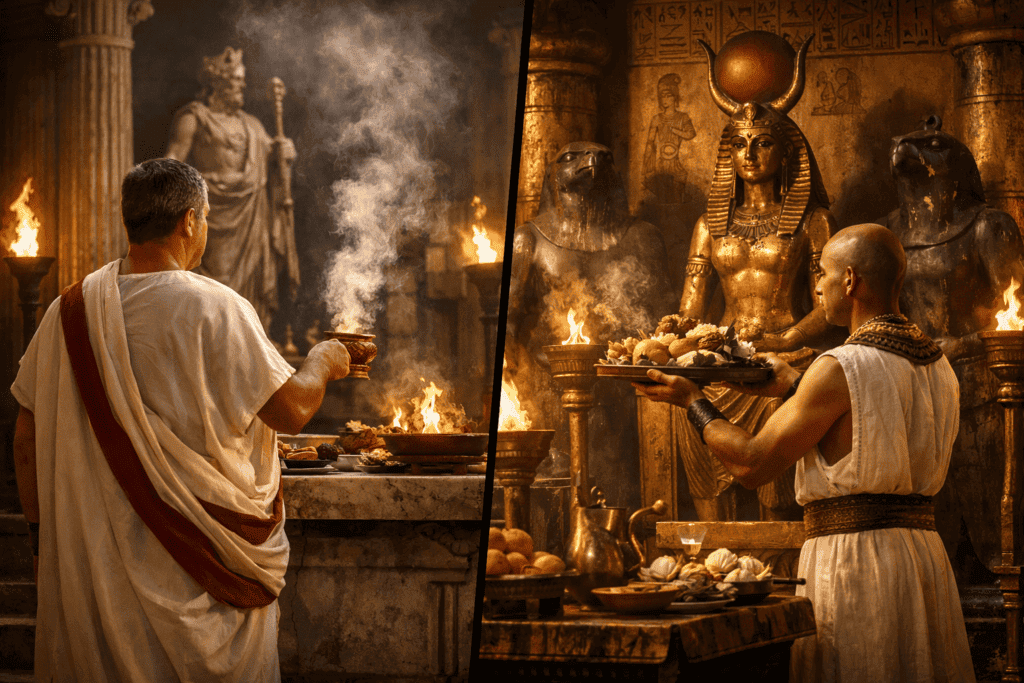
Rome did not simply absorb Egyptian religion. Egypt did not simply adopt Roman forms. What happened was more complex and more interesting: the two ritual systems coexisted, influenced each other, competed, and eventually merged in ways that neither tradition had anticipated.
Understanding how they compared — what each one believed ritual was for, how it organized sacred space, what it demanded of its priests, and what it expected from its gods — is the key to understanding both that encounter and the broader question of how ancient civilizations managed their relationship with the divine.
What Each Tradition Believed Ritual Was Actually Doing
The most fundamental difference between Roman and Egyptian ritual lay not in their specific procedures but in their underlying theology of what ritual accomplished.
Roman ritual was primarily transactional. The principle that organized it was do ut des — I give so that you give — a contractual exchange in which correct offerings and correct ceremonies created a binding obligation on the divine party to fulfill its side of the agreement. The Romans used the word pax deorum — the peace of the gods — to describe the state this transactional relationship was designed to maintain. When the pax deorum was intact, Rome prospered. When it was disrupted — by ritual error, by impiety, by some failure of the correct maintenance of divine relationships — Rome was in danger.
This theology gave Roman ritual its characteristically legal quality. The prayer formulas were precise not because imprecision offended the gods in some vague way but because the contract required precise specification. If you vowed to give Jupiter a temple and then gave him something different, the vow remained unfulfilled and the divine obligation unpaid. The Romans understood themselves as a people who kept their divine contracts, and the entire apparatus of Roman religious life — the priestly colleges, the religious calendar, the augural system — was the institutional machinery for managing those contracts correctly.
Egyptian ritual operated within a fundamentally different theological framework. Its organizing concept was ma’at — often translated as truth, justice, or cosmic order — the principle of right alignment that the universe depended on and that could be disrupted by impiety, chaos, or the failure of the divine service that kept it in place. Egyptian ritual was not primarily transactional. It was cosmic maintenance. The temple ceremonies performed daily by Egyptian priests were not offerings made in hope of return. They were acts of sustaining the divine order itself, keeping the gods active and present and capable of performing their cosmic functions.
The Egyptian creator god had established the world through an act of ordering — separating light from darkness, land from water, the living from the dead — and that ordering required continuous reinforcement. The daily ritual of washing, feeding, and clothing the god’s cult statue was not a symbolic gesture of reverence. It was the actual maintenance of the divine presence that kept the world organized. If the god’s statue was not tended, the god’s power in the world diminished. If the divine service failed, chaos — isfet, the opposite of ma’at — could advance.
The Temple: Public Stage vs Sacred Machine
The architecture of Roman and Egyptian temples expressed these different ritual theologies with remarkable precision.
The Roman temple was oriented outward. The altar stood in front of the building, between the worshippers and the facade. The ceremony happened outside, in public, visible to anyone in the precinct. The temple’s interior housed the cult statue and received specific priestly attentions, but it was not the primary stage of public worship. What happened at the altar — the sacrifice, the prayer, the libation — was the visible, public, witnessed heart of Roman religious practice. The community observed the ceremony being performed correctly on its behalf, and the observation itself was part of what made the ceremony legitimate.
The Egyptian temple was oriented inward. It was built as a series of progressively more restricted zones, each requiring higher levels of ritual purity to enter, each separated from the next by doors and gates that only authorized personnel could pass. The outermost court was accessible to ordinary worshippers. The inner hypostyle hall was for priests. The innermost sanctuary — the naos, the god’s inner chamber — was accessible only to the highest-ranking priests performing the daily cult ceremony. The general population never saw the cult statue or the most sacred rituals. The sacred was hidden, concentrated, protected from contamination by progressive exclusion.
This architectural difference expressed different answers to the question of what made ritual legitimate. For Rome, legitimacy came from public performance — the community witnessing the contract being honored. For Egypt, legitimacy came from correct execution of a precise sacred procedure — the properly trained, properly purified priest performing the ritual sequence in the properly protected space. Roman ritual needed witnesses. Egyptian ritual needed specialists.
The Egyptian Daily Temple Ritual in Detail
The Egyptian daily temple ritual is worth describing specifically because it was so different from anything in the Roman tradition and because its specific procedures reveal so clearly what Egyptian ritual theology was.
Each morning, before dawn, the priests who would perform the daily ceremony underwent a strict purification sequence: bathing in the sacred lake, shaving all body hair, chewing natron (a naturally occurring salt), and dressing in ritually correct garments — linen, never wool or leather, which were considered impure. This purification was not optional or symbolic. It was the prerequisite that made their contact with the divine safe — for them and for the god.
The ceremony itself followed a precise sequence that was performed in the innermost sanctuary. The priest broke the clay seal on the naos — the shrine housing the divine statue — and opened the doors. He bowed before the statue, then performed the Opening of the Mouth ceremony, touching the statue’s lips and eyes with ritual instruments to activate its divine senses. He removed the previous day’s clothing and offerings, washed and anointed the statue, dressed it in fresh garments, applied cosmetics, presented a mirror so the god could see itself properly adorned, and laid out the morning’s food offerings — bread, beer, meat, vegetables, flowers, incense.
The incense was burned throughout. The fragrance was understood as nourishment for the divine presence, and its smoke rising toward the ceiling expressed the communication between the human service-provider and the divine recipient. When the ceremony was complete, the priest backed out of the sanctuary, sweeping his footprints from the floor behind him to erase any trace of human contamination, and sealed the doors again.
This sequence was performed three times daily — morning, noon, and evening. The entire life of a major Egyptian temple was organized around these three ceremonies. The enormous labor of constructing, staffing, and maintaining a temple was in service of three daily repetitions of the same precise sequence of divine household management.
Roman Sacrifice vs Egyptian Offering
The central act of Roman public ritual was animal sacrifice, and its structure was as precisely defined as the Egyptian statue ceremony, though in completely different terms.
Roman sacrifice began with the selection of an appropriate victim — the animal had to be without blemish, of the correct species for the deity being honored (white animals for the gods of the upper world, dark animals for the underworld and the dead), and in the correct physical condition. The animal was then decorated with the vittae — sacred white woolen ribbons — and led to the altar, where the sacrificing priest performed the preliminary ceremony: sprinkling the animal’s head with mola salsa (sacred salt flour prepared by the Vestal Virgins), pouring wine between its horns, and reciting the prayer formula that specified the god being addressed and the benefit being sought.
The killing itself was performed by a specialist — the popa and the cultrarius — not by the priest. The priest maintained the capite velato posture, toga drawn over his head, protecting his eyes from any unfavorable sight that might contaminate the ceremony. After the killing, the haruspex examined the entrails for signs of divine acceptance. Favorable entrails confirmed the ceremony’s success. Unfavorable entrails meant the sacrifice had to be repeated.
The portions belonging to the gods — specific organs, the bones wrapped in fat — were burned on the altar fire, their smoke rising toward the gods in a manner superficially similar to Egyptian incense. The remaining meat was distributed for communal consumption, making the sacrifice simultaneously a religious ceremony and a community feast that reinforced social bonds and hierarchy.
The critical difference from Egyptian practice was the social character of Roman sacrifice. The Egyptian statue ceremony was private, restricted, hidden. The Roman sacrifice was public, witnessed, communal. The meat that came from the sacrifice fed the people who watched it being performed. The ceremony reinforced community at the same moment it honored the divine.
When the Isis Cult Came to Rome
The encounter between Roman and Egyptian ritual was not only theoretical. It played out in specific, historically documented, sometimes contested ways as Egyptian religious traditions spread into Roman territory, particularly after Rome’s conquest of Egypt in 30 BCE.
The cult of Isis had already penetrated the Roman world before the conquest, establishing itself in Italian ports and trading cities as early as the second century BCE. Isis’s appeal was broad: she was simultaneously a mother goddess, a goddess of healing, a goddess of the dead (as the devoted wife who reassembled Osiris’s murdered body), and a universal divine figure whose mythology offered emotional depth and personal divine relationship that Roman state religion rarely provided.
The Roman state’s response to the Isis cult was complicated and revealing. The Senate ordered her altars demolished multiple times during the first century BCE — in 58, 53, 50, and 48 BCE, a pattern of suppression and re-establishment that indicates how resistant the cult was to official disapproval. The workmen assigned to demolish the altars on several occasions reportedly refused to start, fearing divine retribution. Magistrates had to perform the first blows themselves.
What was Rome’s objection? Partly the Isis cult’s foreign origin. Partly its emotional and initiatory character, which differed so dramatically from the civic, public, witnessed Roman model. Partly the cult’s tendency to demand exclusive devotion from its adherents — a demand that conflicted with Roman polytheistic inclusivity. And partly simple xenophobia: a goddess from Egypt with an Egyptian ritual system represented something genuinely alien to Roman religious culture.
Augustus eventually allowed the Isis cult in Rome but confined it initially to areas outside the pomerium — the sacred boundary — following the same logic that kept foreign armies outside the city. Caligula built the first major Isis temple inside Rome proper in the first century CE, and by the imperial period the cult was fully integrated into Roman religious life, its Egyptian ritual elements absorbed, adapted, and in some cases preserved with remarkable fidelity.
The Serapis Compromise
The god Serapis was one of the most explicit examples of deliberate religious synthesis in the ancient world, and his development reveals how both Roman pragmatism and Egyptian religious tradition could work toward a shared divine figure.
Serapis was created — or at least formalized — under Ptolemy I in the early third century BCE as a god who could be genuinely worshipped by both the Greek-speaking Macedonian ruling class and the Egyptian population of the new Ptolemaic kingdom. He combined the Greek god Zeus with the Egyptian god Osiris-Apis (the sacred bull), producing a deity who looked Greek in his artistic representation — bearded, crowned, majestically human in form — but who carried Egyptian associations with the underworld, healing, and the agricultural cycle.
When Rome encountered Serapis, the god’s hybrid character made him unusually easy to absorb into Roman religious practice. He had already been through one cultural translation; a second was not difficult. Serapis temples in Rome offered a version of Egyptian sacred space — the restricted innermost chamber, the cult statue’s daily tending — embedded within an urban context that Romans could access and understand.
The Serapis cult’s success in Rome illustrated a broader principle: that the most successful transfers of Egyptian ritual practice into Roman culture occurred when the Egyptian elements were translated into forms that respected Roman religious sensibilities — when the cosmic maintenance of the Egyptian tradition was reframed in terms compatible with the transactional pact theology of Rome.
Ma’at and Pax Deorum: Two Versions of Cosmic Order
The deepest comparison between Roman and Egyptian ritual is ultimately a comparison between two different answers to the question of what cosmic order was and how it could be maintained.
The pax deorum was a relationship — a specific, historically established, contractually maintained relationship between Rome and its gods, continuously renewed through correct ritual performance and liable to disruption if the correct procedures were not followed. It was personal in the sense that the gods were specific persons with specific expectations. It was political in the sense that it governed the Roman state’s fate. And it was fragile in the sense that it could be broken and required constant active maintenance.
Ma’at was a principle — the principle of right order that pervaded the cosmos from the divine level to the human, from the proper alignment of the heavens to the honest weight of the merchant’s scales. Egyptian ritual was the human contribution to maintaining this principle — not a relationship with specific divine persons but a participation in the cosmic order itself. The temple priest who performed the daily statue ceremony was not only serving a specific god. He was maintaining the order of the universe at the point where his specific divine presence was concentrated.
This difference had practical consequences. Roman ritual anxiety was primarily about procedure — getting the words right, doing the sequence correctly, not making errors that would invalidate the contract. Egyptian ritual anxiety was about purity and cosmic consequence — the fear that contamination or failure would allow chaos to advance against the divine order. Different anxieties, different failures, different recovery procedures, all flowing from the same fundamental divergence in what each tradition believed ritual was ultimately for.
What Rome Learned from Egypt
The influence of Egyptian religion on Roman religious practice was not merely the Isis and Serapis cults. It extended, less obviously but perhaps more deeply, into the imperial cult and into the developing concept of the emperor’s divine nature.
The Egyptian pharaoh had always been understood as simultaneously human and divine — the son of Ra, the earthly Horus, the guarantor of ma’at whose correct performance of cosmic duties maintained the divine order. When Rome conquered Egypt and Roman emperors became the pharaohs of Egypt (receiving Egyptian royal titulary, depicted in Egyptian art performing Egyptian temple ceremonies), this theology of divine kingship began to influence how the imperial cult was understood and presented.
Augustus was careful to avoid direct claims of divinity within Rome itself. But in Egypt, as pharaoh, he was divine in the full Egyptian sense. And the mechanisms of imperial apotheosis — the deification of dead emperors, the eagle released at the funeral to carry the soul to the divine realm, the cult established for the deified emperor — shared certain structural features with the Egyptian tradition of divine kingship that could not have been entirely coincidental.
The cult of Sol Invictus that became increasingly prominent in the third-century imperial period, and which Augustus had already associated with his own iconography, had deep connections to the Egyptian solar theology that made the sun’s daily journey a cosmic drama of creation, death, and rebirth. When the Unconquered Sun became the supreme god of the Roman state under Aurelian in 274 CE, an Egyptian theological current that had been flowing into Roman religion for three centuries had reached something close to its full expression.
Conclusion
Roman and Egyptian ritual were built to solve different versions of the same problem: how to maintain a stable relationship between the human world and the divine order that sustained it. Rome solved it through public, witnessed, contractual exchange — correct ceremonies performed correctly on behalf of the community, divine contracts maintained with legal precision. Egypt solved it through hidden, specialized, cosmic maintenance — daily service to the divine presence, performed by trained specialists in protected sacred space, sustaining the order of the universe itself.
When these two traditions met — in the streets of Roman Alexandria, in the Isis temples of Pompeii, in the pharaonic ceremonies performed by Roman emperors in Egyptian temples — they did not simply merge. They created something new: a hybrid religious culture that drew on both traditions, that could be transactional and cosmic simultaneously, that allowed Roman worshippers to seek Isis’s personal divine care within a framework that still honored the Roman requirement for publicly correct religious practice.
The synthesis was never complete and was never meant to be. But its traces are everywhere in the archaeology of the Roman Empire — in the Isiac frescoes of Pompeian houses, in the obelisks Caligula and later emperors moved from Egypt to Rome, in the solar theology of the late empire, and in the Christian ritual forms that eventually absorbed elements of both traditions into the new religious world that replaced them both.
Share This Page
Cite This Page
MLA
Editors of RomanMythology.com. "Roman and Egyptian Ritual: Two Empires, Two Ways of Managing the Divine." RomanMythology.com, 2026, https://www.romanmythology.com/comparative-mythology/roman-vs-egyptian-rituals/. Accessed June 10, 2026.
APA
Editors of RomanMythology.com. (2026). Roman and Egyptian Ritual: Two Empires, Two Ways of Managing the Divine. RomanMythology.com. Retrieved June 10, 2026, from https://www.romanmythology.com/comparative-mythology/roman-vs-egyptian-rituals/