There is a contradiction at the center of Diana that the Romans never tried to resolve, because to them it was not a contradiction at all. The goddess who guarded her virginity with lethal force was also the goddess women called on in the agony of giving birth.
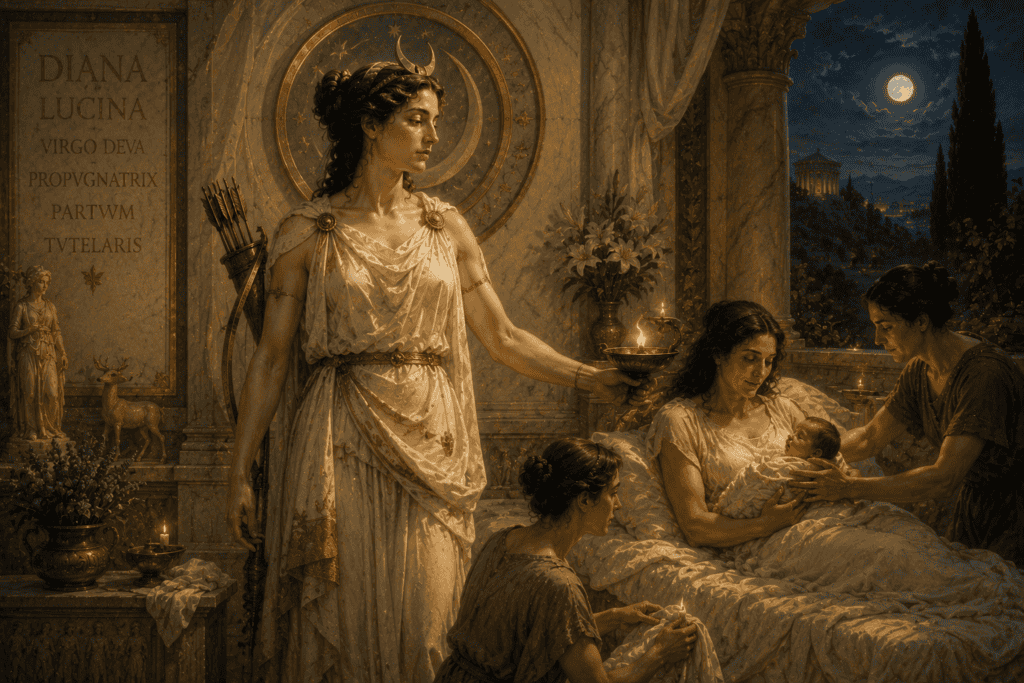
A perpetual maiden who never bore a child stood watch over the most intimate ordeal of motherhood. Far from finding this strange, the Romans built whole cults around it, and the title they gave her for it was Lucina (loo-SY-nuh), the one who brings the child into the light.
The Maiden Goddess
Diana’s virginity was not a passive trait but a defining and defended one. She ran with a band of nymphs who had sworn the same vow, and she punished any breach of it with a severity that ran through her myths.
The hunter who saw her bathing was turned into a stag and torn apart by his own hounds; the story of Diana and Actaeon is the most famous illustration of how absolute that boundary was. A follower who lost her virginity, even to a god, was cast out without appeal.
To be a maiden, for Diana, was not an absence of something but a fierce form of freedom. She belonged to no man, answered to no husband, and kept herself entire, and she defended that wholeness as fiercely as she defended the creatures of her forests.
She Who Brings to Light
And yet women in labor prayed to this same goddess. Under the title Lucina, Diana was invoked to ease the pains of childbirth and to bring the infant safely into the world, a role she shared with the older Roman tradition of the birth goddess.
The name itself tells the story. Lucina comes from lux, light, and to be born was to be brought into the light of day for the first time. The goddess of the moon’s light was fittingly the goddess who lit the way out of the womb.
Women left offerings to her for safe delivery and gave thanks to her when a birth went well. At Diana’s shrines, including the grove at Nemi, the hopes of expectant mothers were among the most common prayers the goddess received.
The Rituals of the Birthing Room
Diana’s care for childbirth was expressed in concrete and intimate practices. As a woman went into labor, those around her would loosen everything that was bound: her hair was unpinned, her garments were untied, and knots throughout the house were undone, in the belief that a loosened world would help loosen the child from the womb.
This sympathetic magic suited a goddess of passage and release. Diana, who opened the way into the light, was asked to undo whatever might hold a birth back, and the untying of knots was a prayer made with the hands rather than the voice.
Light itself played a part, fitting for a goddess named Lucina. Lamps and candles were kept burning through the dangerous hours, both as a practical comfort and as a sign of the daylight the goddess was being asked to grant the child.
At Diana’s shrines, women backed these rituals with offerings and vows. At the grove of Nemi the spring nymph Egeria shared in the work, and expectant mothers came to the lake to seek a safe delivery, leaving gifts in thanks when the goddess granted it.
The Midwife at Her Own Birth
Myth offered a reason why the virgin should preside over birth. According to the stories, when the goddess Latona came to deliver her twins, Diana was born first, and the newborn goddess immediately turned to help her mother bring her twin brother Apollo into the world.
In this telling, Diana became a midwife in the first moments of her own existence. Before she had done anything else, she had eased a birth, and the role was woven into her from her very first breath.
The story is more than a charming detail. It makes the protection of childbirth not a later addition to Diana’s character but a part of her origin, as native to her as the bow and the hunt.
Diana and Juno Lucina
Diana was not the only goddess to bear the title Lucina. It belonged most prominently to Juno, the great goddess of women and marriage, who as Juno Lucina was Rome’s foremost protector of childbirth.
The two goddesses overlapped in this role rather than competing for it. Juno guarded the married woman and the legitimate household, the social institution of motherhood, while Diana brought to childbirth her associations with the moon, the wild, and the dangerous threshold of birth itself.
A Roman woman might call on either or both, depending on her circumstances and her local cults. That two such different goddesses shared the title shows how seriously Rome took the perils of the birthing room, and how many divine protectors it wanted standing by.
The Moon and the Cycles of Women’s Lives
Diana’s care for childbirth cannot be separated from her rule over the moon. The Romans linked the moon to the rhythms of the female body and to the months that measured a pregnancy, so that the lunar goddess was naturally tied to the whole arc of women’s reproductive lives.
This gave Diana a special claim on women’s devotion. She presided over the passage from girlhood, through the threshold of marriage she herself never crossed, to the dangers of childbirth, watching over each stage from her own untouched distance.
She was, in this sense, a goddess of women precisely because she stood slightly apart from the ordinary course of a woman’s life. The maiden who would never marry or bear children could be the patron of all who did, looking on with a sympathy that owed nothing to shared experience.
Resolving the Paradox
The contradiction of the virgin midwife dissolves once Diana is understood as the goddess of thresholds. Virginity and childbirth are not opposites in her worship but two expressions of the same thing: she is the deity who stands at the great passages of a woman’s life.
Virginity is the threshold of marriage, occupied but never crossed. Childbirth is the threshold of life itself, the most dangerous crossing a body can make. Diana belongs at both because she belongs at every edge, and these are among the most charged edges a human being ever approaches.
Seen this way, the maiden goddess of childbirth is not a puzzle but a perfect fit. The power that guards the boundary of her own body is the same power women trusted to guard them at the boundary between the womb and the world.
Final Take: Diana Lucina
Diana Lucina is the answer to a question that should not have an answer: why would women in labor pray to a goddess who had sworn off motherhood entirely? The Romans found the pairing not only acceptable but natural.
The virgin and the midwife are one because Diana is the goddess of passage, and the body of a woman is crossed by more thresholds than almost any other thing in Roman life. The maiden who held her own threshold against all comers was trusted to hold open the one through which every child arrived.
It is one of the most humane faces of a goddess better known for her arrows and her hounds. At the hardest and most dangerous moment of a woman’s life, the cold huntress of the moonlit woods was there, named for the light she helped each new life reach.
Share This Page
Cite This Page
MLA
Editors of RomanMythology.com. "Diana Lucina: The Virgin Goddess of Childbirth." RomanMythology.com, 2026, https://www.romanmythology.com/roman-gods/major-gods/diana-lucina/. Accessed June 12, 2026.
APA
Editors of RomanMythology.com. (2026). Diana Lucina: The Virgin Goddess of Childbirth. RomanMythology.com. Retrieved June 12, 2026, from https://www.romanmythology.com/roman-gods/major-gods/diana-lucina/