When Octavian set out to make himself the first emperor of Rome, he faced a problem no army could solve. He had to explain why one man should hold permanent power in a state that had spent five centuries killing anyone who reached for a crown.
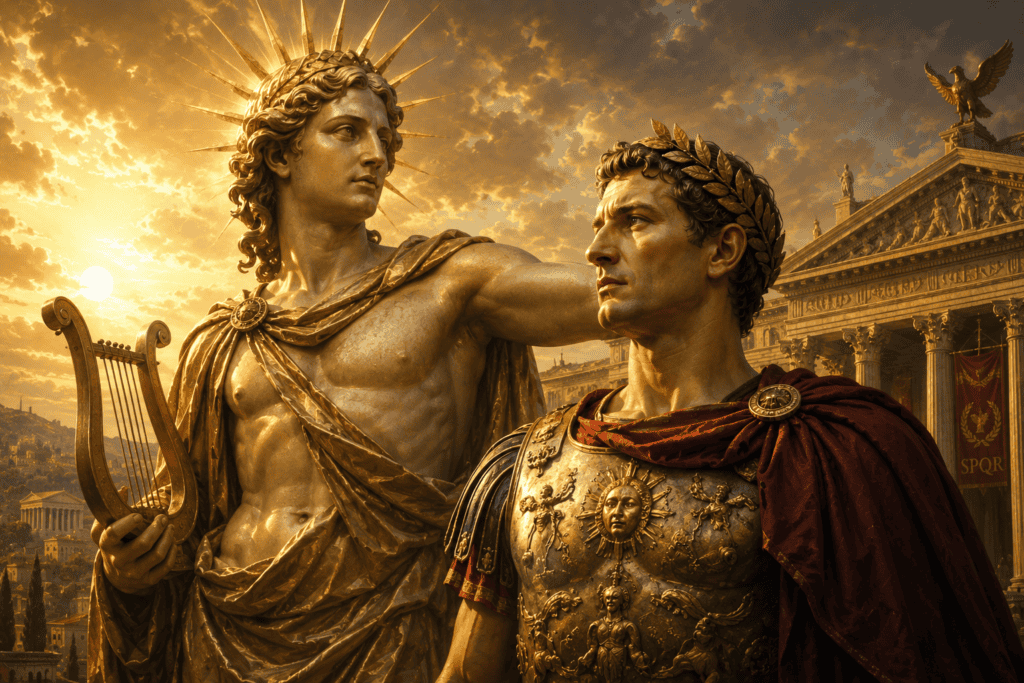
His answer was not a law or a title but a god, and the god he chose was Apollo.
A Son of Apollo
Augustus’s bond with Apollo was personal long before it was political — or at least he took care to make it look that way. A story circulated, later repeated by his biographer Suetonius, that his mother Atia had once fallen asleep during a midnight rite in a temple of the god.
A serpent, the tale went, glided to her in the dark, and ten months later she bore a son who was reckoned the child of Apollo. A mark like a snake was said to have remained on her skin ever after.
Whether or not Augustus invented the legend, he let it spread, and its message was unmistakable. He was not merely a mortal who honored Apollo. He was, in a sense the Romans were happy to leave vague, the god’s own son.
The God Against Dionysus
That claim took on its full force during the long contest with Mark Antony, which was fought as much in images as on the water. Antony, ruling the eastern provinces beside Cleopatra, presented himself as a new Dionysus — the Greek twin of Bacchus, god of wine, ecstasy, and eastern abundance.
Octavian answered with Apollo: reason, restraint, discipline, and the clear cold light of the west. The war could then be told not as Roman against Roman, an unbearable thing, but as order against chaos.
The strategy had a sharp edge, and once it cut him. Suetonius preserved a scandal in which Octavian and a circle of friends held a secret banquet costumed as the twelve gods, with Octavian seated as Apollo himself.
It happened during a grain shortage, and Rome was not amused. Verses went around mocking “Apollo the Tormentor,” the god who had devoured the city’s bread while the people went hungry — a reminder that even a useful god had to be handled with care.
Actium and the Archer God
The decisive moment came in 31 BCE at Actium (AK-tee-um), on the western coast of Greece, beside an ancient temple of Apollo. Octavian’s fleet broke Antony and Cleopatra there, ending the civil wars and leaving him master of the Roman world.
He gave the victory to Apollo. He enlarged the sanctuary at Actium, founded a city of victory called Nicopolis beside it, and revived the Actian Games in the god’s name, so the win would always be remembered as a gift from heaven.
Virgil set the image in bronze and verse. On the great shield that Vulcan forges for Aeneas in the Aeneid, the battle is engraved: Augustus and the gods of Italy on one side, the monstrous animal-headed gods of Egypt on the other, and above the fleet Apollo drawing his bow.
In that picture the war turns cosmic. It is no longer two generals quarreling over power, but the archer of order scattering the barking, bestial deities of the east — with Augustus standing exactly where the god’s arrows point.
The Temple on the Palatine
Augustus turned the propaganda into architecture. The Temple of Apollo on the Palatine Hill had been vowed in 36 BCE, after lightning struck a spot on the hill and the priests declared the ground claimed by the god.
It rose in gleaming white marble and was dedicated in 28 BCE, standing directly beside Augustus’s own house. Emperor and god were neighbors on the founding hill of Rome, each visibly under the other’s protection.
Inside stood not Apollo the archer but Apollo the musician, robed and holding the lyre, flanked by his mother Latona and his sister Diana. The choice was pointed: the god of the imperial peace was the civilized Apollo of the arts, not the plague-bringer of the battlefield.
Two libraries flanked the complex, one Greek and one Latin, among the first great public libraries in Rome. The temple was at once a shrine, a monument, and a center of learning — precisely the blend of religion and culture Augustus wanted his age to stand for.
A Door That Told a Story
The poet Propertius left a description of the place, and its details were chosen to teach. Between the colored columns of the portico stood the fifty Danaids (DAN-ay-ids), the daughters who had murdered their husbands, frozen forever in their punishment.
The temple’s ivory doors carried two scenes. One showed the Gauls hurled down from the heights of Delphi when they dared to plunder Apollo’s shrine; the other showed the children of Niobe struck dead by the arrows of Apollo and Diana for their mother’s pride.
Both images said the same thing. Those who assaulted the god, or set themselves above the gods, were destroyed — a warning carved at the threshold of the regime that claimed Apollo’s favor.
The lesson reached Augustus’s own front door. By decree of the Senate, two laurels — Apollo’s sacred tree and the emblem of triumph — were planted at his doorposts, with a crown of oak above for the citizens he claimed to have saved.
The Books of Fate Come Home
One more transfer bound Apollo to the new order. Augustus gathered Rome’s Sibylline Books, the ancient collection of prophecies consulted in every great crisis, and moved them into the Palatine temple.
He placed them in gilded cases beneath the feet of the cult statue, so that Rome’s official knowledge of the future now rested literally under Apollo — and inside the emperor’s compound. The god of prophecy kept the city’s prophecies in Augustus’s house.
It was a quiet but enormous claim. The future itself, as far as Rome could read it, was now in the keeping of Apollo and his earthly son.
The Secular Games and the New Age
In 17 BCE Augustus staged the Secular Games, an ancient rite marking the death of one age and the birth of the next, and used them to announce a golden age reborn under his rule.
For the climax he commissioned Horace to compose the Carmen Saeculare (KAR-men sek-yoo-LAH-ray), a hymn to Apollo and Diana sung at the Palatine temple by a chorus of twenty-seven boys and twenty-seven girls. It prayed that the god would bless Rome’s harvests, its children, and its empire for the age to come.
With that performance the transformation was complete. Apollo was no longer one general’s chosen patron but the formal guarantor of the peace of the Roman state.
The Two Gods of Augustus
Apollo was not the only god Augustus enlisted, and the pairing is revealing. To avenge the murder of his adoptive father, Julius Caesar, he raised the great temple of Mars Ultor, Mars the Avenger, at the heart of his new forum.
Mars supplied the justice of the sword, the settling of the blood debt that had launched Augustus’s career. Apollo supplied what was meant to come after — order, art, prophecy, the light of a civilization at peace.
Between the avenger and the healer, Augustus covered the whole arc of his reign: the violence that won power, and the serenity that was supposed to justify keeping it.
An Inheritance for the Emperors
The Apollo of Augustus outlived him by centuries. Later rulers reached for the same god whenever they wished to look like civilized governors rather than warlords who had simply prevailed.
Nero, who fancied himself an artist, performed in public as Apollo the lyre-player and wore the god’s radiate crown. The thread running from Apollo to the sun to imperial glory would only grow stronger, until emperors wrapped themselves openly in solar light.
Each of them was working a vein that Augustus had opened. He had shown that a Roman ruler could borrow Apollo’s clarity to make the bare fact of one-man rule look like the natural order of the world.
Final Take: Apollo and Augustus
The brilliance of the Augustan Apollo lay in hiding politics inside worship. By taking the god as patron — and, in the whispered version, as father — Augustus converted a seizure of power into a story about reason defeating chaos, and placed himself at its center.
It worked because Apollo fit the part so well. He was foreign enough to seem elevated and Greek, yet already at home in Rome; bound up with order, art, and prophecy rather than mere conquest; a god of light for an age that wanted to believe the darkness was finally over.
Augustus never had to invent a god. He only had to build in white marble close enough to one, plant his laurels, slide the books of fate beneath the statue’s feet, and let Rome draw the obvious conclusion about whose power stood behind the throne.
Share This Page
Cite This Page
MLA
Editors of RomanMythology.com. "Apollo and Augustus: The Emperor’s Divine Patron." RomanMythology.com, 2026, https://www.romanmythology.com/roman-gods/major-gods/apollo-and-augustus/. Accessed June 3, 2026.
APA
Editors of RomanMythology.com. (2026). Apollo and Augustus: The Emperor’s Divine Patron. RomanMythology.com. Retrieved June 3, 2026, from https://www.romanmythology.com/roman-gods/major-gods/apollo-and-augustus/