Angerona was one of the most deliberately obscure figures in Roman religion — a goddess whose power was inseparable from the secrecy that surrounded her. She governed silence, the relief of hidden anxiety, and the protection of the things that must not be spoken. Her festival was observed on December 21. Her statue stood in the sanctuary of Volupia, the goddess of pleasure, with her mouth bound and her finger pressed to her lips. Ancient writers noted these facts and offered no further explanation, which was itself a form of honoring what she represented.
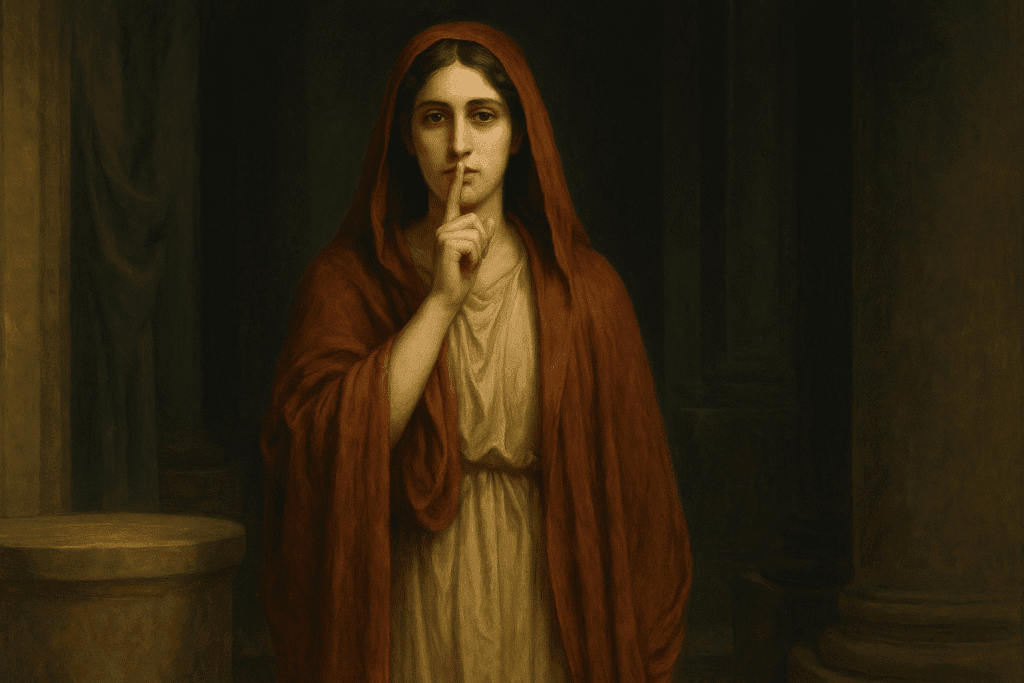
She is sometimes called Diva Angerona in ancient sources — the divine Angerona, the epithet diva carrying a weight that distinguished her from ordinary minor deities and placed her in the category of genuinely sacred powers. Whether she was a goddess in the full theological sense or a deified abstraction was debated even in antiquity. What was consistent was the respect with which she was treated and the deliberate absence of elaboration that surrounded her cult.
The Name and Its Meanings
Angerona’s name was understood by Roman writers to connect to two related Latin concepts, both of which illuminate her domain.
The first connection is to angustia — distress, tightness, constriction — the physical metaphor Romans used for emotional anguish. The feeling of anxiety was understood in bodily terms: the throat tightened, the chest compressed, breath became difficult. A goddess whose name carried this root and who was invoked to relieve it was addressing a physiological as much as a spiritual condition.
The second connection is to angere — to throttle, to strangle — which expressed the extreme end of the same phenomenon. The Romans who named or identified this goddess were encoding in her name both the affliction she governed and its relief. Angerona was not simply the goddess of silence. She was the goddess of the kind of silence that follows when the suffocating pressure of anxiety releases.
The connection to angustus also placed her in the temporal frame of the angusti dies — the contracted days of late December, when daylight had compressed to its minimum and winter darkness was most complete. Her festival at the winter solstice was therefore not arbitrary but theologically precise: she presided over the most contracted, most silent, most compressed point of the year.
Volupia and the Bound Mouth
The most striking detail of Angerona’s cult — and the one ancient writers left most pointedly unexplained — was the location of her statue. It stood at the altar of Volupia, the goddess of sensual pleasure, in her sanctuary near the Tiber.
The pairing of silence and pleasure, secrecy and enjoyment, was noticed by ancient commentators and produced two distinct explanations, neither of which was considered definitive.
The first explanation held that Angerona and Volupia were sequential rather than paired — that Angerona represented the suppression of anxiety, and Volupia the pleasure that followed its release. You endured in silence; you were rewarded with joy. The bound mouth of Angerona’s statue expressed the discipline required before pleasure could be achieved.
The second explanation, offered by Macrobius and others, connected both goddesses to the experience of concealed love — the angustia of unexpressed desire and the voluptas of its eventual fulfillment. In this reading, Angerona presided over the private suffering of those who could not or would not speak their feelings, and Volupia over what became possible when that silence was finally broken.
Neither explanation satisfied all ancient writers, which may have been intentional. The association of Angerona’s statue with Volupia’s altar was a mystery that the cult preserved rather than resolved — another instance of deliberate silence about a goddess who governed deliberate silence.
Her statue’s bound and sealed mouth was not merely an iconographic convention. It was a theological statement: the mouth that does not speak is the mouth that cannot betray. The silence itself was protective.
The Secret Name of Rome
The most consequential tradition attached to Angerona was her role as guardian of Rome’s secret name.
The Romans held a belief, preserved in ancient sources including Pliny the Elder and Macrobius, that Rome had a true sacred name that was never spoken publicly. The name by which the city was commonly known — Roma — was understood as a conventional designation, not the city’s actual divine identity. The true name was known only to certain priests and was never uttered aloud, because naming a city’s sacred identity in the hearing of enemies — human or divine — could expose it to supernatural attack or magical subjugation.
This belief was connected to the Roman practice of evocatio — the ritual by which Roman generals could invite an enemy city’s gods to abandon it and transfer their allegiance to Rome. The invocation required knowing the city’s true name and the names of its tutelary deities. Rome’s own sacred name was therefore the city’s most sensitive vulnerability, and its protection was a matter of theological national security.
Angerona was understood as the divine guardian of this name. Her sealed mouth was the seal on Rome’s most essential secret. The fact that her statue stood at the altar of Volupia — in a location not associated with any obvious theological connection to civic protection — may have been its own form of concealment: hide the guardian of the secret name in an unexpected place, and the secret name is doubly protected.
Whether Rome actually had a secret name, and what it might have been, was debated in antiquity. Several ancient writers proposed candidates — Valentia, Hirpa, Flora — but the very proliferation of guesses confirms that no one actually knew, which was precisely the point. Angerona’s silence had held.
The Divalia
The Divalia (di·VAH·lee·a) was Angerona’s festival, observed on December 21 — the winter solstice, the shortest day of the year. It was a day of sacrifice at her sanctuary, conducted by the pontifices, Rome’s senior priestly college, which placed the Divalia firmly within the calendar of state religion rather than popular or informal cult.
The specific rites performed at the Divalia were not publicly recorded, which again aligns precisely with Angerona’s nature. The festival honored the goddess of secrecy through secret rites. What is known is that the day marked a moment of religious acknowledgment at the year’s darkest and most silent point — the day when the sun had contracted to its minimum and the Romans formally recognized the divine power that presided over contraction, silence, and the hidden.
The solstice timing carried additional resonance in Roman religious thinking. The days surrounding the winter solstice were the angusti dies — the contracted, narrow days — a phrase whose root connected directly to Angerona’s name. She presided over them with the same authority she held over the contracted breath of anxiety and the sealed mouth of protective silence.
The proximity of the Divalia to the Saturnalia — the great festival of Saturn that occupied the days around it — placed Angerona in interesting theological company. The Saturnalia was a festival of release, inversion, and celebrated excess. The Divalia, observed in the same week, honored the power of restraint, quiet, and the held breath. The two festivals expressed complementary aspects of the same seasonal turning point: the release of social inhibition and the silent discipline that Rome understood as equally necessary.
The Temple and Its Location
Angerona’s sanctuary stood near the Forum Holitorium — the vegetable and herb market in the area between the Tiber and the Capitoline Hill. The Forum Holitorium was one of Rome’s oldest commercial spaces, associated with the earliest layers of Roman urban settlement, and several very ancient temples stood in its vicinity including those of Janus, Spes (Hope), and Juno Sospita.
The location placed Angerona in the context of Rome’s most archaic religious layer, suggesting that her cult was genuinely old — one of the native Italian religious traditions that predated Rome’s systematic absorption of Greek mythology. Like Cardea, Janus, and the older Italic agricultural deities, she belonged to the stratum of Roman religion in which divine power was highly specific, practically oriented, and connected to the detailed observation of natural and human cycles rather than to narrative mythology.
The proximity to the Forum Holitorium also connected her, through the herbs and plants sold there, to the pharmacological dimension of her domain. Relief from anxiety in ancient Roman medical practice involved herbal treatments as well as religious intervention. A goddess of the relief of angustia in the neighborhood where medicinal plants were sold expressed the ancient world’s understanding that bodily and spiritual healing were continuous rather than separate.
Angerona and Roman Silence
The theological significance of silence in Roman religion was deeper than simple quietness. Silence was a functional religious requirement at many points in Roman ritual: the command favete linguis — be favorable with your tongues, keep silent — was issued at the beginning of important ceremonies. Verbal errors during sacrifice could invalidate the entire rite. Words had causal power in Roman religious thinking, which meant that their absence could be equally powerful.
Angerona presided over the meaningful dimension of this silence — not the silence of ignorance or inattention, but the silence of deliberate restraint. Her sealed mouth was not the closed mouth of someone who had nothing to say. It was the closed mouth of someone who understood the consequences of speaking and chose not to.
This made her relevant to a wide range of Roman contexts. Political discretion — the senator who held his tongue at the right moment. Military intelligence — the commander who did not reveal his plans. Personal loyalty — the friend who kept a confidence. Religious propriety — the priest who maintained ritual silence during sacred rites. All of these fell within the domain of a goddess who embodied the principle that silence is not absence but a form of active and consequential power.
Final Take: Angerona
Angerona mattered to Rome because silence mattered to Rome — not as mere quietness but as a form of civic, religious, and personal power. The bound mouth, the sealed lips, the statue in the unexpected location, the festival whose rites were never recorded: all of these were expressions of a theology that understood secrecy as protective, restraint as strong, and the unspoken as sometimes more potent than anything that could be said.
Her role as guardian of Rome’s secret name placed her at the center of the city’s most fundamental anxiety: that what made Rome Rome could be named, and therefore could be stolen. She was the seal on that anxiety, the divine confirmation that the most important things are the things that remain unsaid.
The fact that she stood at the altar of Volupia — pleasure — was either a theological argument about the relationship between discipline and joy, or a concealment strategy, or both. That we cannot be certain which is itself the most Angeronan thing about her.
Share This Page
Cite This Page
MLA
Editors of RomanMythology.com. "Angerona: Roman Goddess of Silence, Secrets, and the Hidden Name of Rome." RomanMythology.com, 2025, https://www.romanmythology.com/roman-gods/minor-deities/angerona/. Accessed June 3, 2026.
APA
Editors of RomanMythology.com. (2025). Angerona: Roman Goddess of Silence, Secrets, and the Hidden Name of Rome. RomanMythology.com. Retrieved June 3, 2026, from https://www.romanmythology.com/roman-gods/minor-deities/angerona/