The Romans had a word for what they did with foreign gods: interpretatio. When they encountered a deity they did not recognize, they looked for the functional equivalent in their own divine system and identified the two as aspects of the same underlying power.
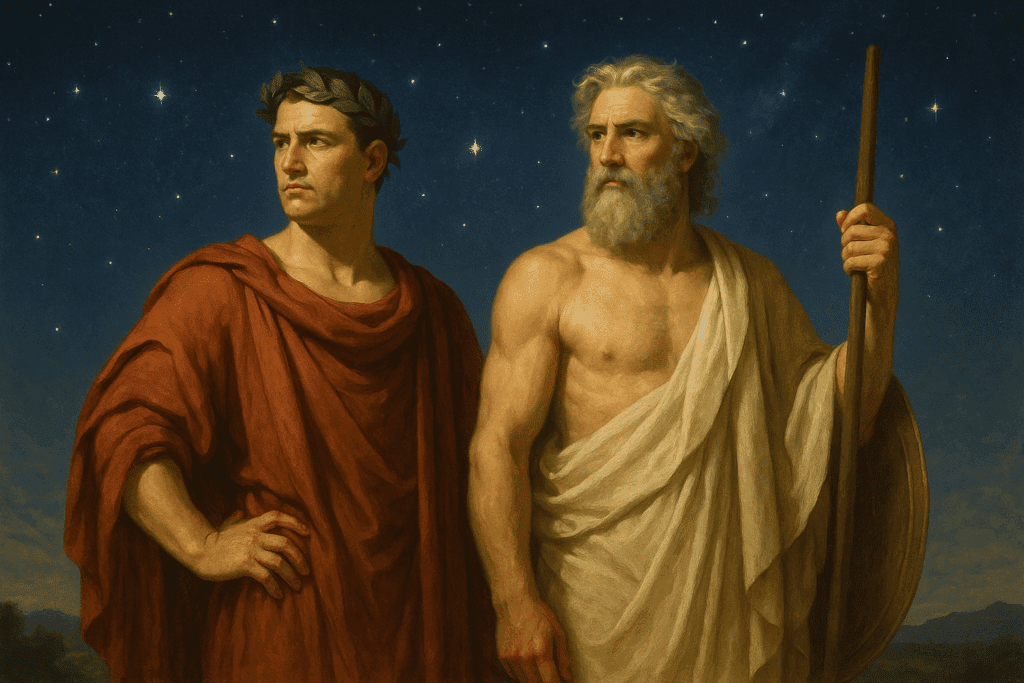
A Gallic war god became Mars. A Germanic sky deity became Jupiter. A Carthaginian goddess became Juno or Venus depending on her attributes. The foreign god was not rejected, not suppressed, not required to prove itself — it was simply recognized and incorporated, its alien name replaced with a Latin one that expressed what the Romans understood its nature to be.
This was interpretatio romana — the Roman reading of the divine — and it was one of the most powerful tools of cultural absorption in the ancient world. But with Greek religion, the process was both more thoroughgoing and more complicated than with any other culture Rome encountered. Greek mythology was not simply absorbed through identification of functional equivalents. It was absorbed wholesale, translated, adapted, and used to fill a gap in the Roman mythological tradition that the Romans themselves recognized and explicitly chose to address.
Why Greek Religion Was Different
The interpretatio romana process worked cleanly when a foreign god had a straightforward functional equivalent in Roman religion. Mars and the Germanic Tiw were both war gods: the identification was simple. But the Greeks had an entire sophisticated theological and mythological tradition — cosmological narratives, divine genealogies, hero cycles, philosophical elaborations of divine nature — that was not simply a set of functionally equivalent gods but a complete and richly developed system of meaning.
Roman religion, in its original form, was not narrative-rich in the same way. The early Roman divine world was populated by numina — divine powers associated with specific functions and locations — rather than by gods with personalities, genealogies, love affairs, rivalries, and the rich biographical mythology that made the Greek tradition what it was. Jupiter was the sky god. Janus was the god of beginnings. Mars was the god of war and agriculture. They had cults, ritual requirements, and civic functions — but they did not have the stories that the Greek Zeus, the Greek Hermes, and the Greek Ares had.
When Romans encountered Greek religion — primarily through contact with the Greek colonies of Magna Graecia in southern Italy, beginning seriously in the fourth and third centuries BCE — they were not encountering functional equivalents of gods they already had. They were encountering a narrative richness, a mythological depth, and a philosophical elaboration that their own tradition lacked. The absorption of Greek religion was therefore not simply the recognition of familiar gods under foreign names. It was the adoption of an entire cultural framework that Rome had not previously possessed.
The Mechanism: How the Absorption Actually Happened
The absorption of Greek religion into Roman practice occurred through several specific and historically documented channels, each of which worked differently.
The most politically significant was the Sibylline Books — the collection of oracular verses attributed to the Cumaean Sibyl that the Roman Senate consulted in moments of national crisis. When Rome faced catastrophe — military defeat, plague, famine, the Hannibalic invasion — the Senate voted to consult the Books. The Books, written in Greek and requiring Greek interpretation, consistently recommended the introduction of Greek religious practices: new temples, new festivals, new cults drawn from the Greek tradition. It was through the Sibylline Books that the cult of Apollo entered Rome in 431 BCE during a plague. It was through them that Cybele, the Great Mother, was brought from Phrygia to Rome in 204 BCE during the Second Punic War. The Books were the institutional mechanism through which the Roman state officially authorized the reception of foreign religious practices.
The lectisternium — a ceremony in which the images of the gods were arranged on couches and offered a ritual banquet — was introduced to Rome in 399 BCE on the authority of the Sibylline Books and brought specifically Greek gods into Rome’s official religious calendar. The first lectisternium honored Apollo, Latona, Diana, Hercules, Mercury, and Neptune — six gods, all identifiable with Greek deities, arranged in pairs on three couches, receiving divine hospitality in a specifically Greek ceremonial form. This was Rome’s state formally incorporating a Greek ritual, performed for Greek-identified gods, at a moment of crisis.
The second channel was the Greek colonies of Magna Graecia — the cities of southern Italy and Sicily where Greek culture had been established for centuries before Rome conquered them. These colonies had temples, religious festivals, artistic traditions, and philosophical schools. As Rome absorbed them politically, it absorbed their religious culture simultaneously. The southern Italian Greek communities were not peripheral to Roman culture: they were the conduit through which the most sophisticated aspects of Greek civilization — including its mythological tradition — entered the Roman world.
The third channel was individual Romans — educated men of the senatorial class who learned Greek, read Greek literature, hired Greek tutors, traveled to Greece, and brought back not just philosophical ideas but a deep familiarity with the Greek mythological tradition. By the second century BCE, the Roman elite was substantially bilingual, and the cultural prestige of Greek learning was enormous. For a Roman aristocrat of this period, being ignorant of Greek mythology was roughly equivalent to a modern educated person being ignorant of the Bible or Shakespeare — it was a cultural baseline that educated discourse assumed.
The Specific Identifications and Their Complications
When Rome formally identified its gods with Greek equivalents, the process was rarely as clean as the textbook lists suggest. The identifications involved specific choices about which aspects of each god to emphasize, and those choices reflected Roman values and priorities rather than purely functional equivalence.
Jupiter and Zeus were identified early and deeply, but the Roman Jupiter carried a civic and legal weight that Zeus did not. Zeus was capricious, lustful, and frequently subject to the kind of divine soap opera that the Iliad depicted. Jupiter, while sharing these characteristics in the myths Rome imported from Greece, was primarily the guarantor of Roman law, the protector of oaths, and the divine legitimator of Roman political authority. The Roman Jupiter Optimus Maximus — Jupiter the Best and Greatest — whose temple dominated the Capitoline Hill and who received the offerings of victorious generals — was a god of civic authority in a way that Zeus never quite was.
Venus and Aphrodite illustrate the identification’s political dimension most clearly. Aphrodite was the goddess of erotic love and beauty, frequently characterized in Greek literature as a troublemaker whose desire-causing powers created the conditions for tragedy. Venus inherited all of this, but the Roman tradition added something Aphrodite entirely lacked: the status of divine ancestress of the Roman people through Aeneas and specifically of the Julian family through Julius Caesar and Augustus. The Venus Genetrix — Venus the Mother — whose temple Julius Caesar built in his forum was not simply Aphrodite renamed. She was a specifically Roman divine figure whose mythological role in Virgil’s Aeneid made her the divine origin of Rome’s entire imperial destiny.
Mercury and Hermes were identified functionally and their mythological characteristics mapped neatly — both were swift messengers, both governed commerce and boundaries, both had wings and a distinctive staff. But Mercury was given a specifically Roman commercial emphasis that Hermes, who was also a god of thieves and a guide of souls, had in more complex combination. The Roman Mercury who appeared on coins and in the imagery of commerce was the patron of the merchant class and the protector of fair exchange, his caduceus the symbol of protected commercial passage.
The most complicated identifications were those where the functional equivalence was partial or the characters were too different to map cleanly. Ares and Mars is the clearest example — a case we have treated in its own article — where the identification was universally accepted but the two gods were genuinely different in character and civic function. Hephaestus and Vulcan presented similar complications: both were smithing gods, but Vulcan was a dangerous, potentially destructive fire deity in early Roman religion, associated with the Volcanalia festival and propitiated to prevent city fires, while Hephaestus was the craftsman god whose Homeric characterization as a lame, cuckolded husband was more comic than threatening.
What Rome Did Not Take: The Survivals
The interpretatio romana process did not result in the complete replacement of Roman religion by Greek mythology. Significant and distinctly Roman elements survived the absorption of Greek influence and remained the unassimilable core of Roman religious identity.
Janus had no Greek equivalent. He was one of the oldest Roman deities — perhaps the oldest — whose two-faced iconography and governance of beginnings, thresholds, and transitions expressed something about the Roman relationship with time and passage that the Greek tradition had no parallel for. When the Romans tried to provide him with a mythological biography on the Greek model, the results were awkward and unconvincing. He remained stubbornly himself.
The Lares and Penates — the household guardian spirits and the protectors of stored provisions — were genuinely Roman in character. The Greek tradition had household religion, but it was organized differently. The Roman lararium and the daily rituals of the domestic cult were without Greek equivalent, and they persisted throughout the period of Greek influence as the most intimate expression of specifically Roman religious practice.
The Flamen Dialis — the priest of Jupiter whose life was governed by the extraordinary network of taboos we described in the priests article — preserved a layer of archaic Roman religious practice so ancient that it predated Greek influence entirely. The taboos against touching iron, against seeing an army, against taking oaths — these were the remnants of a pre-Greek Roman religion whose character had been substantially transformed by the Greek absorption but whose most ancient institutional expressions remained intact.
The suovetaurilia — the triple sacrifice of pig, sheep, and bull — was a specifically Roman ritual form with no Greek equivalent that persisted as the most solemn form of Roman sacrifice throughout the period of Greek influence and beyond. Its use at the census lustration, at military purifications, and at agricultural ceremonies connected it to the oldest layers of Italian religious practice in a way that the Greek influence never touched.
Syncretism as Imperial Policy
The interpretatio romana process that began with Greek religion was extended systematically throughout the Roman Empire as Rome’s territorial expansion brought it into contact with the divine traditions of Gaul, Britain, Germany, Spain, North Africa, Syria, and Egypt.
The consistent pattern was the same: local deities were identified with Roman equivalents, given Roman names alongside their native ones, and incorporated into the Roman religious system as local manifestations of universal divine powers. A Gallic healing deity became Apollo Grannus. A British warrior god became Mars Cocidius. A Germanic tribal deity became Mercury or Hercules depending on his character. The interpretatio romana was simultaneously a theological claim — all gods were aspects of the same universal divine powers — and a political tool — giving local populations a version of their own gods embedded in the Roman system encouraged loyalty and integration without requiring the abandonment of local identity.
The most sophisticated expression of this imperial syncretism was the cult of Sol Invictus — the Unconquered Sun — which the emperor Aurelian established as the supreme deity of the Roman state in 274 CE. Sol Invictus was not simply a Roman god. He was a synthesis that drew on Mithraic solar theology from Persia, Egyptian solar religion, Greek Apollo, and Roman military solar cult into a single imperial divine figure who could be genuinely honored by subjects from every province of the empire. The interpretatio romana operating at imperial scale, producing a god who was everyone’s sun god simultaneously.
Why Rome Was Better at This Than Anyone Else
The Roman capacity for religious syncretism was not accidental or simply pragmatic. It reflected a genuinely sophisticated theological conviction — that the divine powers were universal, that the same underlying realities organized the cosmos everywhere, and that different peoples had simply arrived at different cultural expressions of the same fundamental truths.
This conviction made Roman polytheism fundamentally inclusive rather than competitive. Roman religion did not claim that its gods were the only real gods or that the gods of other peoples were false. It claimed that its gods and the gods of other peoples were the same gods — the same divine powers recognized under different names. The interpretatio romana was therefore not cultural imperialism in the religious sphere but a genuine, if sometimes awkward, attempt to recognize divine reality across cultural differences.
This is what made the Roman encounter with monotheism — first Jewish and then Christian — so genuinely difficult. Judaism and Christianity made exclusive claims that the interpretatio romana could not accommodate. You could not identify the God of Israel with Jupiter and expect either party to accept the identification. The God of Israel was not Jupiter with a Hebrew name. He was a fundamentally different kind of divine claim, one that excluded the very inclusivity that made Roman syncretism work. The Roman persecution of Christians was, among other things, the failure of the most effective religious absorption mechanism the ancient world had produced to cope with a religion that refused to be absorbed.
Conclusion
The Roman absorption of Greek religion was the most consequential religious syncretism in Western history. It took the narrative richness, the mythological depth, and the philosophical elaboration of Greek religious tradition and gave it Latin names, Roman civic application, and the imperial machinery of the world’s most powerful state. The result was a tradition that preserved Greek mythology while transforming its meaning — that kept the stories of the gods while redirecting their significance toward Roman identity, Roman political legitimacy, and Roman understanding of the cosmic order.
The myths we know — Zeus and Hera, Apollo and Daphne, Aphrodite and Ares — we know primarily through Roman transmission. Ovid, Virgil, and their contemporaries preserved and popularized the Greek mythological tradition in Latin forms that survived when much of the original Greek was lost or obscured. Western civilization’s inheritance of classical mythology is, to a remarkable degree, a Roman inheritance — the Greek tradition absorbed, adapted, and transmitted by the civilization that found in it the narrative depth it had always needed.
Share This Page
Cite This Page
MLA
Editors of RomanMythology.com. "How Rome Absorbed Greek Religion: The Process of Syncretism." RomanMythology.com, 2025, https://www.romanmythology.com/comparative-mythology/roman-vs-greek-syncretism/. Accessed June 3, 2026.
APA
Editors of RomanMythology.com. (2025). How Rome Absorbed Greek Religion: The Process of Syncretism. RomanMythology.com. Retrieved June 3, 2026, from https://www.romanmythology.com/comparative-mythology/roman-vs-greek-syncretism/