Niobe had everything a mortal could reasonably want: a kingdom, a royal husband, and fourteen healthy children. Her mistake was saying so out loud, in front of the wrong listener.
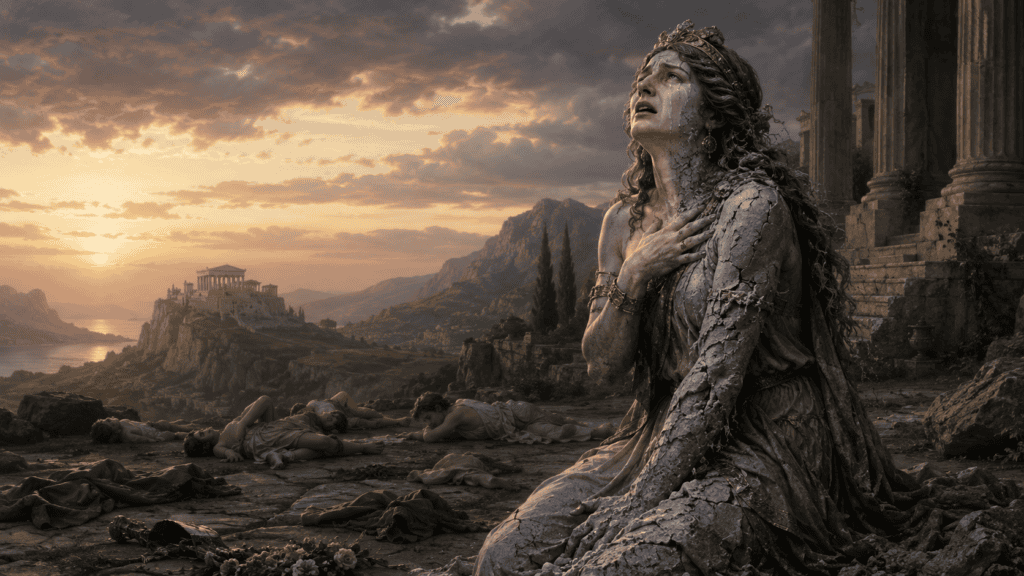
By the end of a single afternoon, every one of those children was dead, her husband had taken his own life, and Niobe herself had been turned to weeping stone. Few myths punish a careless word so totally, or so cruelly.
The Queen of Thebes
Niobe (NY-oh-bee) was the queen of Thebes, and by any mortal measure she had been favored beyond reason. Her father was Tantalus, who had once dined with the gods, and her husband was Amphion (am-FY-on), whose music was said to have charmed the very stones into building the city’s walls.
She had wealth, royal blood, a great city, and a famous name. Above all of it, she had her children: seven strong sons and seven beautiful daughters, the pride and the center of her life.
It was a life with no obvious wound in it, and that may have been the danger. Niobe had never learned what it was to lose, and so she had never learned to be careful.
The Boast
The women of Thebes had gathered to honor the goddess Latona (luh-TOH-nuh) and her two divine children, the twin gods Apollo and Diana. They wore laurel in their hair and burned incense at her altars, and into this rite Niobe came striding in her royal robes to interrupt it.
Why worship a goddess no one has ever seen, she demanded, when a queen of proven greatness stands before you in the flesh? She listed her advantages aloud, her ancestry, her husband, her kingdom, and most of all her fourteen children, and she mocked Latona for having managed to bear only two.
Even if some misfortune struck her, she said, she would still be left with far more children than the goddess had ever had. Then she ordered the women to take the laurel from their hair and abandon the rite. It was not enough for Niobe to feel superior to a goddess; she had to say it in front of the goddess’s worshippers and stop their prayers.
Latona’s Appeal
On her mountain, Latona heard every word, and she turned to her son and daughter in cold anger. She did not beg, and she did not need to ask twice.
Apollo and Diana were the two great archers of the heavens, and they answered their mother at once. Wrapped in cloud, they came gliding down toward Thebes with their bows already in hand, and the city had no idea what was descending on it.
The Death of the Sons
Niobe’s seven sons were out on the plain beyond the walls, riding their horses and wrestling in the way of young princes. Apollo began with them, and his arrows fell one after another without mercy.
One boy slid dying from his horse; two brothers locked together in a wrestler’s grip were pierced through by a single shaft and fell as one. The youngest, seeing his brothers drop around him, lifted his hands and cried out for pity to whatever god was doing this, and the arrow took him in the throat as he prayed.
Word of the slaughter reached the city before the bodies did. When Amphion learned that all seven of his sons were dead, he drove a blade into his own breast rather than live in a world so suddenly emptied.
The Death of the Daughters
Even now Niobe would not bow. Standing over the biers of her sons, her hair wild and her face streaked, she still found the breath to boast: ruined as she was, she said, she had more children left than Latona had ever borne, and so she remained the greater mother.
The words were barely spoken when Diana’s bowstring sang, and the daughters began to fall. One dropped beside her dead brothers, one trying to flee, one trying to hide, until only the youngest girl was left.
Niobe threw her whole body over the last child and begged the gods, who had taken thirteen, to leave her just this one. The arrow found the girl anyway, in her mother’s arms. There would be no mercy and no exception.
Turned to Stone
Childless and widowed within the space of an afternoon, Niobe sat down among her dead and did not rise. She did not weep loudly or tear her clothes; she simply stopped, emptied of everything, including the will to move.
Grief hardened her where she sat. Her tongue froze to the roof of her mouth, her blood ran cold and still, her neck would no longer turn, and slowly, from within, she changed entirely to marble.
A whirlwind lifted the stone figure and carried it across the sea to her old homeland, where it was set upon a peak of Mount Sipylus (SIP-ih-lus). There the statue stands to this day, and water still seeps down the cold rock face, as though the stone itself has never stopped weeping.
The Sister Story to Arachne
Ovid sets Niobe directly after the tale of Arachne, and the placement is deliberate. Both are mortals destroyed for claiming to stand level with the gods, Arachne through the matchless skill of her art and Niobe through the abundance of her children, and read together they form a single sustained meditation on the gulf between heaven and earth.
Yet Niobe’s story is the colder of the two. Arachne, at least, suffered for her own gifts and her own words alone, while Niobe’s punishment falls first and most heavily on fourteen innocent children, who die for nothing but their mother’s tongue.
That is what makes the myth so hard to read as a simple lesson. The crime is pride, but the price is paid almost entirely by those who never committed it, and the gods who collect it show no flicker of restraint.
The Weeping Rock
The strangest thing about the myth is that the rock is real. On Mount Sipylus, in what is now western Turkey, there is a weathered limestone formation that from a distance resembles the face of a grieving woman, and it appears to weep as rainwater and snowmelt trickle from its porous stone.
Ancient travelers knew this formation as Niobe and pointed it out as the queen herself, frozen forever in her sorrow. The myth, in other words, grew up around a feature of the landscape that genuinely seems to cry, an explanation for a stone that would not stop shedding water.
From there Niobe became the enduring archetype of inconsolable grief. Shakespeare’s Hamlet compares his weeping mother to her, “like Niobe, all tears,” and later writers called a fallen, mourning city a “Niobe of nations.” The image of a mother turned to stone in the act of weeping has never lost its force.
Final Take: Niobe
Niobe survives as a warning against pride, the queen who thought her blessings made her the equal of a goddess and lost them all in an afternoon. The lesson is there, and the ancient world took it seriously.
But the deeper power of the myth lies in its sheer disproportion. A few arrogant words bring down fourteen children, a husband, and a queen, and the gods who answer the insult do not stop until there is nothing left of the household to punish.
The weeping rock is the right place to end. It is not a monument to Niobe’s pride but to her grief, a stone that goes on shedding water long after the boast that caused it has been forgotten, the oldest image we have of a sorrow too great for the body that holds it.
Share This Page
Cite This Page
MLA
Editors of RomanMythology.com. "Niobe: The Mother Turned to Stone by Grief." RomanMythology.com, 2026, https://www.romanmythology.com/roman-myths/niobe/. Accessed June 4, 2026.
APA
Editors of RomanMythology.com. (2026). Niobe: The Mother Turned to Stone by Grief. RomanMythology.com. Retrieved June 4, 2026, from https://www.romanmythology.com/roman-myths/niobe/