Amulius had planned carefully. He had overthrown his brother Numitor, king of Alba Longa, seized the throne, killed Numitor’s sons to prevent future challenge, and forced Numitor’s daughter Rhea Silvia into the Vestal order — the one institution in Rome whose obligations guaranteed that she could produce no heirs. A Vestal who broke her vow of chastity faced death. Amulius believed he had secured his position permanently.
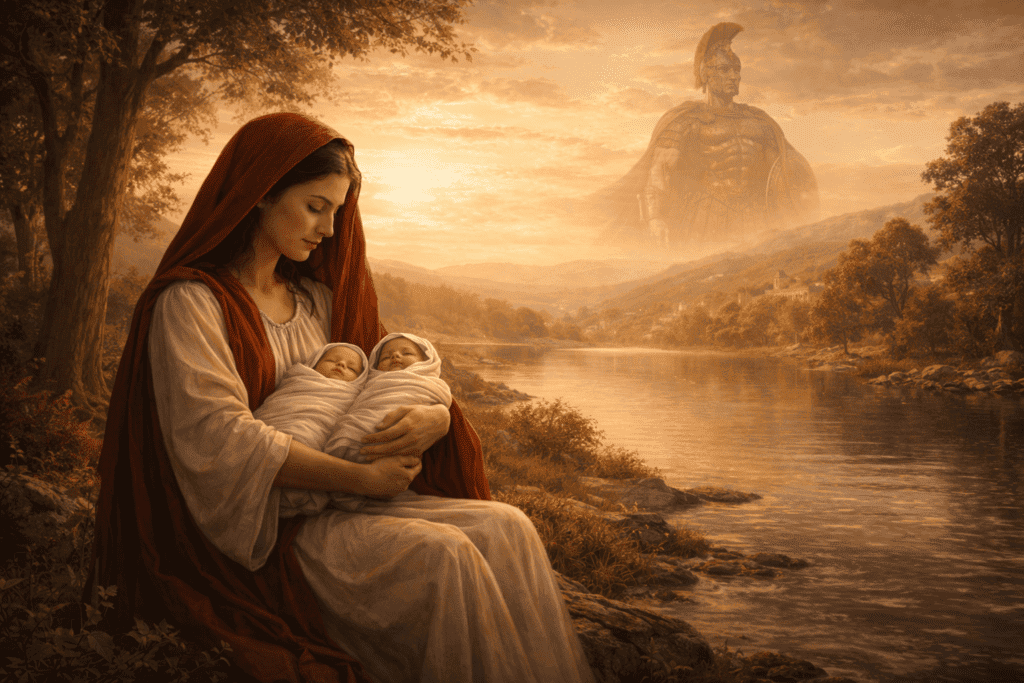
He had not reckoned with Mars.
The union of Mars and Rhea Silvia was the founding theological act of Roman civilization — the moment when the divine force of war and protection entered the human bloodline that would produce Romulus, the city’s founder. What Amulius had designed as a permanent political solution became the origin of the very power he had tried to extinguish. Rome did not begin with ordinary politics or ordinary genealogy. It began with a god descending to a Vestal and producing the man who would build the walls.
Rhea Silvia: Who She Was
Rhea Silvia — also called Ilia in some traditions, names that may have represented distinct traditions that were later merged — was a princess of the Latin city of Alba Longa, the settlement that Aeneas’s son Ascanius had founded and from which Rome would eventually emerge. She was the daughter of Numitor, the legitimate king of the Alban dynasty that traced its descent from Aeneas and therefore from Venus.
The political situation that preceded her story was the dynastic crisis of Alba Longa. Numitor and his brother Amulius had been joint heirs to the Alban throne, but the succession had gone to Numitor. Amulius, unable to accept this, had seized power by force — overthrowing his brother, killing Numitor’s sons to prevent their eventual challenge, and then addressing the remaining threat in Numitor’s daughter with the strategy that defined his character: institutional containment rather than outright murder.
By forcing Rhea Silvia into the Vestal order, Amulius achieved several things simultaneously. He removed her from the marriage market where she might have produced a husband whose children would carry a legitimate dynastic claim. He placed her under the most severe chastity obligation in Roman religious law, where violation was punishable by death. And he gave the arrangement a religious legitimacy that simple imprisonment or execution would not have had — Rhea Silvia was not a prisoner but a priestess, her removal from dynastic life not a political act but a religious one.
The strategy was sophisticated and it almost worked. What it could not account for was that the gods had their own plans for Numitor’s bloodline.
The Encounter: How Ancient Sources Told It
The specific circumstances of the union between Mars and Rhea Silvia were told differently by different ancient sources, and the variations are themselves revealing about what each tradition was emphasizing.
Livy, writing in the first century BCE in his monumental history of Rome, presented the encounter with characteristic Roman restraint. He stated simply that Rhea Silvia was violated — vi compressa — and that she attributed the twins’ paternity to Mars. Livy neither confirmed nor denied the divine paternity, noting that the attribution might be genuine or might be a face-saving claim by a Vestal who needed a divine excuse for an inexplicable pregnancy. The ambiguity was deliberate: Livy was a historian writing for a sophisticated audience that understood the difference between religious tradition and historical fact, and he preserved the tradition while leaving its literal truth open.
Dionysius of Halicarnassus, a Greek historian writing in Rome in the same period and providing the most detailed account of Rome’s early history in Greek, was more willing to treat the divine paternity as a genuine mythological claim. In his account, Mars appeared to Rhea Silvia while she was carrying water for a sacred ceremony in his grove — the specific detail of the Martian grove was important, locating the encounter in a space already sacred to the god, where his presence would have been understood as appropriate and his action as constitutive of something sacred rather than transgressive.
Plutarch, writing his Life of Romulus in the second century CE, preserved another tradition: that Rhea Silvia encountered a figure of extraordinary beauty in the grove, that she later told her companions she had lain with a man of divine appearance, and that afterward a wolf and a woodpecker — both animals sacred to Mars — had appeared and guarded her during the encounter. The specific animals were theologically significant. The wolf was Mars’s sacred animal, connected to his aggressive protective power. The woodpecker was the bird most closely associated with Mars in the oldest Italian religious tradition, credited with prophetic powers and divine guidance. Their presence authenticated the divine character of what had happened.
Rhea Silvia’s Punishment
The pregnancy was impossible to conceal, and the discovery was catastrophic. A Vestal Virgin who broke her vow of chastity had committed the most serious religious offense in Roman law — not merely a personal failing but a cosmic disruption, since the Vestals’ purity was understood as a condition of Rome’s (or in this case, Alba Longa’s) divine protection. The conventional punishment was burial alive — the Vestal who had committed unchastity was interred in a sealed chamber with minimal food and water, her death accomplished without the pollution of direct execution.
Amulius imprisoned Rhea Silvia. The specific form of her punishment varied in ancient accounts: some said she was imprisoned and eventually killed; others preserved a tradition that Romulus later rescued his mother and restored her to Numitor’s care when he overthrew Amulius. The most poetic version — that she was thrown into the Tiber and became a river goddess, married to the river god Tiber — expressed her transformation from human victim to divine figure, the punishment becoming apotheosis.
What all accounts agreed on was the central paradox: the pregnancy that should have resulted in Rhea Silvia’s death was the same pregnancy that would produce the founder of the greatest city in the world. Amulius’s most effective political measure had been turned against him by the divine force he had not considered.
The Twins’ Exposure
When Romulus and Remus were born, Amulius ordered them killed. The specific method of their intended death — exposure rather than direct execution — was both practically motivated and theologically meaningful.
Exposure of unwanted infants was a practice the ancient world recognized and debated: leaving an infant to die removed the direct guilt of killing while achieving the same practical result. For Amulius, it had the additional advantage of not requiring him to directly shed the blood of divine offspring — if the twins were truly Mars’s sons, direct violence against them carried theological risks that exposure, leaving their fate to the gods and the elements, did not.
The servants charged with exposing the twins were apparently unwilling to carry out a direct killing and chose instead to place them in a basket and set them in the flooding Tiber — a method that technically fulfilled Amulius’s order while giving the infants a chance that outright execution would not have provided. Whether this was mercy, superstition about the divine paternity, or simply a convenient interpretation of their orders, the result was that Romulus and Remus floated rather than drowned.
The She-Wolf and the Lupercal
The basket came to rest at the foot of the Palatine Hill, near a fig tree called the Ficus Ruminalis, at the edge of the cave called the Lupercal. Here the most famous image of Roman mythology was enacted: the she-wolf who came to the crying infants, nursed them, and saved their lives.
The she-wolf was not a random animal in this context. She was Mars’s creature — the wolf was sacred to the god of war in the most ancient Italian tradition, associated with his aggressive, protective, boundary-marking power. A she-wolf nursing the sons of Mars expressed a specific theological logic: the divine force that had fathered the twins now provided them their first sustenance through his sacred animal, the god’s paternity confirmed and continued through the natural world he governed.
The Lupercal — the cave of the wolf — retained its sacred status in Roman religious life throughout the Republic and Empire. The Lupercalia festival, one of Rome’s oldest and most ancient ceremonies, was performed each February at the Lupercal cave, where priests called the Luperci sacrificed goats and a dog, smeared their foreheads with the sacrificial blood, and then ran through the city’s streets striking women with thongs cut from the sacrificed animals. The ritual’s connection to Mars through the she-wolf and the cave was understood even in antiquity as evidence of the myth’s historical depth — the cave had been sacred since before the founding, and the festival preserved the memory of what had happened there.
Augustus, who used the founding mythology of Rome extensively in his political program, had the Lupercal identified and honored as one of Rome’s most ancient sacred sites. When excavations in 2007 discovered a decorated cave beneath the Palatine Hill that some archaeologists identified with the Lupercal, the find generated extraordinary international attention — evidence of how deeply the myth of Mars, Rhea Silvia, and the she-wolf had remained embedded in Western cultural memory.
The Woodpecker’s Role
Alongside the she-wolf, ancient accounts mentioned a woodpecker — the picus — bringing food to the twins during their time in the Lupercal.
The woodpecker was the bird most specifically sacred to Mars in the old Italian religious tradition, with a significance that predated Roman religion’s Greek absorption. The picus was associated with prophetic knowledge and divine guidance, credited with the ability to signal Mars’s presence and will through its behavior. The woodpecker appearing to bring food to Mars’s sons expressed the same logic as the she-wolf’s nursing: the divine father’s sacred animals sustained the children his human enemy had tried to destroy.
Picus was also the name of an ancient Italian king who was eventually transformed into a woodpecker in mythological tradition — the king whose lineage ran parallel to the Latin royal lines and who had been associated with Mars from the earliest period of Italian religion. The woodpecker’s role in the founding myth connected Rome’s origin story to the deepest layer of pre-Roman Italic religion, where Mars and the picus were both ancient protective forces of the agricultural community.
What the Myth Expressed
The myth of Mars and Rhea Silvia was not simply a story about divine paternity or miraculous survival. It was Rome’s answer to the most fundamental question any civilization faces: where did we come from, and why does our existence matter?
The answer encoded in the myth was specific and deliberate. Rome did not emerge from ordinary political history — from one tribe defeating another, one king supplanting another through human power alone. It emerged from the intervention of the god of war in the human bloodline at the moment when ordinary human power had done everything it could to prevent the founding. Amulius had played his hand perfectly by purely human standards: he had controlled the succession, eliminated the male heirs, and institutionally contained the female heir. It was not enough. The god entered the situation and made Rome possible anyway.
This framing gave Roman civilization a theological warranty that went beyond the normal claims of royal dynasties. The Romans were not simply the descendants of capable rulers. They were the descendants of Mars, the god whose force and protective power had made their city possible when every human obstacle was in the way. Their military effectiveness, their civic discipline, their capacity to survive and expand — all of it was grounded in this divine origin, the god of war’s entrance into history at the moment Rome needed him most.
Conclusion
The story of Mars and Rhea Silvia was the story Rome told about itself at its most fundamental level. It explained why Rome was not simply another Italian city but a divinely originated civilization — the product of a god’s intervention in human history, the fulfillment of a purpose that Amulius’s very opposition had helped to define.
Rhea Silvia’s forced entry into the Vestal order, the divine encounter in the Martian grove, the twins’ exposure and rescue by Mars’s sacred animals, the Lupercal cave that remained sacred for centuries afterward — each element was not simply narrative detail but theological argument, expressing the Roman conviction that the force of war and protection had been present at their city’s origin and remained present in everything the city subsequently became.
Share This Page
Cite This Page
MLA
Editors of RomanMythology.com. "Mars and Rhea Silvia: The Divine Union That Founded Rome." RomanMythology.com, 2026, https://www.romanmythology.com/roman-myths/mars-and-rhea-silvia/. Accessed June 14, 2026.
APA
Editors of RomanMythology.com. (2026). Mars and Rhea Silvia: The Divine Union That Founded Rome. RomanMythology.com. Retrieved June 14, 2026, from https://www.romanmythology.com/roman-myths/mars-and-rhea-silvia/