QUICK SUMMARY
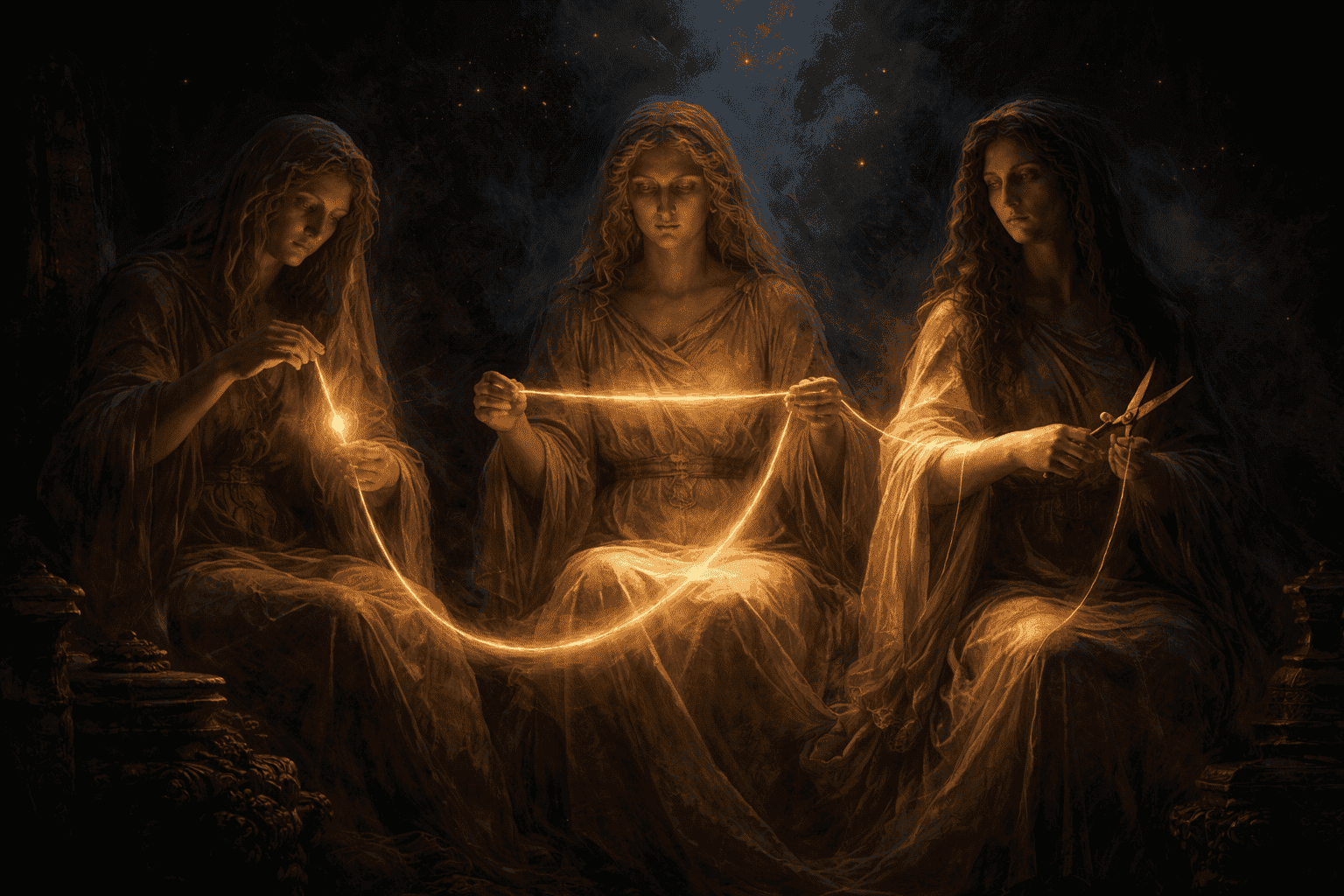
The Parcae (PAR-see or PAR-kye), known as the Fates in Roman mythology, were three powerful goddesses who controlled the thread of every human life. From birth to death, they determined destiny itself, representing a force that even the gods could not fully escape.
Who Were the Fates in Roman Mythology?
In Roman mythology, the Fates were known as the Parcae, three goddesses who governed the life and destiny of every mortal. Their power extended beyond individual lives, shaping events, outcomes, and the structure of time itself.
They were not gods of war, love, or the sky. They were something more fundamental. They represented inevitability.
Where other gods influenced events, the Parcae defined them. Their presence suggests that beneath divine action lies a deeper structure that cannot be altered, only fulfilled.
The Three Parcae and Their Roles
The Parcae were typically described as three sisters, each responsible for a specific stage of life. Together, they formed a complete system governing existence from beginning to end.
Nona: The Spinner of Life
Nona was responsible for spinning the thread of life at the moment of birth. Her role marks the beginning of existence, where fate first takes form.
She represents origin, but also limitation. The thread she spins is not infinite. It is already shaped by what will follow.
Decima: The Measurer of Destiny
Decima measured the length of the thread, determining how long a life would last and how it would unfold. Her role introduces structure and proportion.
Life, in this sense, is not random. It has a defined length and pattern.
Morta: The Cutter of the Thread
Morta brought life to its end by cutting the thread. Her act is final and irreversible.
She represents the certainty of death, not as chaos, but as completion. The thread is not broken. It is finished.
Fate as a Force Beyond the Gods
One of the most striking aspects of the Parcae is their relationship to the other gods. In many interpretations, even powerful deities like Jupiter do not fully control fate.
This does not mean the gods are powerless. They act, influence, and intervene. But their actions often unfold within boundaries that fate has already set.
The existence of the Parcae suggests that Roman mythology recognizes a deeper order beneath divine authority. Even kings of the gods operate within a structure they did not create.
This idea reinforces one of the central Roman beliefs: that the universe is governed by order, not chaos.
The Symbol of the Thread
The image of the thread is one of the most powerful symbols in Roman mythology.
It represents:
- The beginning of life
- The measured span of existence
- The inevitability of death
Unlike a story that can be rewritten, a thread once spun can only move forward toward its end. It cannot be undone.
This symbolism reflects a worldview where time is linear, structured, and irreversible.
The Parcae and Human Life
For the Romans, the idea of fate was not abstract. It shaped how people understood success, failure, suffering, and death.
If life is governed by the Parcae, then:
- Some events are unavoidable
- Effort matters, but within limits
- Outcomes may be shaped, but not completely controlled
This does not lead to passivity. Instead, it reinforces the importance of discipline and acceptance. One does not resist fate. One fulfills it.
Fate, Duty, and Roman Identity
The concept of fate is closely tied to Roman ideas of duty, especially the value known as pietas. This idea emphasizes loyalty to family, gods, and state.
Figures like Aeneas embody this principle. He does not choose the easiest path. He follows the path that fate requires, even when it demands sacrifice.
In this way, the Parcae are not just distant mythological figures. They are part of a larger system that defines what it means to live correctly.
To accept fate is not weakness. It is alignment with the structure of the world.
The Parcae and Greek Influence
The Roman Parcae are closely related to the Greek Moirai, the Fates of Greek mythology. Like their Greek counterparts, they spin, measure, and cut the thread of life.
However, in Roman thought, the emphasis often shifts slightly toward order and structure rather than dramatic conflict. The Parcae fit naturally into a system where hierarchy, function, and balance are central.
This reflects the broader Roman tendency to adapt Greek myth while reshaping it to reflect Roman values.
Why the Fates Still Matter
The idea of the Fates continues to resonate because it speaks to a question that has never gone away: how much control do we really have?
Roman mythology does not give a comforting answer. It suggests that control is limited, that structure exists, and that not everything can be changed.
At the same time, it offers a form of clarity. If life is structured, then meaning can be found not in resisting that structure, but in understanding and fulfilling one’s place within it.
Final Thoughts
The Parcae stand at the center of one of the most powerful ideas in Roman mythology: that life is not random, and that even the gods exist within a larger order.
They do not command armies or rule kingdoms, yet their power is more absolute than most deities. They define beginnings, measure existence, and determine endings.
In doing so, they remind us that the Roman world was not built only on strength or ambition, but on the belief that everything unfolds according to a pattern that cannot be escaped.