


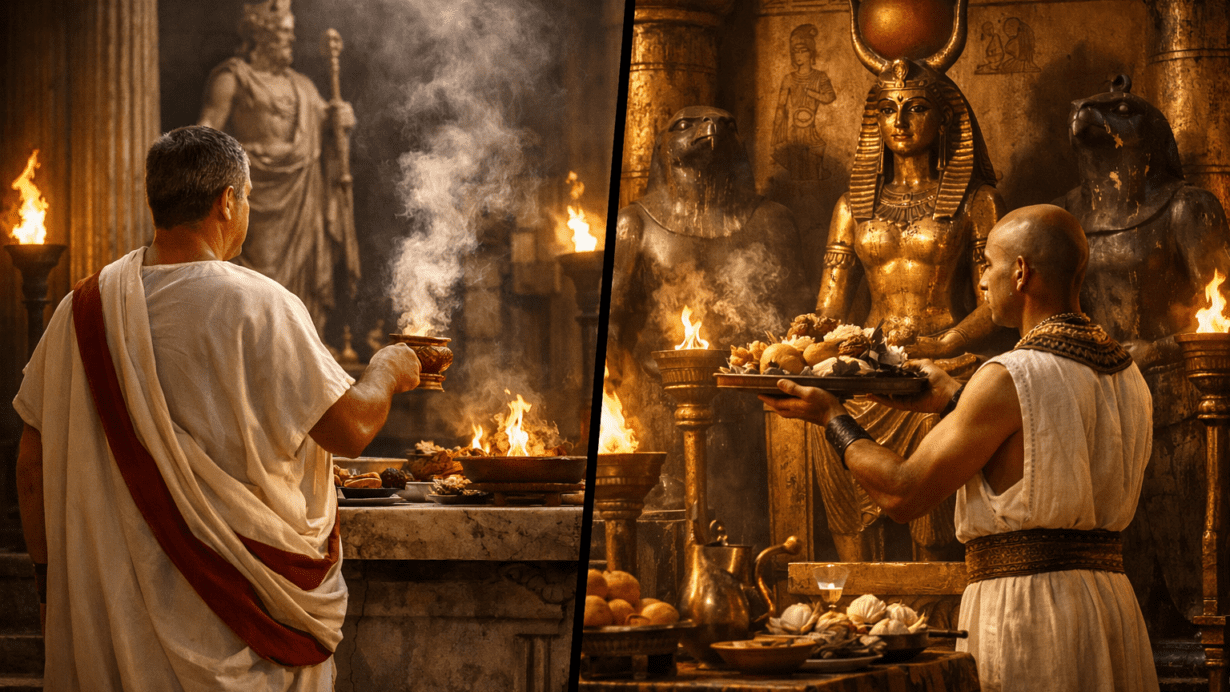

Empires do not run on laws and legions alone. They run on the idea that the universe is listening, that order can be maintained, and that someone in charge knows the correct way to ask the gods for continued cooperation.
Rome and Egypt both built ritual systems so regular, so public (in Rome’s case), and so integrated into daily life that religion became infrastructure. Yet the two cultures did not perform ritual for the same reasons, in the same way, or even with the same definition of what “success” looked like.
At the risk of oversimplifying two civilizations that never asked to be compared in one article: Roman ritual tended to be transactional and civic, while Egyptian ritual tended to be cosmic and devotional. Both were practical. Both were political. Both were deeply invested in doing things correctly. But they were “correct” in different ways.
What Romans and Egyptians Thought Ritual Was For
Ritual only makes sense once you understand what a culture believes it accomplishes. Rome and Egypt agreed it mattered. They disagreed on what was at stake.
Rome: Keeping the Pact With the Gods
Roman ritual often looks like a sacred contract: we offer X, so you grant Y. It is not that Romans lacked feeling or belief. It is that they built religion to support a society that prized stability, hierarchy, and public order.
A rite performed correctly strengthened the community because it reassured everyone that Rome remained in good standing with the divine. If something went wrong, the risk was not just personal. It could be civic, military, and political.
Egypt: Maintaining the Universe Itself
Egyptian ritual was built around the idea of cosmic balance and rightness, often captured by ma’at. Ritual did not merely ask for favors. It helped keep reality aligned.
The gods were not simply powerful beings who might assist you. They were sustaining forces of creation, and temple ritual was daily labor that maintained that creation. If rites failed, chaos could creep in. If rites held, the world stayed workable.
Sacred Space: Where Ritual Happened
Where a culture places ritual tells you what it wants from it: public agreement, private precision, or both.
Roman Temples: Public, Visible, Civic
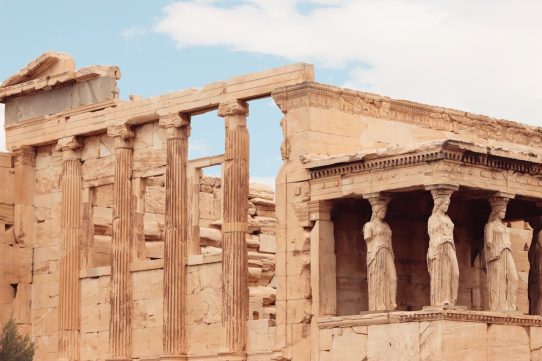
Roman temples were public statements planted in forums, on hills, and along processional routes. Many rituals took place outside the temple at an altar, where the community could see and validate what was being done.
This visibility mattered. Roman ritual was often designed to be witnessed, because witnessing made it legitimate. The gods were honored on behalf of the people, and the people needed to know it was done properly.
Egyptian Temples: Hidden, Layered, Restricted
Egyptian temples were built like sacred machines: the deeper you went, the more restricted the space became. The holiest area, where the deity’s cult statue resided, was not a place for crowds. It was for trained priests performing precise, repeated actions.
In Egypt, a temple was not simply a public shrine. It was the god’s house. Ritual was a form of divine household service, performed with cosmic consequences.
Priests: Who Was Allowed to Touch the Sacred
Both civilizations had priesthoods, but they treated priesthood like different kinds of work.
Rome: Priests as Officials
Roman priests were often elite citizens performing public roles. Many priesthoods functioned like civic offices tied to state administration: supervising calendars, omens, vows, sacrifices, and the careful maintenance of Rome’s relationship with its gods.
This is a key difference: Roman priesthood was not necessarily a life separated from society. It was often a prestigious duty within it.
Egypt: Priests as Specialists
Egyptian priests were specialists trained in purity, procedure, and sacred knowledge. Strict cleanliness routines and exact ritual sequences were central to their work. Some served in rotating shifts, but the expectation of competence was relentless.
If Rome treated ritual competence like governance, Egypt treated it like a craft with strict standards and serious consequences for failure.
Offerings and Sacrifice: What Was Given
What gets offered reveals what a society thinks the gods actually want: food, blood, fragrance, respect, or proof of submission.
Rome: Animal Sacrifice and Shared Meals
Roman ritual frequently centered on animal sacrifice. The process was formal and highly structured: offering, prayer, slaughter, division of portions, and burning what belonged to the gods.
Often the remaining meat was consumed in communal meals. Sacrifice became both religious action and social cement: the gods received their due, and people participated in a shared event reinforcing hierarchy and identity.
Egypt: Food, Incense, and the Daily Cult
Egyptian temple ritual emphasized offerings like bread, beer, meat, flowers, and incense presented to the god’s image. The goal was not a public feast. It was serving and sustaining divine presence within the temple.
Animal sacrifice existed, but Egyptian ritual is remembered especially for its daily rhythm: washing, anointing, censing, clothing the statue, and presenting offerings as part of continuous sacred maintenance.
Purity and Cleanliness: Different Obsessions
Both cultures cared about purity. They just worried about different kinds of contamination.
Roman purity tended to focus on correct timing, correct wording, and correct procedure. Physical cleanliness mattered, but procedural correctness mattered more. A mistake could invalidate a rite, even if everyone had good intentions.
Egyptian purity often demanded strict physical cleansing, ritual garments, and controlled access to sacred spaces. The fear was that impurity would compromise the god’s house, not merely spoil the performance.
In short: Rome feared botched procedure. Egypt feared contamination of sacred space.
Words, Formulas, and the Fear of Mistakes
Rome was famously anxious about ritual error. If a priest stumbled over words or an omen appeared unfavorable, a ritual might be restarted. The rite mattered as a performed sequence, not merely as inner belief.
Egyptian ritual also relied on correct recitations, but it often treated words as active forces. Sacred speech could shape reality. The spoken formula was not only respectful. It was effective.
Both cultures used words like tools. Romans used them like legal language. Egyptians used them like creative power.
Divination and Reading the Divine Will
Divination makes the gods legible, or at least gives humans a structured excuse to claim they have been consulted.
Rome: Omens as Public Decision Tools
Romans used divination like civic infrastructure. Augury, auspices, and the reading of signs helped decide when to act and whether to proceed. This made divination political: unfavorable signs could delay or cancel public actions.
Sometimes this reflected genuine caution. Sometimes it provided convenient leverage. Either way, it embedded divine approval into civic decision-making.
Egypt: Oracles and Sacred Answers
Egypt also practiced divination, including oracle consultations connected to temple life. Oracles could be delivered through processions, ritual movements, or consultative ceremonies tied to specific gods.
Roman divination often functioned as authorization for public action. Egyptian divination more often functioned as a channel for divine direction within a sacred setting.
Festivals and the Calendar
Both empires marked time through ritual, but they built their religious rhythms differently.
Rome: Ritual as a Public Schedule
Roman religious life was heavily calendar-driven. Festivals structured civic time, reinforced shared memory, and connected political authority to divine favor. Ritual was woven into public life through ceremonies, vows, games, and communal observances.
The calendar turned religion into a recurring public demonstration: Rome honors its gods, therefore Rome endures.
Egypt: Ritual as Daily Continuity
Egypt had major festivals and public processions, but its foundation was the daily temple cycle. The god’s care and service were performed as routine. That continuity mattered even when there was no public spectacle.
Rome emphasized seasonal civic rhythm. Egypt emphasized constant sacred maintenance.
Death Rituals and the Afterlife
Death reveals what a culture fears most, and what it hopes can be controlled.
Roman funerary practice centered on honoring ancestors and maintaining family continuity. Death rites often worked like boundary management: keep the dead properly honored and properly separated so the living remain safe and socially stable.
Egypt treated death as a high-stakes transition requiring preparation and protection. Preserving the body, supplying ritual knowledge, and aligning the dead with cosmic order were part of engineering a successful passage.
Rome maintained the boundary. Egypt engineered the journey.
Religion and Power: Who Benefited From Ritual
Neither empire was shy about using religion to legitimize authority. They just styled it differently.
Roman ritual made the state look competent: the right people performed the right rites on behalf of everyone else. The system reinforced hierarchy and the idea that Rome’s leaders were custodians of divine order.
Egyptian ritual made kingship look cosmic: the ruler’s role was tied to the maintenance of order, and temples served as visible proof that divine care was being performed correctly.
Rome looked like a well-managed pact with heaven. Egypt looked like a living bridge between heaven and earth.
The Big Similarities and Differences
After all the details, the comparison comes down to what each culture wanted ritual to accomplish and how it wanted it seen.
Both would recognize:
- Ritual must be done correctly, not casually.
- Temples concentrate authority.
- Divine relationships and politics overlap.
- Community stability depends on divine order.
The sharpest contrasts:
- Public vs restricted: Roman ritual sought witnesses; Egyptian ritual guarded access.
- Transactional vs cosmic: Roman rites often sought outcomes; Egyptian rites maintained balance.
- Feasting vs service: Roman sacrifice reinforced community; Egyptian offerings sustained divine presence.
- Omens vs oracles: Roman divination often authorized action; Egyptian divination often revealed direction.
Why This Comparison Matters for Roman Mythology
Roman mythology is not only stories about gods. It is a system for explaining how society, fate, and divine power interact, and for managing that relationship through correct practice.
Comparing Roman ritual to Egyptian ritual clarifies what Rome emphasized: procedure, civic order, and public continuity. It also highlights what Egypt emphasized more strongly: daily temple devotion, restricted sacred interiors, and ritual as a method for maintaining cosmic balance and guiding the dead.
Two empires, two ritual machines, one shared human habit: building enormous systems to bargain with the unseen, then calling it “order.”