QUICK SUMMARY
Venus was worshipped in ancient Rome through temples, festivals, and personal offerings, reflecting her role in love, fertility, political identity, and the unity of Roman society.
Venus was not just admired in myth. She was actively worshipped across Roman life, from private prayers to state-sponsored temples. Her influence extended far beyond romance. She represented fertility, prosperity, lineage, and even the legitimacy of Rome itself.
To understand how Venus was worshipped is to understand how the Romans viewed love, beauty, and connection as forces that shaped both personal lives and the destiny of their civilization.
Why Was Venus Worshipped?
Venus was worshipped because she represented essential forces in Roman life. Love and attraction were not seen as trivial emotions, but as powers that influenced marriage, family, and social stability.
She was also associated with fertility and growth, making her important to both individuals and the wider community. Through her connection to Aeneas, Venus became tied to Rome’s origin story, elevating her to a figure of national importance.
For the Romans, honoring Venus meant acknowledging the forces that sustained both life and society.
Temples of Venus in Ancient Rome
Venus was honored through several major temples, each reflecting a different aspect of her identity.
Venus Genetrix emphasized her role as a mother and ancestor. This aspect was especially important to Roman leaders, who linked their lineage to her through Aeneas. Julius Caesar famously promoted this connection to strengthen his political legitimacy.
Venus Victrix represented victory and success. In this form, Venus was associated not just with love, but with triumph and achievement, showing how her influence extended into areas typically associated with power.
Venus Verticordia was linked to moral transformation and the guidance of desire. This aspect reflects a more controlled interpretation of love, aligning it with virtue and social order.
These temples were not just places of worship. They were symbols of how Venus was woven into the structure of Roman life.
Festivals of Venus
Venus was honored through several festivals, the most important of which was Veneralia.
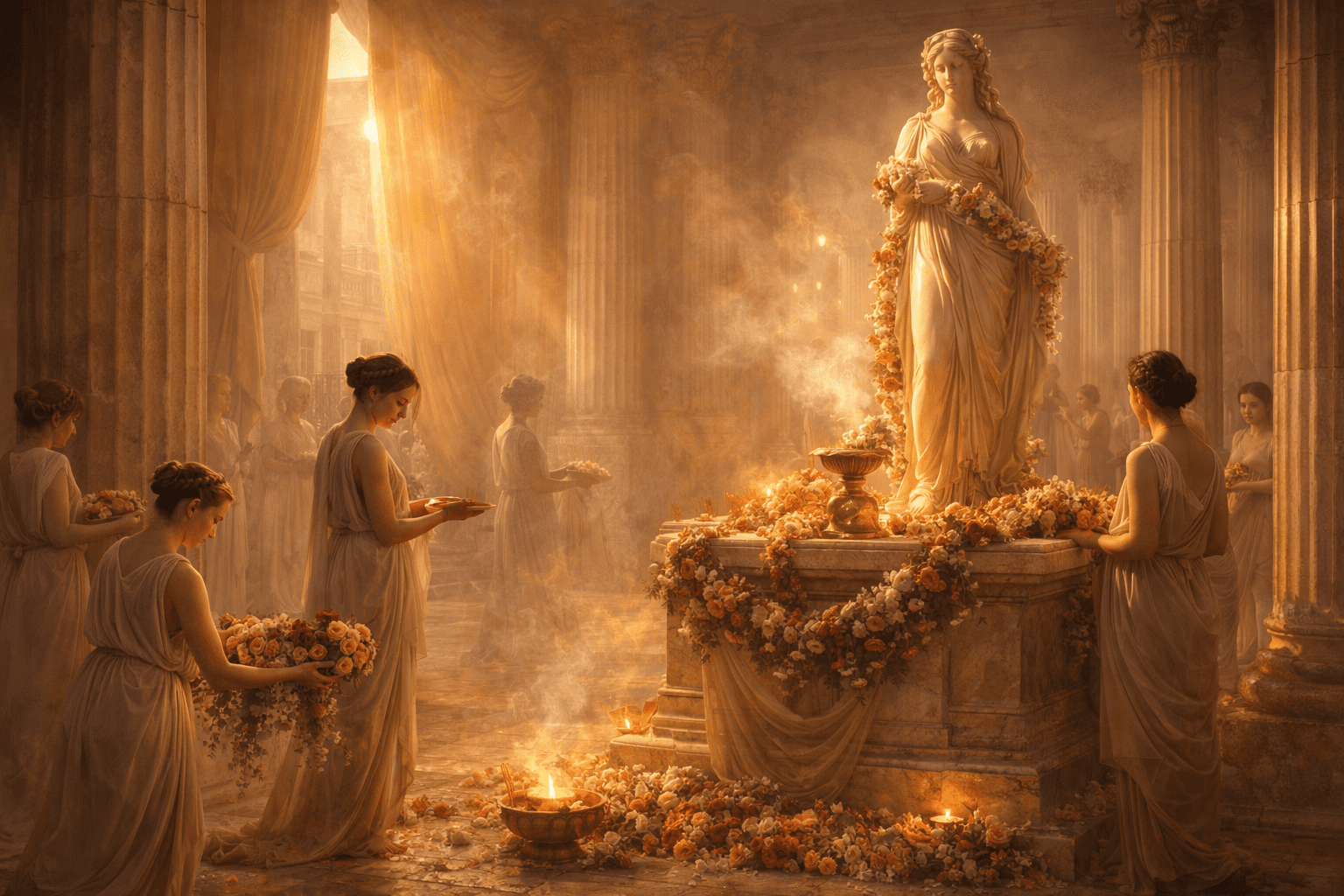
Held in April, Veneralia focused on renewal, beauty, and emotional balance. Women, in particular, played a central role in these celebrations. They washed and adorned statues of Venus, offering flowers and prayers for harmony in love and relationships.
The festival was both personal and communal. It reflected the idea that love and attraction were not isolated experiences, but part of a shared social fabric.
Offerings to Venus
Worship of Venus often involved simple but meaningful offerings.
People brought flowers, especially roses, as symbols of beauty and desire. Incense was burned to create an atmosphere of reverence, and wine was offered as a gesture of devotion.
Prayers to Venus were often personal. Individuals asked for success in love, harmony in relationships, or fertility and prosperity. These offerings were not grand displays, but expressions of connection between the worshipper and the goddess.
Who Worshipped Venus?
Venus was worshipped by a wide range of people across Roman society.
Women often prayed to her for love, beauty, and successful relationships. Couples sought her blessing for harmony and fertility. Political figures invoked her to strengthen claims of legitimacy through ancestry.
Even soldiers and leaders recognized her importance. Through her connection to Mars and her role in Roman identity, Venus was seen as a force that supported both unity and strength.
Her influence crossed boundaries between private life and public power.
Venus and Roman Society
Venus occupied a unique position in Roman culture because she connected personal experience with broader social structures.
She influenced marriage and family life, but also represented continuity and identity. Her association with Aeneas placed her at the foundation of Rome’s story, making her a symbol of origin and destiny.
In this way, Venus was not just worshipped as a goddess of love. She was honored as a force that sustained the Roman world itself.
The Meaning of Worshipping Venus
Worship of Venus reflects a deeper Roman understanding of the world.
Attraction, beauty, and connection were not seen as superficial. They were essential forces that brought people together, created families, and maintained society.
By honoring Venus, the Romans acknowledged that these forces required respect and balance. Love was powerful, but it needed to be guided and understood.
Final Thoughts
The worship of Venus was both intimate and expansive. It existed in quiet personal prayers and in grand public temples. It shaped relationships and reinforced political identity.
Through Venus, the Romans recognized that connection is not a minor aspect of life, but a foundational one.
To worship her was to acknowledge the forces that bind people together and give meaning to the world they built.