In 1477 or 1478, Lorenzo de’ Medici commissioned a large painting from a young Florentine artist for his cousin Lorenzo di Pierfrancesco’s villa at Castello. The subject was mythological — Venus surrounded by the Three Graces, Mercury, Zephyr, Flora, and the transformed Chloris in a flowering orange grove. The painting was not destined for a church. It was not a devotional image. It was painted for a private villa, designed to hang in a room where educated men would look at it, think about it, and discuss what it meant.
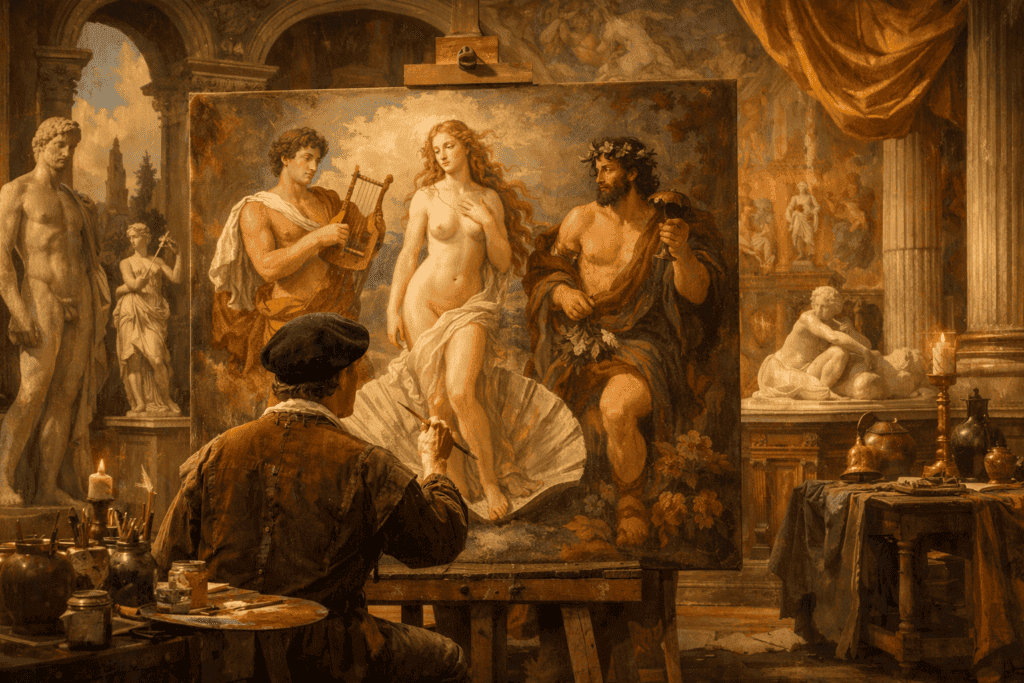
That painting — Botticelli’s Primavera — is one of the most discussed works in the history of art, and what is most extraordinary about it is not its beauty but the fact that it existed at all. A decade earlier it would have been nearly impossible. Two centuries earlier it would have been unthinkable. The Roman gods had returned to Italian art — not as objects of worship, not as historical curiosities, but as a living visual language through which fifteenth-century Florence could think about beauty, love, politics, philosophy, and the meaning of a civilization that believed itself the heir of Rome.
The Mechanism of Return: Manuscripts, Printing, and Ovid
The Roman gods did not simply reappear in Renaissance art because artists thought they looked nice. They returned because a specific set of intellectual and material conditions made them available and made them prestigious.
The most important single text was Ovid’s Metamorphoses — fifteen books of mythological narrative in dactylic hexameter, covering the transformation stories of the entire classical tradition from the creation of the world to the apotheosis of Julius Caesar. The Metamorphoses had never entirely disappeared from medieval literary culture, but its reception had been predominantly allegorical — the myths read as moral lessons in Christian disguise, Diana as chastity, Venus as marital love, Jupiter as divine providence. The medieval tradition understood the myths as a code to be deciphered, their pagan surface concealing Christian truth underneath.
What changed in the fifteenth century was the recovery of a more genuinely classical mode of reading — the humanist scholars’ insistence on reading Ovid as a literary artist rather than as a confused pagan accidentally encoding Christian wisdom. When Poliziano wrote his Stanze per la giostra in the 1470s, drawing on Ovid for mythological imagery that he deployed with full awareness of the literary tradition behind him, he was modeling a way of using myth that was neither the allegorical medieval approach nor simple pagan belief. He was using myth as poets used it — as a resource of narrative beauty, emotional power, and cultural prestige.
The printing press made Ovid’s text available on an unprecedented scale. The first printed edition of the Metamorphoses appeared in 1471. By the end of the century it had been reprinted dozens of times across Italy and was in the libraries of every educated household. Artists working for humanist patrons in Florence, Venice, Ferrara, and Mantua could expect their clients to know the stories, recognize the characters, and bring literary knowledge to bear on the visual images they commissioned. The Metamorphoses was not a reference work consulted for unfamiliar stories — it was a shared cultural text that educated people carried in their heads.
Botticelli and the Neoplatonic Venus
The two most famous mythological paintings of the Florentine Renaissance — Botticelli’s Primavera and Birth of Venus — were both produced in the late 1470s and early 1480s for the Medici circle, and both reflect the specific intellectual culture of that circle rather than simply generic mythological taste.
The Medici had gathered around them the leading Neoplatonic philosophers of the fifteenth century — most importantly Marsilio Ficino, who translated Plato’s complete works into Latin and whose commentary on Plato’s Symposium, written in 1469, proposed an elaborate philosophical account of love as the force that connected the human soul to the divine. Ficino’s Neoplatonic Venus was not the erotic troublemaker of Homer’s Iliad or even the maternal divine of Virgil’s Aeneid. She was the embodiment of humanitas — the civilizing grace that transformed rough natural desire into something beautiful, ordered, and spiritually elevating.
The Primavera‘s iconographic program — still debated by art historians five centuries after it was painted — appears to map something like Ficino’s account of love onto Ovidian mythological imagery. The transformation of Chloris into Flora on the right of the painting expressed the Ovidian narrative of metamorphosis. The Three Graces in their spinning dance expressed the Neoplatonic cycle of beauty going forth and returning. Venus at the center presided over the scene as humanitas — not as the erotic goddess of desire but as the civilizing principle that ordered the scene’s various forces into beauty.
Whether or not this specific reading is correct — scholars have proposed many alternatives — the painting’s existence demonstrated something new about what mythological art could do. It could be simultaneously beautiful and philosophical, simultaneously Ovidian narrative and Neoplatonic allegory, simultaneously a private commission for a specific occasion and a meditation on universal themes. The Roman gods had acquired, in Botticelli’s hands, a depth and layering that neither ancient art nor medieval allegory had given them.
The Birth of Venus was simpler and perhaps more radical in its simplicity. It depicted the goddess’s emergence from the sea in a format that recalled ancient cult statues — the Venus pudica type of ancient sculpture, the goddess modestly covering herself with hands and flowing hair — while giving the ancient form a Renaissance sensibility of lyrical melancholy and refined grace. The painting was not trying to reconstruct an ancient work. It was creating a new image that felt ancient, that invoked the authority of classical antiquity while being unmistakably of its own time.
The Studiolo and the Space of Mythological Art
Understanding where mythological paintings were meant to hang is essential to understanding what they were meant to do. Most of the major mythological works of the early Renaissance were not designed for public spaces. They were designed for private rooms — studies, bedchambers, reception rooms in villas — where they would be seen by educated individuals or small groups capable of interpreting them.
The studiolo — the private study of a Renaissance prince or wealthy humanist — was one of the key spaces for mythological art. Isabella d’Este’s studiolo at the Gonzaga palace in Mantua was the most famous of its kind: a small room decorated with a cycle of mythological paintings commissioned from the most celebrated artists of the age, designed as a complete allegorical program whose themes addressed philosophy, virtue, the liberal arts, and the cultivation of refined taste. The artists commissioned for the cycle — Mantegna, Perugino, Lorenzo Costa — produced works that required sustained intellectual engagement rather than simple visual pleasure.
The marriage chamber was another significant space. Cassone — the painted wooden chests that formed part of a bride’s trousseau — were often decorated with mythological scenes relevant to marriage, fertility, and the values of conjugal life. The choice of Ovid’s story of Cupid and Psyche, or of Venus’s own marriage to Vulcan, or of Diana’s protection of chaste women was never accidental. The myths that decorated marriage cassone were chosen for specific allegorical relevance to the specific occasion of the marriage they celebrated.
These domestic contexts transformed mythological painting’s social function. A Venus in a church was impossible — a pagan goddess in a sacred Christian space was a contradiction. A Venus in a studiolo was a philosophical statement about beauty and love. A Venus in a marriage chamber was a blessing on conjugal harmony and fertility. The painting was the same. Its meaning was determined by where it hung and who looked at it.
Raphael and the Narrative Myth
While Botticelli’s mythological paintings were primarily lyrical and allegorical, Raphael’s treatment of classical myth — most fully expressed in the frescoes he painted for Agostino Chigi’s Villa Farnesina in Rome in the 1510s — brought narrative energy and physical grandeur to the same tradition.
The Farnesina frescoes depicted the myth of Galatea — the sea-nymph pursued by the Cyclops Polyphemus, whom Ovid had described in the Metamorphoses with characteristic wit and sensuality — in a format that combined the scale of ancient Roman decorative fresco with Renaissance mastery of the human figure. The Triumph of Galatea, with its swirling composition of sea creatures, Tritons, and the radiant central figure of the nymph, was not allegory in Botticelli’s Neoplatonic sense. It was myth as visual spectacle — the ancient story rendered with a physical vitality and compositional grandeur that made the viewer feel the energy of the narrative rather than decode its philosophical content.
Raphael’s treatment of mythological narrative was closer to Titian’s mature approach than to Botticelli’s earlier Florentine one — myth as dramatic experience rather than philosophical meditation. The shift from the lyrical, interior world of the Primavera to the expansive physical energy of the Triumph of Galatea expressed a broader development in Renaissance mythological art: from the private, contemplative, intellectually demanding mode of early Florentine humanism toward the more publicly theatrical, physically immediate mode of High Renaissance and Venetian painting.
Titian and the Poesie
No Renaissance artist engaged more deeply or more sustainably with Roman mythological subject matter than Titian, and no series of mythological paintings better exemplifies what the tradition could achieve at its most ambitious than the poesie — the “painted poems” — that Titian produced for Philip II of Spain in the 1550s and 1560s.
The series of six large paintings — Danaë, Venus and Adonis, Perseus and Andromeda, Diana and Actaeon, Diana and Callisto, and The Death of Actaeon — was based on episodes from Ovid’s Metamorphoses and was explicitly described by Titian in his correspondence with Philip as paintings that complemented each other in the manner of a poem’s varied voices. The term poesie — poems — was Titian’s own, and it expressed his understanding of what he was doing: not illustrating ancient texts but creating visual equivalents of Ovidian narrative, paintings that operated with the same freedom from moral simplicity that Ovid’s verse possessed.
The poesie were radical in their treatment of the mythological figure. Titian’s Diana was not a serene allegorical embodiment of chastity. She was a goddess of terrifying power, whose accidental discovery by Actaeon — who stumbled upon her bathing in Diana and Actaeon — triggered a punishment of extreme violence: the hunter transformed into a stag and torn apart by his own hounds. Titian did not soften this. In The Death of Actaeon, one of his last paintings, he depicted the hunter already partially transformed, his hounds already attacking, Diana watching from the distance with her bow. The myth’s violence was not allegorized away. It was rendered directly, with the physical immediacy that Titian brought to everything he painted.
This directness was central to what the poesie achieved. Titian used Ovid’s stories — with their mixture of beauty, desire, cruelty, and transformation — not as raw material to be decoded into moral lessons but as occasions for exploring what painting could do with color, light, the human body, and the natural world. The poesie were not illustrations of Ovid. They were responses to Ovid, a painter’s account of what it felt like to be inside the mythological world the poet had described.
The Myth of the Nude and What It Permitted
One of the most practically significant functions of Roman mythological subject matter in Renaissance art was the legitimacy it provided for the depiction of the nude human figure.
Medieval Christian art had strict conventions about nudity. The nude appeared primarily in scenes of the Fall, the Last Judgment, and specific biblical narratives that required it — Adam and Eve before the expulsion, the souls of the damned in Hell. The nude body in these contexts was associated with shame, sin, or punishment. It was not celebrated as beauty.
Roman mythology gave Renaissance artists a different framework. The gods of antiquity had been depicted nude in ancient sculpture and on ancient coins and gems that Renaissance collectors studied and owned. Venus and Diana and Apollo and Bacchus were ancient nude figures of enormous prestige. To depict them nude in the Renaissance context was not to celebrate human sexuality in a morally problematic way — it was to align oneself with the highest tradition of ancient art, to demonstrate mastery of the human form in its most demanding and most prestigious mode, and to participate in the cultural project of recovering classical antiquity.
This gave mythological painting a protective function. Nude figures that would have been impossible in a religious context could appear in mythological paintings because the mythological frame provided the necessary justification. The nude Venus was not a naked woman — she was a goddess of antiquity depicted in the mode of ancient sculpture. The nude Diana at her bath was not a scene of voyeurism — it was a mythological episode with a clear ancient literary source. The mythology did not merely provide stories. It provided cover.
The Legacy of the Renaissance Mythological Tradition
The Renaissance mythological tradition that Botticelli, Raphael, Titian, and their contemporaries established did not end with the sixteenth century. It became the foundation of a visual vocabulary that European art drew on for the next three hundred years.
Baroque artists — Rubens above all — pushed the physical energy and sensual immediacy of mythological painting to its limits, using Ovid’s narratives as occasions for the most virtuosic demonstrations of figural skill, coloristic richness, and compositional drama that Western painting has ever produced. Rubens’s Rape of the Daughters of Leucippus, his Venus and Adonis, his enormous Rape of the Sabine Women — these were not simply illustrations of ancient stories. They were extensions of the tradition Titian had established, pushed into a new register of physical immediacy and emotional force.
Neoclassical artists in the eighteenth century returned to mythological subjects with a different emphasis — not Titian’s sensual immediacy but a cool, formal idealism modeled on the discipline of ancient sculpture. The French Academy’s hierarchy of genres placed history painting — which included mythological subjects — at the summit of artistic achievement, and the long tradition of mythological painting at the École des Beaux-Arts continued well into the nineteenth century.
The Pre-Raphaelites, the Symbolists, and the academic painters of the late nineteenth century all drew extensively on Roman mythological subjects, each reinterpreting them according to their own cultural moment while remaining connected to the tradition of Renaissance mythological painting through which the ancient gods had been made visually available to the modern world.
Conclusion
The Renaissance did not simply rediscover Roman mythology. It created a visual language from it — a set of images, conventions, and interpretive frameworks that made the ancient gods available to any artist or patron who knew the tradition and wanted to use it.
From Botticelli’s philosophical Primavera to Titian’s visceral poesie, from Raphael’s narrative Triumph of Galatea to the elaborate allegorical programs of Renaissance studioli, the Roman gods were put to work in fifteenth and sixteenth-century Italy with a sophistication and variety that ancient art itself had never achieved. They were simultaneously philosophical, political, erotic, moral, aesthetic, and deeply personal — carrying whatever meaning the specific patron, artist, and moment required.
That flexibility was what made them last. The Roman gods survived the fall of Rome, survived the rise of Christianity, survived the medieval period’s allegorical reduction, and returned in the Renaissance as the richest single source of non-biblical imagery available to Western art. They are still returning. Titian’s poesie still hang in their respective collections. Botticelli’s Venus still rises from her shell. The ancient stories have not finished generating new readings, new images, and new conversations about what beauty, desire, and the gods mean to the human beings who cannot stop inventing them.
Share This Page
Cite This Page
MLA
Editors of RomanMythology.com. "Roman Mythology in Renaissance Art: How the Ancient Gods Returned." RomanMythology.com, 2026, https://www.romanmythology.com/culture/roman-mythology-in-renaissance-art/. Accessed June 11, 2026.
APA
Editors of RomanMythology.com. (2026). Roman Mythology in Renaissance Art: How the Ancient Gods Returned. RomanMythology.com. Retrieved June 11, 2026, from https://www.romanmythology.com/culture/roman-mythology-in-renaissance-art/