The Romans and the Norse never met in the way we might imagine — they were separated by centuries, by the fall of the Western Empire, by the long migrations of the Germanic peoples. But they were not separated by ignorance. Tacitus wrote about the Germanic tribes in 98 CE, describing their gods, their rituals, and their understanding of the universe in terms that immediately reveal the Roman interpretive framework being applied to something genuinely alien to it. He identified the Germanic war god with his Mars, their sky god with his Mercury, their earth goddess with his Ceres. The interpretatio romana reached as far north as the Roman frontier on the Rhine and the Danube, and through it the Romans tried to make sense of a cosmological system that was, in its deepest structure, profoundly different from their own.
The comparison between Roman and Norse cosmology is therefore not simply an academic exercise in contrasting two ancient traditions. It is the comparison of two worldviews that were actually in contact along Rome’s northern frontier for centuries, that applied their different frameworks to the same human questions, and that produced answers so different that the gap between them reveals something fundamental about what each civilization understood the universe to be.
The Structure of the Cosmos: Hierarchy vs Network
The most immediately visible difference between Roman and Norse cosmology was the physical model each tradition used to organize the universe.
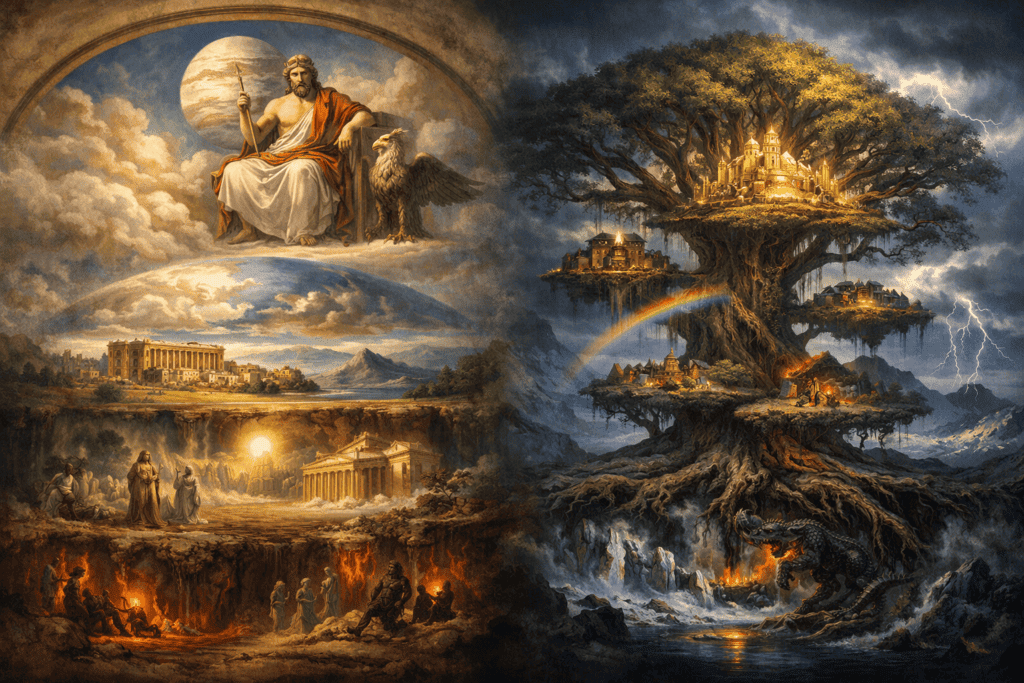
Roman cosmology was hierarchical and concentric. The universe was organized in layers from the highest to the lowest: the sphere of the fixed stars at the outermost boundary, then the planetary spheres in descending order — Saturn, Jupiter, Mars, the Sun, Venus, Mercury, the Moon — and finally the sublunary world of change and mortality at the center. Below the earth lay the underworld, the inverted complement of the heavens above. The whole structure was spherical, symmetrical, and organized by the principle that higher meant more divine, more permanent, more rationally ordered. Jupiter’s realm was at the summit because the summit was where supreme divine authority resided.
This model was not mythology in the narrative sense. It was cosmological physics, the description of how the physical universe was actually structured, elaborated by Greek philosophy and absorbed into Roman intellectual culture through the works of Plato, Aristotle, and their Stoic successors. The spheres were real. The planets moved through them in predictable orbits. The divine order expressed itself through the regularity of celestial motion.
Norse cosmology organized the universe completely differently. Rather than concentric spheres arranged vertically, it imagined nine distinct realms arranged around a central axis — the World Tree Yggdrasil, the great ash whose roots reached into three wells and whose branches extended into the heavens. The nine realms were not arranged in a simple hierarchy of better and worse, higher and lower. They were a network of distinct territories, each with its own character and population, connected by Yggdrasil’s structure but not organized by a single vertical principle of divine authority.
Asgard, the realm of the Aesir gods, sat at the highest level of this network but was connected to Midgard — the human world — by the Bifrost, the rainbow bridge, a physical pathway rather than a graduated hierarchy. Jotunheim, the realm of the giants, was not below Asgard in the sense of being less divine or less powerful — it was beside it, a separate territory whose inhabitants were ancient enemies of the gods rather than subordinate subjects. Helheim, the realm of many of the dead, was below — but not because death was cosmologically inferior to life in the same way that the Roman underworld was inferior to the heavens. It was simply where the dead who had not died in battle went, one territory among several rather than the lowest point of a divine hierarchy.
This structural difference expressed something deeper. Roman cosmology was a cosmos of order — the same word, the Greek kosmos, meant both universe and order. The universe was orderly precisely because it was cosmological, and its orderliness was the visible expression of the divine rational principle that organized it. Norse cosmology was a cosmos of conflict — the nine realms were in perpetual tension, the gods were at perpetual war with the giants, and the cosmic structure itself was constantly under threat from the dragon Nidhogg gnawing at Yggdrasil’s roots, from the serpent Jormungandr encircling Midgard, from the forces of chaos that would eventually be unleashed at Ragnarok.
Yggdrasil and What It Expressed
Yggdrasil was not simply a large tree that happened to connect nine realms. It was the structural principle of the Norse cosmos — the living organism whose health was the condition of the universe’s continued existence, whose decay was the sign of cosmic crisis, and whose eventual destruction in Ragnarok was the mechanism of cosmic ending.
The tree was tended by the Norns — the three fate-weavers, Urð, Verðandi, and Skuld — who drew water from the Well of Urðr at one of Yggdrasil’s roots and used it to water the tree, maintaining its life and through it the life of the cosmos. The Norns wove the fate of gods and humans on their great loom, their work as necessary to the cosmos as the tree’s own existence. Fate in Norse cosmology was not simply an abstract principle — it was actively produced by specific divine beings performing specific work, and the work required continuous maintenance just as Yggdrasil itself did.
The various creatures inhabiting the tree expressed the cosmic tensions it embodied. The eagle at its crown and Nidhogg at its roots were in perpetual enmity, the squirrel Ratatoskr running between them carrying messages designed to inflame the conflict. The four deer that grazed its branches consumed its leaves continuously, degrading it even as the Norns tended it. The cosmic tree was never at rest, never simply present as a stable structure. It was a dynamic system under constant biological pressure, maintained against erosion by divine effort, slowly losing the battle it would eventually lose entirely at Ragnarok.
The Roman cosmos had nothing analogous. The sphere of the fixed stars required no maintenance. The planetary spheres moved in their orbits by necessity, not by divine effort. The cosmic order sustained itself through its own rational structure — the divine logos that pervaded it was not a force that could be exhausted or defeated. The Roman universe did not need tending because it was self-sustaining by design.
This difference was not accidental. It reflected different answers to the question of what kind of universe this was. Roman cosmology answered: a rational structure, governed by an immanent divine principle that expressed itself through natural law. Norse cosmology answered: a living system, maintained by the labor of divine beings, under permanent threat from forces of chaos, and doomed to eventual collapse.
Creation: Ordering Chaos vs Building from a Body
Both traditions had creation myths, but the contrast between them was almost total.
Roman cosmological creation — as Ovid presented it in the Metamorphoses, the most influential Latin account — began with chaos: a formless, undifferentiated mass of matter in which all things were mixed together without distinction. A god or divine nature — Ovid is deliberately vague about the agent — separated the elements, lifted the earth from the water, drew the heavens away from the earth, and organized the undifferentiated mass into the structured cosmos. The sky received its stars. The air its winds. The sea its boundaries. The earth its varied terrains. It was a process of differentiation and organization — the imposition of rational structure on formless matter.
This creation was peaceful. There was no violence, no defeated opponent, no cosmic body dismembered to provide the material for the world. The Stoic cosmological tradition that influenced Roman thinking described the universe as emanating from the divine fire of the logos — not made from anything but organized through the expression of rational principle. Creation was a logical process, not a violent one.
Norse creation was built from a corpse. Ymir, the first frost giant who emerged from the primordial void where ice and fire met, was the ancestor of all giants and the raw material of everything that existed. When Odin and his brothers killed him, his blood flooded the world and drowned all the frost giants except Bergelmir and his wife. From his body the gods constructed the cosmos: flesh became earth, blood became sea and rivers, bones became mountains, skull became sky, brain became clouds, eyelashes became the barrier protecting Midgard from Jotunheim.
The Norse universe was therefore literally made of enemy flesh. The material of every mountain and every sea was the body of a being the gods had killed to make room for their creation. The giants who remained were the kin of the being whose body had become the world. Their enmity toward the gods was not simply cosmic conflict — it was the enmity of a people whose ancestor had been murdered and dismembered, whose entire world was built from his remains. The conflict between gods and giants was cosmologically necessary: it was built into the structure of the universe at the moment of its creation.
The Gods: Authority vs Struggle
The Roman gods were authorities. Jupiter, from his position at the summit of the heavenly hierarchy, governed the cosmos with sovereign power. He could be defied — Juno conspired against his plans, other gods pursued their own agendas — but his ultimate authority was not in doubt. The cosmic order was stable because its divine governor was stable. Jupiter would not lose.
The Norse gods were fighters who knew they would eventually lose. Odin, the Allfather, was not Jupiter. He was a god of wisdom, war, magic, and poetry who had sacrificed an eye to drink from the Well of Wisdom, who had hung himself on Yggdrasil for nine days to gain the knowledge of runes, who had fathered children with multiple partners specifically to produce the warrior sons he would need at Ragnarok. Everything Odin did was preparation for a battle he knew he would die in.
This difference was expressed in what each tradition valued most in its supreme deity. Jupiter’s defining attributes were sovereignty, authority, and the capacity to guarantee cosmic order. The thunderbolt was his primary weapon because it expressed the decisive imposition of divine will — unstoppable, final, from above. Odin’s defining attributes were cunning, knowledge, and sacrifice. He was the god of strategy rather than direct power, the god who obtained advantage through intelligence and self-deprivation rather than through overwhelming force.
Tacitus, in his Germania, identified Odin with Mercury — an identification that seems strange at first given that Mercury was Rome’s god of communication and commerce rather than war. But Tacitus was working from the interpretatio romana, looking for functional equivalents, and what he found in the Germanic Wotan/Odin was a god who moved between worlds, who was associated with the dead, who was a guide of souls — all Mercury’s functions in the Roman system — alongside his war associations. The identification was wrong in the sense that it missed what was most important about Odin. But it was not random. It captured something real about Odin’s role as a liminal, boundary-crossing deity in a way that identifying him with Mars or Jupiter would not have done.
Ragnarok and the Roman Eternal Order
The most fundamental difference between Roman and Norse cosmology was the Norse concept of Ragnarok — the twilight of the gods, the end of the world, the cosmic catastrophe that Norse mythology understood as inevitable from the beginning of the universe’s existence.
Ragnarok was not simply an apocalypse in the sense of a final battle. It was the logical conclusion of the universe’s structural tensions. The giants and the gods had been in conflict since the universe was built from Ymir’s body. The wolf Fenrir had been bound since he was a pup, the snake Jormungandr confined in the ocean, Loki imprisoned under a mountain — all of these were temporary containments of forces that could not be permanently contained. At Ragnarok the containments failed, the bound beings broke free, and the accumulated cosmic tension released in a final catastrophic event. Odin was swallowed by Fenrir. Thor killed the Midgard Serpent but died from its venom. The sun and moon were consumed. Yggdrasil shook.
And then the world began again. A new earth rose from the sea. Surviving gods — Baldr returned from Helheim, the sons of Thor, the sons of Odin — gathered on the plains and found the golden game pieces of the earlier gods scattered in the grass, relics of the age before the catastrophe. A human couple, hidden in the tree Hoddmimis holt during the destruction, emerged to repopulate the new world. The cycle continued.
Roman cosmology contained nothing analogous. The universe’s rational structure was permanent by definition. Cicero, in the Dream of Scipio, described the cosmic cycles of the Great Year — the vast astronomical period after which all the celestial bodies returned to their original positions — but even this was a cycle within a stable cosmic framework, not the destruction and replacement of the framework itself. The Stoic tradition imagined periodic ekpyrosis — cosmic conflagrations in which the universe dissolved back into divine fire before reconstituting itself — but even this was understood as a rational process, the logos reconstituting itself through its own fire, not a catastrophic defeat of the divine order by its enemies.
The Roman universe was designed to last. The Eternal City’s mythology was the mythology of an eternal cosmos — a universe that reflected and legitimized Rome’s own self-understanding as an civilization intended to be permanent. The Norse universe was designed to end and begin again — a cosmos that reflected the Norse understanding of existence as cyclical struggle, in which even the gods were mortal and the best one could hope for was to fight well before the inevitable came.
The Days of the Week: Where the Two Traditions Touched
The most visible surviving evidence of the encounter between Roman and Germanic-Norse religious traditions is something most people use every day without thinking about it: the names of the days of the week.
The seven-day week was a Roman institution, organized around the seven planetary deities in a specific sequence derived from the hours each planet governed. The Roman planetary days were: Saturn’s day, Sun’s day, Moon’s day, Mars’s day, Mercury’s day, Jupiter’s day, Venus’s day.
As the Roman Empire’s Germanic frontier populations absorbed the seven-day week structure, they substituted their own divine equivalents for the Roman planetary deities through a process of interpretive translation. The result is visible in the English names that derive from this Germanic substitution: Saturn’s day remained Saturday (the Germanic peoples had no equivalent for Saturn). Sun’s day and Moon’s day survived unchanged as Sunday and Monday. Mars’s day became Tiw’s day — Tuesday, from the Germanic war god Tiw. Mercury’s day became Woden’s day — Wednesday, from Wotan/Odin, whom Tacitus had identified with Mercury. Jupiter’s day became Thor’s day — Thursday, from the thunder god Thor whom the Germanic peoples identified with Jupiter. Venus’s day became Frigg’s day — Friday, from the goddess Frigg or Freya.
The planetary week thus preserved in its English form a direct record of the Roman-Germanic religious encounter — the Roman divine framework surviving in the week’s structure while the Germanic divine names replaced the Roman ones in the individual days. Every time an English speaker says Thursday, they are using a word that encodes both the Roman Jupiter and the Norse Thor, the two traditions’ thunder gods identified and substituted by the Germanic peoples who stood between them.
What the Comparison Reveals
Roman and Norse cosmology were not simply different descriptions of the same universe. They were expressions of fundamentally different understandings of what the universe was and what human life within it meant.
Roman cosmology expressed confidence in rational order — a universe structured by divine reason, governed by permanent divine authority, organized to reflect and support the hierarchical, law-governed civilization that Rome believed itself to embody. The Roman cosmos was an argument for Rome. If the universe was rational and hierarchical, then a civilization based on rational law and hierarchical authority was the appropriate way to live within it.
Norse cosmology expressed clarity about the limits of order — a universe structured by conflict, maintained by labor, and destined for eventual catastrophic transformation. The Norse cosmos was not an argument for a specific political order. It was an argument for courage in the face of inevitable loss. The gods knew Ragnarok was coming. They prepared for it anyway. They fought, maintained the cosmos, and accepted that the fighting would eventually end in defeat. The appropriate human response to this cosmos was not civic compliance but heroic endurance.
Both were honest about something real. The Roman cosmos expressed something true about the possibility of building durable, rational institutions. The Norse cosmos expressed something true about the limits of those institutions’ durability, and about what was required of those who lived within them knowing they would not last forever.
Share This Page
Cite This Page
MLA
Editors of RomanMythology.com. "Roman and Norse Cosmology: Two Visions of How the Universe Works." RomanMythology.com, 2026, https://www.romanmythology.com/comparative-mythology/roman-vs-norse-cosmology/. Accessed June 10, 2026.
APA
Editors of RomanMythology.com. (2026). Roman and Norse Cosmology: Two Visions of How the Universe Works. RomanMythology.com. Retrieved June 10, 2026, from https://www.romanmythology.com/comparative-mythology/roman-vs-norse-cosmology/