The Roman underworld had a specific address. It lay beneath the earth — accessible through volcanic lakes, through deep caverns in coastal rock, through the cracks that opened in the ground at places like the mundus in the Roman Forum on certain days of the year. It was not a vague spiritual realm of uncertain location but a structured landscape with identifiable regions, specific residents, a governing administration, and a physical character that Roman poets described with the same topographical precision they brought to describing the hills of Latium or the ports of the Mediterranean coast.
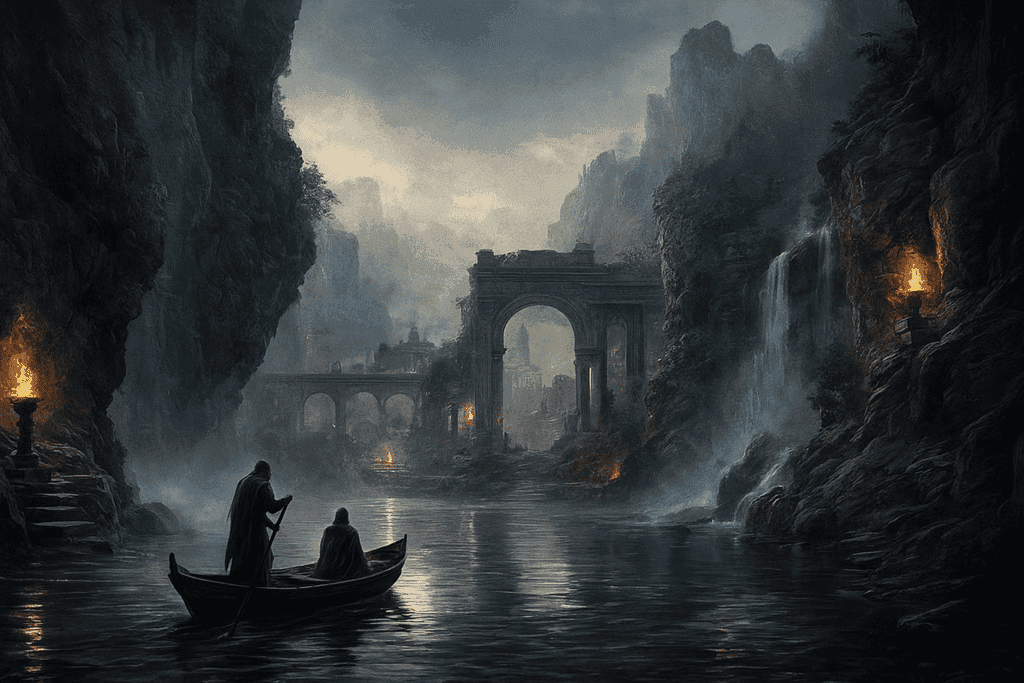
The most complete map of that landscape was produced by Virgil in Book VI of the Aeneid, written in the 20s BCE, in which Aeneas descends through Avernus with the Cumaean Sibyl as his guide and traverses the underworld from its outermost vestibule to the deepest recesses of Elysium. Virgil’s account synthesized centuries of Greek literary and philosophical tradition with specifically Roman religious and political content, producing what became the authoritative description of the underworld’s geography for the remainder of antiquity and for much of the subsequent Western tradition. Dante used it as his primary guide. Milton knew it intimately. It is still the most coherent and vivid map of the underworld that classical civilization produced.
What follows is that map, traced as precisely as the ancient sources allow.
The Vestibule: Before the Underworld Proper
The geography of the Roman underworld began before the underworld itself, in a vestibule — an antechamber between the living world and the dead one — that contained the personified abstractions of everything that made human life most terrible. Virgil describes this space in terms that make its function clear: it was the threshold architecture of death, the conceptual zone between the mortal world’s last moments and the realm of the dead’s first.
In the vestibule dwelled Grief and anxious Care, the pale diseases, sad Old Age, Fear, Hunger the evil counselor, Poverty of shameful appearance, Death, and Agony — their sister Sleep — and the mind’s guilty joys, and on the facing threshold, Death-dealing War, the Furies’ iron chambers, and mad Discord with her viper hair bound by a bloody fillet. A great elm tree spread its branches over the vestibule, its leaves sheltering the Dreams that clung beneath every leaf. Monstrous creatures inhabited its margins: the Centaurs, the Scyllae, the Briareus, the Lernaean Hydra, the Gorgons, Harpies, and Geryon.
This vestibule was not a region of the underworld where souls resided. It was the threshold’s menagerie — the accumulated terrors of mortal life given form at the boundary between the living and dead worlds. The soul that had passed through the vestibule had left the world where all of these threats were real and entered the world where their power could no longer reach. Death’s antechamber was furnished with everything that made death comprehensible as a departure.
The Bank of the Acheron: The Uncrossed Shore
Beyond the vestibule, the path descended to the bank of the Acheron — the first river, the first genuine boundary of the underworld proper. Here Virgil places one of his most famous and most affecting passages: the description of the souls crowded on the near shore, pressing toward Charon’s boat.
The souls crowded to the bank as thick as leaves falling in the first frost of autumn, as birds driven landward by the winter storm, the countless dead pressing eagerly toward the crossing. Charon stood in his boat — a god, but one of terrible appearance, filthy, his beard white and matted, his eyes like flames, his ragged cloak knotted from his shoulder. He worked his boat himself, managing the sail and the pole, an ancient ferryman who had not improved with age.
What Aeneas observed that struck him hardest was the souls on the far shore — the ones Charon would not carry. These were the souls of those whose bodies lay unburied, who had not received the funeral rites that entitled them to cross. Charon would not take them until their bodies had been buried and the hundred years of wandering had been served. Aeneas saw among them young men, aged men, girls, and unmarried youths laid on the pyre before their parents’ eyes — and he recognized Palinurus, his own helmsman, who had fallen into the sea and whose body had not been found.
This image — the crowded bank of the Acheron, the willing souls and the unwilling refusals, the hundred years of waiting for those who lacked burial — was the most emotionally immediate expression of the Roman burial obligation in all of literature. The theology that made the coin necessary, that made proper burial a religious requirement, was here given its most vivid narrative form.
The Crossing and the Far Shore
Charon carried Aeneas and the Sibyl across — reluctantly, the golden bough’s authority overriding his normal refusal to transport the living — and the far shore of the Acheron was immediately another landscape with its own population and structure.
Here, in the meadows of the near underworld, souls were sorted into groups by the nature of their deaths rather than the quality of their lives. Infants who had died at the threshold of life without tasting the sweetness of any of it occupied the first region. Near them were those condemned to death on false charges. Further on were those who had killed themselves out of weariness with life — a group Virgil treats with particular sympathy, noting that they would gladly now endure poverty and hard labor if they could, but the law of fate forbade it.
Then came the Fields of Mourning — the lugentes campi, a separate region dedicated to those who had died of unhappy love. Here wandered Phaedra and Procris, Eriphyle, Evadne, Pasiphae, and others — and here Dido, the Carthaginian queen whose love for Aeneas had led to her death, walked in a great forest. Aeneas approached her, wept, spoke to her, tried to explain. She turned away from him and walked into the shadow where her former husband Sychaeus returned her love. Virgil gives Aeneas this encounter as the underworld’s most painful personal reckoning — the recognition that his departure from Carthage had killed someone who had loved him, and that even in the underworld she would not speak to him.
Beyond the Fields of Mourning lay the further reaches of the near underworld, where the great heroes of the Trojan War and earlier mythology walked — Tydeus, Parthenopaeus, Adrastus, the Trojan dead, and among them Deiphobus, Priam’s son, terribly mutilated, who told Aeneas the story of how he died on the night Troy fell.
The Fork in the Road
At a certain point the path divided. The Sibyl explained: the left branch descended to Tartarus, the place of punishment from which no one returned. The right branch led to Elysium, the domain of the blessed.
They took the right branch, but the Sibyl first described what lay to the left — because Aeneas could not enter Tartarus, as no living person could, and she needed to explain what was there. What she described was the most architecturally elaborate region of the underworld: a great citadel surrounded by the triple wall and encircled by the Phlegethon, the river of fire. The Adamantine Gate with its columns of solid iron. Tisiphone, one of the Furies, seated in a blood-drenched robe, guarding the entrance, never sleeping. The groans of the tortured audible from outside.
Tartarus itself, the Sibyl explained, was twice as deep as the distance from earth to the upper sky — a cosmological measure that placed it at the absolute nadir of the universe, as far below the earth’s surface as the heavens were above it. Within it the Titans, Salmoneus, Tityus, the Lapiths, Ixion, Pirithous — the figures whose crimes had been specifically against the divine order or divine hospitality — endured their specifically calibrated punishments. Tityus lay stretched over nine acres while a vulture tore at his liver, which regenerated to be torn again. Tantalus reached for the receding water and fruit. Sisyphus pushed his stone. The Danaids labored at their holed vessels.
The Sibyl listed the categories of those sent to Tartarus with Roman precision: those who hated their brothers while alive, struck their parents, cheated their clients, brooded over their gains without sharing with their kindred, committed adultery, took up arms against their own country, broke their pledges to their lords. A judge named Rhadamanthus heard all the cases, compelled confessions, and sent souls to their appropriate levels.
Elysium: The Blessed Realm
Passing by the fork, Aeneas and the Sibyl continued on the right branch and arrived before the entrance to Elysium — a great gate, to which the Sibyl fixed the golden bough that admitted them. They entered a landscape of extraordinary beauty: open green fields, a freer air than above, a light the realm itself produced from its own purple radiance, with its own sun and its own stars.
The Elysian dead pursued the activities of their earthly lives at their most excellent. Those who had been warriors exercised with horses and weapons on the grass. Others danced and sang. Orpheus played his lyre and the dead gathered around him. The founding fathers of the Trojan race wandered in the groves. Priests who had maintained their purity throughout their lives, poets who had spoken of things worthy of Apollo, those who had improved life through the arts they discovered — all inhabited this region of the underworld where light and joy were permanent rather than occasional.
Aeneas looked for his father Anchises among this population. He found him in a secluded valley, reviewing the souls of his descendants who would live after him — counting them, marking their destinies, loving them already before they had existed. The long list of Roman heroes that Anchises showed to Aeneas, beginning with the early kings and moving through the great Republic and to Augustus himself, was Virgil’s most direct statement of the poem’s political purpose: the underworld was where Rome’s future greatness was already present, waiting in the souls of those who would build it, and the journey to find it required a living man to descend to the land of the dead.
The Topography Summarized
Reading across the ancient sources — Virgil’s Aeneid, Plato’s Phaedo (which influenced Virgil significantly), Lucretius’s De Rerum Natura (which argued that Tartarus’s punishments were allegories of earthly psychological states rather than literal posthumous places), and Seneca’s philosophical letters — a reasonably consistent geography emerges.
The underworld occupied a subterranean space of enormous extent, organized roughly as follows. At its outermost edge, accessible through specific entry points including Avernus, lay the vestibule with its personified abstractions. Beyond that, the bank of the Acheron and Charon’s crossing. On the far shore of the Acheron, the near underworld — the sorting grounds for those who had died in infancy, by judicial error, by suicide, and from love. The Fields of Mourning for the love-dead. The meadows of the warrior dead.
Deeper in, the fork: left to Tartarus, right to Elysium. Tartarus descended to the lowest point of the cosmos, its architecture of iron and fire surrounding the souls whose crimes against cosmic order required infinite correction. Elysium occupied the right branch’s destination, a self-lit paradise where the blessed dead pursued their earthly excellences freed from suffering.
Between the structured regions of Tartarus and Elysium lay the Asphodel Meadows — not mentioned in Virgil’s topography by name but present in other accounts as the neutral ground where the majority of the dead resided, the ordinary souls whose lives had been neither exceptional enough for Elysium nor offensive enough for Tartarus, wandering in a dim colorless version of the world they had known.
At the deepest accessible point of Elysium — not Tartarus’s nadir but the most sacred interior of the blessed realm — the river Lethe wound through meadows of green, and around it gathered the souls of those destined for rebirth, waiting to drink and forget.
Pluto and Proserpina: The Governing Pair
The underworld had rulers, and they mattered for its character. Pluto — whose name ancient writers sometimes connected to ploutos, wealth, because all precious things were mined from beneath the earth — was the god who governed the realm. He was not a god of death in the sense of being death’s personification; that role belonged to the separate figure of Mors or to the Parcae who cut the thread of life. Pluto was the administrator of the dead, the king of the domain into which the dead entered.
His queen Proserpina — whom he had abducted from the upper world and whose partial return to the surface produced the seasons — brought to the underworld its most distinctive character: the presence of someone who did not entirely belong there, who maintained a connection to the living world above, who embodied the principle that the boundary between the upper and lower world was not absolute. Every spring, Proserpina’s return to her mother Ceres produced the flowering of the earth. Every autumn, her descent back to Pluto produced the dying of the vegetation. The underworld was seasonally connected to the world above through the movements of its queen.
This meant that the underworld’s ruler was simultaneously fully present in his realm and permanently marked by his relationship to someone who was not. Pluto’s marriage to Proserpina expressed something about the underworld’s nature: it was not entirely sealed off from the world of the living. The boundary was permeable in specific ways at specific times, and the ruler of the dead was himself involved in managing that permeability.
The Other Residents: Hecate, the Furies, Cerberus
Beyond Pluto and Proserpina, the underworld’s population included several significant divine and semi-divine figures whose presence shaped its character.
Hecate — the triple goddess, associated with Diana and Luna in the syncretic Roman tradition — presided over the underworld’s magical dimensions, over crossroads, over the dead who had not been properly received. Her presence in the underworld connected it to the world of chthonic magic, to the nocturnal rituals performed at crossroads where the boundaries between worlds grew thin, to the torch-lit darkness that both Hecate and Diana inhabited.
The Furies — Erinyes in Greek, Furiae or Dirae in Latin — were the underworld’s agents of vengeance, the forces that pursued those who had committed the specific crimes that the underworld’s justice system was designed to punish: oath-breaking, crimes against family, violations of divine hospitality. Tisiphone, Megaera, and Alecto embodied the principle that certain crimes could not be escaped by death — that the underworld was where justice was finally delivered to those who had evaded it in life.
Cerberus — the three-headed dog who guarded the underworld’s gate — served as the boundary’s biological enforcement mechanism. He welcomed the dead coming in and prevented them from leaving, his three heads allowing him to face simultaneously the directions from which threats might come. Heroes who needed to pass him used different methods: the Sibyl used a drugged honey cake, Orpheus used music, Hercules used force. Each method expressed something about the hero’s specific quality and the nature of the transgression involved in descending to the underworld while alive.
The Underworld in Roman Funerary Art
The underworld’s geography was not confined to literary texts. It appeared extensively in Roman funerary art — on sarcophagi, in tomb paintings, in the decorative programs of mausolea — where the visual language of the underworld’s regions and inhabitants served as both narrative and consolation for the living who commissioned the works and eventually rested within them.
Charon appears on sarcophagi reaching for the coin that will allow the crossing. Cerberus appears as a guardian at threshold points. The Elysian Fields are depicted as pastoral scenes of eternal peace, the blessed dead pursuing gentle activities in a landscape of perpetual spring. Scenes from the Orpheus myth — the hero descending to retrieve Eurydice, charming Cerberus with his lyre — appear with particular frequency, their narrative of love strong enough to penetrate the underworld’s boundaries resonating deeply in a funerary context.
The Aeneas-and-Anchises encounter was depicted in Roman art as an emblem of piety extending across the boundary of death — the son who descended to find his father expressing the same pietas that Romans expressed annually through the Parentalia rites. The underworld was not an alien place in Roman visual culture but a familiar geography, its major sites and figures as recognizable as the Forum’s monuments, its narrative as available for artistic deployment as any mythological episode from the upper world.
Conclusion
The Roman underworld was a place with a specific layout, specific residents in specific locations, specific processes through which souls were received and sorted and assigned. The vestibule and its terrors, the crowded bank of the Acheron, the ferry crossing, the Fields of Mourning, the fork between Tartarus and Elysium, the iron walls of punishment and the self-lit meadows of the blessed, the Lethe at the center of it all — these were not vague spiritual impressions but a structured geography that the Romans had inherited, elaborated, and made their own.
Virgil gave that geography its most powerful literary form. But the geography was real in the sense that mattered most to the Romans who lived with it: it organized their understanding of what death was, what followed it, what the rituals of burial and mourning were actually accomplishing, and what kind of existence awaited the souls of those they loved. The map of the underworld was the map of Roman mortality, and knowing it was part of knowing what it meant to be Roman.
Share This Page
Cite This Page
MLA
Editors of RomanMythology.com. "The Roman Underworld: A Geography of the Dead." RomanMythology.com, 2025, https://www.romanmythology.com/roman-cosmology/roman-underworld/. Accessed June 14, 2026.
APA
Editors of RomanMythology.com. (2025). The Roman Underworld: A Geography of the Dead. RomanMythology.com. Retrieved June 14, 2026, from https://www.romanmythology.com/roman-cosmology/roman-underworld/