


QUICK SUMMARY
Lemures were restless and often malevolent spirits in Roman mythology, believed to be the unsettled dead who haunted the living and required ritual expulsion during the festival of Lemuria.
In Roman mythology, death was not a simple departure from the world of the living. It was a transition that required careful handling, proper ritual, and continued remembrance. When these elements were neglected or disrupted, the result was not peaceful rest but lingering unrest. The Romans believed that some souls failed to cross fully into the realm of the dead, becoming instead the wandering spirits known as the Lemures.
These beings occupied an uneasy position within Roman belief. They were not honored ancestors, nor were they protective spirits tied to the household. Instead, they represented something unresolved, a failure of the natural and ritual order that governed life and death. The Lemures were not simply dead; they were the dead who had not been properly settled.
The Nature of the Lemures
Lemures were generally understood as the spirits of individuals who had not received the proper rites necessary for a complete transition into the afterlife. In Roman culture, burial and commemoration were essential acts, ensuring that the soul could move into its rightful place among the dead. When these rites were neglected, whether through accident, poverty, or social breakdown, the spirit remained incomplete.
This state of incompletion defined the Lemures. They were not fully part of the world of the living, but neither were they accepted among the honored dead. As a result, they were believed to wander, returning to the spaces they once inhabited and disrupting the balance of the household. Their presence was not always visible, but it could be felt in disturbances, unease, illness, or a persistent sense that something was not as it should be.
While later traditions would often give ghosts clear personalities and motives, Roman thought treated the Lemures more as a condition than as individuals. They embodied unrest itself, rather than a specific story or identity.
A Spiritual Landscape Filled With Presence
To understand the Lemures fully, it is necessary to step into the Roman view of the world, where the boundary between the visible and invisible was never absolute. The Romans did not divide existence into separate realms of natural and supernatural. Instead, they understood their environment as layered with unseen forces that interacted continuously with daily life.
Within this worldview, spirits were not rare intrusions but expected presences. The home, the land, and even routine actions were believed to carry divine or spiritual significance. The dead remained part of this structure, integrated into the life of the family through ritual and memory. The Lemures emerged when that integration failed.
They were not an exception to the system, but evidence of its breakdown. When rituals were neglected or memory faded, the carefully maintained balance between the living and the dead began to weaken, allowing unrest to take form.
Lemures, Manes, and Lares: Order Among the Dead
Roman religion distinguished carefully between different types of spirits, reflecting a deep concern for classification and order. Not all dead were treated equally, and the state of the soul depended on how it was remembered and honored.
The Manes represented the properly buried and respected dead. These spirits were considered part of the family, receiving offerings and remembrance during festivals and private rituals. They were not feared but integrated into the ongoing life of the household.
The Lares, often associated with the home, functioned as protective spirits. They watched over the family, ensuring continuity and stability across generations. Their presence reinforced the idea that the dead, when properly honored, could remain benevolent and supportive.
The Lemures, however, stood outside this order. They were the unappeased, the forgotten, or the improperly buried. Their existence marked a failure of ritual and memory, transforming what should have been a stable relationship between the living and the dead into something unpredictable and potentially harmful.
The Festival of Lemuria: Restoring Balance
The Romans did not leave the problem of the Lemures unaddressed. Instead, they developed a set of rituals designed to confront and expel these restless spirits. The most significant of these was the festival of Lemuria, observed annually on the ninth, eleventh, and thirteenth days of May.
Unlike public festivals dedicated to the gods, Lemuria was a private and solemn observance, conducted within the household. It reflected a deeply personal concern with the presence of the dead and the need to maintain order within the home.
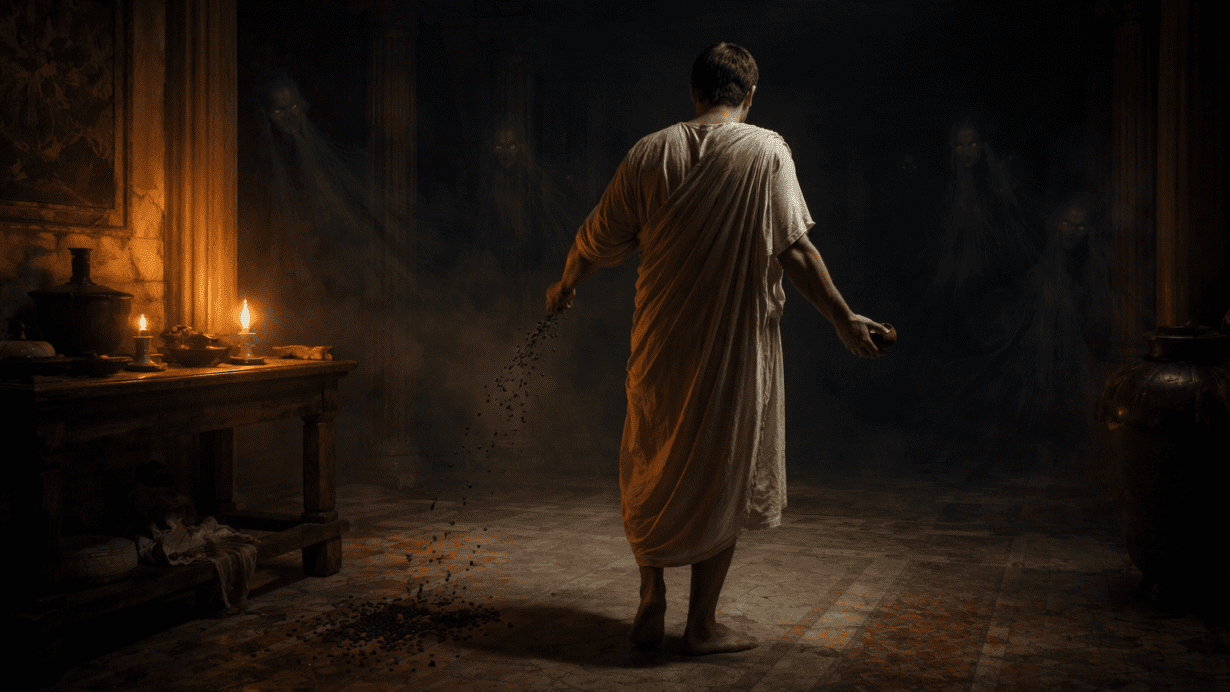
During the ritual, the head of the household would rise at midnight and perform a sequence of actions intended to purify the space and drive away the spirits. After washing his hands, he would walk barefoot through the house, casting black beans behind him while reciting a formula. These beans were believed to act as offerings, something the Lemures would accept in place of the living.
The ritual concluded with the clashing of bronze objects and a verbal command for the spirits to depart. This act was both symbolic and practical, reinforcing the authority of the living and reestablishing the boundary that had been disturbed.
Symbolism and Meaning of the Ritual
The details of the Lemuria ritual reveal much about Roman beliefs. The use of black beans, for example, reflects associations with death, the underworld, and unseen forces. By offering these objects, the living acknowledged the presence of the Lemures without directly confronting them.
Equally significant is the act of turning away while casting the beans. This gesture suggests a careful balance between recognition and avoidance, an understanding that the dead must be addressed but not engaged too directly. The ritual maintained distance while still fulfilling its purpose.
The final command to depart underscores the Roman emphasis on order. The spirits were not simply appeased; they were expelled. The household was reclaimed as a space of the living, and the boundary between worlds was restored.
The Psychological Dimension of the Lemures
Beyond their role in ritual, the Lemures reflect deeper human concerns that remain recognizable today. They embody the fear of being forgotten after death, of failing to receive proper closure, and of lingering in a state of unresolved existence.
In Roman society, where family continuity and ritual duty were central, the idea of becoming a restless spirit carried particular weight. To be denied proper burial or remembrance was not only a personal tragedy but a disruption of the social and religious order.
The Lemures also represent the anxiety that the past can return in unsettling ways. They remind us that neglect, whether of ritual, memory, or obligation, can have consequences that extend beyond the visible world.
From Ancient Rome to Modern Ghost Traditions
The concept of restless spirits did not end with Roman religion. It continued to evolve, influencing later traditions across Europe and beyond. The idea that the dead might linger due to unfinished business or improper rites appears in countless cultural narratives, from medieval ghost stories to modern accounts of hauntings.
While the details have changed, the underlying pattern remains strikingly similar. The fear of unrest after death, the importance of ritual closure, and the presence of unseen forces all echo the Roman understanding of the Lemures.
In this sense, the Lemures are not merely relics of an ancient belief system. They are part of a broader human attempt to understand death, memory, and the limits of the visible world.
Final Thoughts
The Lemures occupy a subtle but important place in Roman mythology. They are not central figures in grand narratives, nor are they celebrated in the same way as the gods. Yet they reveal a great deal about how the Romans understood the relationship between life and death.
In a world governed by ritual and order, the existence of restless spirits served as a warning. Proper rites, remembrance, and respect were not optional. They were necessary to maintain balance between the living and the dead.
The Lemures remind us that for the Romans, the past was never entirely separate from the present. It remained close, shaped by memory and ritual, and always capable of returning when neglected.