In the fifth book of the Iliad, the Greek hero Diomedes wounds Ares in battle — the god of war, stabbed in the side by a mortal hero, screaming with a sound like nine thousand men in pain, fleeing the battlefield in his chariot to complain to Zeus on Olympus. Zeus, rather than offering sympathy, tells him he is the most hateful of all the Olympians, and that if he were not his son, he would have been thrown into Tartarus long ago. The other gods, by Zeus’s account, actively detest him.
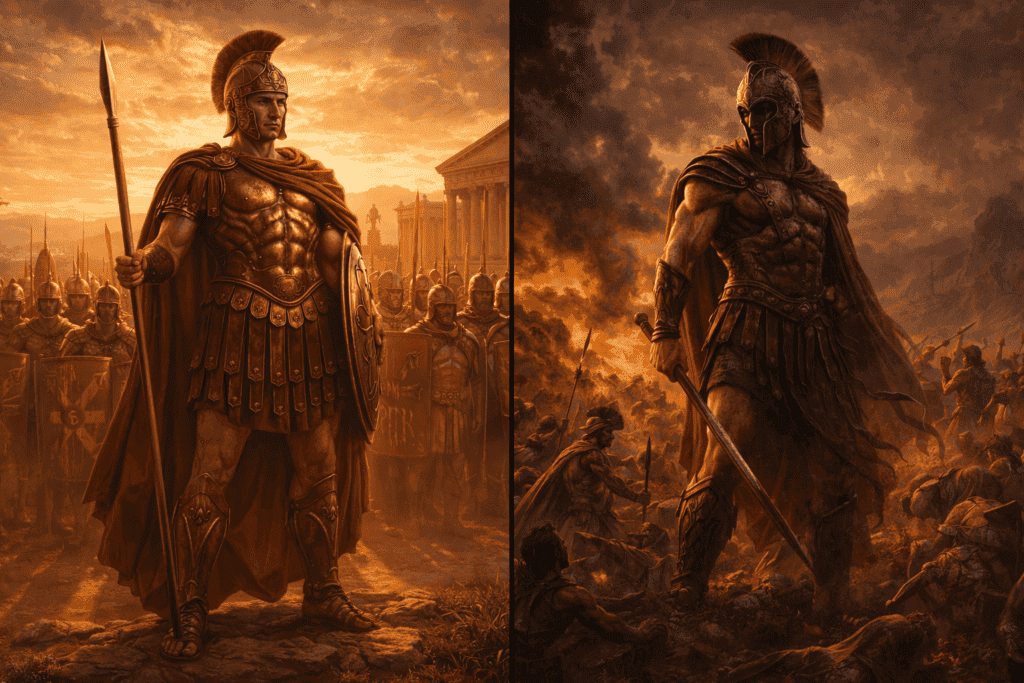
It is almost impossible to imagine this happening to Mars. Not because Mars was more powerful — the two gods were in most technical respects equivalent. But because the Roman Mars occupied a completely different position in his civilization’s self-understanding. Mars was the father of Romulus, the divine ancestor of Rome itself. He had a month named after him. He had sacred weapons in the Regia that were believed to move spontaneously before wars. He had a field — the Campus Martius — named after him where Rome’s armies assembled and Rome’s citizens voted. Augustus built him a magnificent temple in fulfillment of a vow of divine vengeance for Julius Caesar’s murder.
This is not a small difference of cultural accent. It is the difference between a god who is a liability to his own mythology and a god who is his civilization’s divine co-founder.
What the Iliad Actually Does with Ares
The Homeric treatment of Ares is the clearest evidence of his position in Greek religious thought, and it repays close reading. In the Iliad, Ares is on the Trojan side — already a mark against him in a poem whose sympathies are not straightforwardly anti-Trojan but whose Greek audience would have found the association uncomfortable. He fights with brutal enthusiasm, roaring across the battlefield, encouraging slaughter. When Diomedes wounds him — aided by Athena, who guides the spear — Ares’s reaction is immediate and undignified: he howls with pain, abandons the battle, and goes straight to Olympus to complain.
His complaint to Zeus receives the response quoted above. Zeus then has him healed, but the healing is described in terms that make Ares seem more like a nuisance being managed than a god being honored. He is useful to Zeus as a son and as a divine instrument of conflict, but he is not admired, not respected, and not treated as someone whose judgment or character deserves emulation.
This is consistent with Ares’s treatment elsewhere in Greek literature. He loses repeatedly in direct conflict with Athena, the goddess who represents strategic intelligence in warfare. In the Odyssey, the comic episode of his affair with Aphrodite and his humiliation by Hephaestus’s net makes him simultaneously a figure of lust and ridicule. In tragedy, he appears as a force of destruction to be lamented rather than celebrated. The Greeks worshipped him — he had temples, rituals, and genuine cult sites — but their literary tradition viewed him with profound ambivalence.
The reason is theological. Ares embodied the experience of war at its most uncontrolled — the killing frenzy, the blood and screaming, the moment when the organized structure of battle collapses into individual survival and individual violence. Greeks understood this as real and important but not as admirable. Ares was the god of the part of war they feared and could not romanticize.
What Roman Literature Does with Mars
The contrast with Mars’s literary treatment could not be more complete. The most important Roman literary work of the Augustan age — Virgil’s Aeneid, which was simultaneously the supreme achievement of Latin poetry and the ideological foundation document of Augustus’s regime — is organized around the divine ancestry that connects Rome to Mars through Venus and Aeneas.
The Aeneid‘s theological framework placed Rome’s origin in the union of two divine lineages: the Trojan royal line descended from Venus, and through Rhea Silvia and Romulus the founding family descended from Mars. Augustus, as the adopted son of Julius Caesar, claimed descent from both these lines simultaneously. Mars in the Aeneid is not a problematic character associated with uncontrolled violence. He is the divine force whose son will found the city whose destiny is the poem’s entire subject.
This foundational role gave Mars a gravity and a dignity that Ares never acquired. When Virgil depicts warfare — and the Aeneid‘s second half is substantially a war narrative — it is martial valor, disciplined courage, and the quality of virtus that he celebrates. These were Mars’s qualities in their Roman form. The god of war in Rome was the god of the organized, disciplined, purposeful application of force in service of the state, and the literary tradition reflected this.
The Agricultural Dimension: What Ares Never Had
One of the most significant differences between Mars and Ares, and one that is often overlooked in popular comparisons, is that Mars had a substantial agricultural dimension that Ares entirely lacked.
In the earliest Roman religious calendar — established, according to tradition, by Numa Pompilius, Rome’s second king and its great religious legislator — Mars governed the beginning of the agricultural year alongside the beginning of the military season. March, the month named after him, was both when armies began to campaign and when fields began to be prepared for planting. The Ambarvalia festival, in which sacrifices were made to Mars to purify and protect the agricultural land, connected the god of war directly to the fertility of the Italian soil.
This agricultural connection reflected an older stratum of Mars’s identity — the pre-Olympian, pre-Greek-influence Mars who was a god of the Italian countryside, protecting fields and flocks and communities against the threatening forces of the wilderness, before his martial dimension was elaborated under Greek influence into the more specifically military figure we recognize. The Roman Mars retained this agricultural layer even as his military identity developed, giving him a connection to productive abundance that Ares, who was purely and entirely a war god, never possessed.
The suovetaurilia — the great triple sacrifice of pig, sheep, and bull offered to Mars — was performed not only before military campaigns but at the conclusion of the census, when the Roman citizen body was purified in its collective military and civic capacity. The same sacrifice that prepared armies also purified the agricultural and civic community. Mars’s domain was not war alone. It was the organized, productive, defended life of the Roman community in its totality.
The Paternity Question: Rome’s Divine Father
The most concrete and politically consequential difference between Mars and Ares was the role each played in the founding mythology of his civilization.
Ares was not the father of anything Greek. He had children in Greek mythology — Phobos, Deimos, Harmonia, the Amazons in some traditions — but none of them founded Greek civilization. He was not present at the origin of the polis, the philosophical tradition, the poetic tradition, or any of the other things Greeks understood as defining their civilization. His mythological children were either personifications of war’s attendant emotions or figures of exotic otherness.
Mars was the father of Romulus, and Romulus was the founder of Rome. This is not a minor mythological footnote. It is the claim that the Roman state was founded by the son of the god of war, that the qualities of Mars — strength, discipline, organized force, the defense of the community — were literally built into Rome’s genetic material at the moment of its creation.
This paternity shaped everything about how Mars functioned in Roman religious life. He was not merely a god whom Romans worshipped because war was important. He was the divine ancestor of the Roman people, the deity through whose son the entire civic project of Rome had come into existence. Honoring Mars was, in a theological sense, honoring Rome’s own divine origins.
The Sacred Objects and the Living Presence
Mars’s presence in Roman daily and political life was expressed through a set of sacred objects that had no equivalent in the Ares tradition — physical instruments of divine connection whose behavior was believed to communicate the god’s will directly to the Roman state.
The ancilia — twelve sacred shields stored in the Regia at the edge of the Forum — were understood as divine gifts, the originals having fallen from the sky during the reign of Numa. The Salii, twelve dancing priests of Mars, carried them through Rome’s streets each March and October in processions that structured the military year. The sacred spear of Mars, also stored in the Regia, was believed to move spontaneously before major events — ancient writers record it shaking in the days before Julius Caesar’s assassination, a sign that the god of Rome’s foundation was communicating his awareness of the approaching disruption.
Before any major military campaign, the general came to the Regia, took up the sacred spear and shields, and performed the ritual of Mars vigila — Mars, awake — shaking the weapons and calling on the god. This ceremony connected the living military commander directly to the god through the physical objects that expressed Mars’s presence in Rome’s sacred geography.
None of this has any parallel in the Ares tradition. Greek military commanders did not handle sacred objects of Ares before campaigns. There was no Ares equivalent of the ancilia or the hasta Martis. The Greek relationship with Ares was conducted through sacrifice and prayer, the standard mechanisms of Greek divine relationship, without the specifically intimate, object-mediated connection that Rome maintained with Mars.
How the Interpretatio Romana Handled the Gap
When Rome identified its gods with Greek equivalents — the process called interpretatio romana — the Mars-Ares identification was among the most automatic and least questioned. The two gods were the gods of war; they were therefore the same god. The identification was universally accepted in antiquity.
But the Romans were also aware that it was not a perfect fit. Several ancient writers note that Mars’s character and Mars’s civic position were different from Ares’s. Plutarch, writing in Greek for a Greek-speaking audience but deeply familiar with Rome, explicitly discusses the difference between Roman and Greek attitudes toward the god of war, noting that the Romans gave war a more honored and organized position in their civic life than the Greeks typically did.
The imperfect fit of the identification was precisely what makes the comparison interesting. Two cultures decided that their war gods were the same deity, but the gods they brought to that identification were different enough that the decision reveals more than it conceals. What the Romans saw when they looked at Ares was a cruder, less civic version of their own god — and what the Greeks saw when they looked at Mars was a version of Ares who had somehow acquired respectability and a founding role that their own Ares had never achieved.
What Each God Reveals About His Civilization
The Mars-Ares comparison is ultimately not a comparison of two characters in two mythologies. It is a comparison of two civilizational answers to the question of what war is and what it means.
Greek mythology’s answer, expressed through Ares, was that war was a terrifying, partially ungovernable force that produced both heroism and catastrophe, that deserved recognition but not uncritical celebration, that was most honestly represented by a god who was powerful but not admirable, necessary but not lovable. The Iliad is the greatest war poem in Western literature precisely because it holds both of these truths simultaneously — the glory and the horror, the heroism and the waste.
Rome’s answer, expressed through Mars, was that war could be domesticated — brought within civic structure, organized into disciplined military practice, justified through religious ritual, and directed toward the construction and defense of a civilization that would outlast any individual conflict. Mars was the divine template for this domestication: a war god who was also a founder, an agricultural deity, a civic ancestor, a protector of the state. His worship was not an acknowledgment of war’s terrifying power but a claim that Roman civilization had found the way to make that power serve rather than destroy.
Both answers were honest about different aspects of the same reality. Ares expressed what war felt like from inside its chaos. Mars expressed what war looked like when organized into civilization’s service. Neither was simply right or simply wrong. They were complementary accounts of the same human experience, offered by two of the ancient world’s most sophisticated civilizations.
Conclusion
Mars and Ares were identified with each other for two thousand years and treated as interchangeable for much of that time. The identification was not wrong — they shared origin, function, and many specific attributes. But it concealed a difference that is among the most revealing contrasts in comparative mythology.
Ares was the god of what war actually did to people — the chaos, the wounding, the noise, the gods-devouring themselves in conflict that should have been beneath their dignity. Mars was the god of what Rome wanted war to be — disciplined, purposeful, divinely authorized, productive of the civilization that made Rome what it was. One was a mirror held up to war’s reality. The other was a vision of what war could become when it was properly organized by a civilization capable of organizing it.
The fact that Rome chose a different version of the war god than Greece did tells us, more directly than almost anything else, what kind of civilization Rome intended to be.
Share This Page
Cite This Page
MLA
Editors of RomanMythology.com. "Mars vs Ares: What’s the Difference?." RomanMythology.com, 2026, https://www.romanmythology.com/comparative-mythology/mars-vs-ares/. Accessed June 14, 2026.
APA
Editors of RomanMythology.com. (2026). Mars vs Ares: What’s the Difference?. RomanMythology.com. Retrieved June 14, 2026, from https://www.romanmythology.com/comparative-mythology/mars-vs-ares/