Mars fathered Romulus. Romulus founded Rome. Rome became the most powerful city in the ancient world. And when Romulus disappeared in a storm on the Campus Martius, the Romans declared that Mars had taken his son back — that the founder had been received into the divine realm of his father, deified as Quirinus, and was now watching over the city he had built from a position of permanent divine authority.
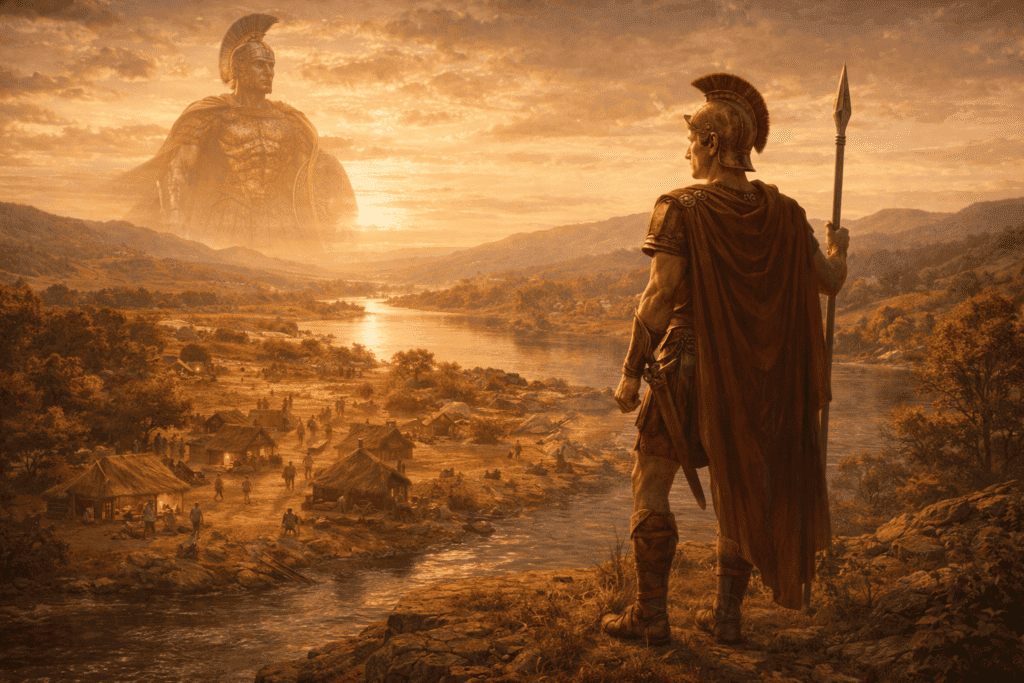
The arc from divine conception to deification was complete. The god of war had produced a son, given him the qualities that built a civilization, and received him back when his human work was done. The relationship between Mars and Romulus was not simply a genealogical fact in Roman mythology. It was the theological structure on which Roman identity rested.
What Romulus Inherited From Mars
The Roman tradition was explicit about what divine paternity meant for Romulus’s character. He was not simply a capable man who happened to have a divine father. He was the human expression of Martian qualities — the embodiment in mortal form of what the god of war, protection, and discipline represented at the divine level.
These qualities expressed themselves throughout Romulus’s life in ways that the ancient sources consistently connected to his divine origin. His physical strength — he and Remus were described as exceptionally powerful even as young men, capable of the kind of feats that marked heroes in the ancient tradition. His military instinct — when the twins discovered their true identity and confronted Amulius, Romulus organized the attack with the strategic decisiveness that would later organize Rome’s armies. His authority — when the dispute between the twins about which hill to found the city on was settled by augury and then by violence, Romulus’s capacity to impose order through force was presented not as moral failing but as Martian necessity.
Livy, in Book I of his history, described Romulus as already showing in his adolescence the qualities that would make him Rome’s founder: a natural authority that attracted followers, a capacity for organized violence that was disciplined rather than merely aggressive, and the political intelligence to understand that a new community required structure rather than simply strength. These were Mars’s qualities translated into human form — the god’s force given mortal expression.
The Overthrow of Amulius
The first major act of Romulus’s adult life was the overthrow of Amulius — the great-uncle who had seized the throne of Alba Longa, killed Numitor’s sons, forced Rhea Silvia into the Vestal order, and ordered the twins exposed as infants. The restoration of Numitor to his rightful throne was Romulus’s first exercise of the Martian combination of force and justice that would characterize everything he subsequently did.
Ancient accounts varied in their details, but agreed on the essential structure: Romulus and Remus, having learned their true identity from the shepherd Faustulus who had raised them, organized a rebellion that overthrew Amulius and killed him. Numitor was restored. The punishment of Amulius was presented as justice — the correction of a usurpation that had violated both divine and human order — rather than simple violence.
This first act established the pattern of Romulus’s career: force applied in service of order, violence in service of justice, the son of Mars imposing right arrangement on a situation that had been wrongly arranged by human ambition. The same quality that had made Mars the divine avenger — Mars Ultor, the force that corrected injustice — was expressed in Romulus’s overthrow of the man who had tried to prevent his birth.
The Founding: Augury, the Wall, and the First Death
The founding of Rome was the central act of Romulus’s life, and its specific details encoded the theological claims that Roman mythology made about the city’s divine origin.
Romulus and Remus could not agree on where to found the city. Romulus favored the Palatine Hill; Remus favored the Aventine. They agreed to settle the dispute by augury — by observing divine signs in the sky that would indicate which hill the gods approved. Remus, according to one tradition, saw six vultures. Romulus then saw twelve. Each claimed the augury’s support: Remus that he had seen his first, Romulus that he had seen more. The dispute was not resolved by the augury; it was sharpened by it.
What followed was the founding of Rome and the death of Remus — the two events that ancient sources connected with devastating narrative economy. Romulus marked the boundary of the new city by plowing a furrow around the Palatine. The furrow was sacred: it represented the city’s boundary, the pomerium, whose violation was a religious offense. Remus jumped over it — in mockery, according to the standard tradition, demonstrating that the walls were too low to keep anyone out. Romulus killed him.
Ancient accounts differed on whether Romulus killed Remus directly or whether one of Romulus’s followers named Celer killed him and Romulus approved the act after the fact. But all accounts agreed on the theological principle that Romulus expressed in the act’s aftermath: “So shall it be henceforth with every one who leaps over my walls.” The violation of the sacred boundary — even by a twin brother — was answered with death. The city’s first blood was spilled on the day of its founding, over the sacred boundary that defined what the city was.
This was Mars’s lesson expressed through his son: order required absolute enforcement. The boundary that defined the community could not be treated as negotiable. The force that protected Rome had to be as uncompromising as the threat that Rome faced.
The Rape of the Sabine Women
The founding of Rome created an immediate demographic problem: the new city was populated almost entirely by men — former shepherds, runaway slaves, landless farmers, and other marginal figures who had attached themselves to Romulus’s enterprise. A city of men could not perpetuate itself. Rome needed women.
Romulus’s solution was characteristic of his approach: direct, effective, and morally complex. He invited the neighboring Sabine people to a festival, and while the Sabine men were watching the games, Romulus’s men seized the unmarried Sabine women and carried them off as wives.
The ancient sources were not comfortable with this episode and their discomfort is evident in how they handled it. Livy was careful to note that Romulus himself addressed the captured women, telling them that the violence had been necessary but that they would be treated as honored wives rather than slaves, and that their status would be fully legitimate. The subsequent Roman legal tradition about the rights of wives and the obligations of husbands was sometimes traced back to these founding negotiations. The discomfort was managed, but it was not eliminated.
The episode’s resolution was equally characteristic. The Sabines went to war to recover their women. A Sabine nobleman named Titus Tatius led the attack. When the battle had reached its peak, the Sabine women themselves intervened — running into the space between the fighting armies and begging their fathers and brothers not to kill the husbands they had come to love and the fathers of their children. The armies stopped. A treaty was made. The Sabines joined Rome as full citizens. Rome’s population doubled.
This outcome — violence producing integration, abduction producing genuine partnership — was the Martian logic of Rome’s founding expressed at its most complex. The god of war’s son had used force to create the community that force alone could not sustain, and the community’s survival depended on the voluntary decision of the women who had been its first victims to become its foundation.
The Romulean Institutions
In the years between Rome’s founding and his death, Romulus established the institutional structures that would define Roman political and military life for centuries. The ancient tradition attributed to him the basic organization of Roman civic and military life with a directness that later historical scholarship has made more complicated but that the Romans themselves took seriously as their foundational constitutional history.
The Senate — the council of elders that would govern Rome through the Republic and into the Empire — was traditionally founded by Romulus, who selected one hundred of the city’s most respected men to advise him. The number was later doubled to two hundred and eventually expanded further, but the institution traced its origin to Romulus’s recognition that a king needed counsel and that the community’s best men deserved a formal role in governance.
The curiae — the thirty divisions of the Roman citizen body, named after the thirty Sabine women whose abduction had made Rome’s expansion possible — were attributed to Romulus as the basic unit of Roman civic organization. The comitia curiata, the oldest Roman assembly, voted by curiae and its authority derived from Romulus’s original organization of the citizen body.
The legionary structure — the specific organization of Rome’s military force — was traditionally attributed to Romulus, who organized three thousand infantry and three hundred cavalry into the force that would become the template for Rome’s military expansion. The three cavalry centuries — the Ramnes, Tities, and Luceres — bore names that some ancient writers connected to Romulus, Titus Tatius, and Lucumo respectively, preserving the memory of Rome’s tripartite ethnic origin in the military structure.
These institutions were not simply practical arrangements. They were the Martian quality of organized force expressed in political and military form — the son of the god of disciplined strength creating the structures through which that discipline would operate for generations.
The Death of Romulus: Apotheosis or Assassination
Romulus’s death was the most theologically charged event of his life, and the ancient tradition preserved two competing versions that the Romans themselves debated without full resolution.
The official version — the one that Roman religion endorsed and that Livy presented first — was the apotheosis: Romulus disappeared during a storm on the Campus Martius, taken up to the heavens by his divine father Mars. A Roman senator named Julius Proculus subsequently reported that Romulus had appeared to him in a vision and commanded him to tell the Romans that he had been received into divinity, that he would henceforth be worshipped as the god Quirinus, and that Rome would become the greatest city in the world if it maintained military discipline and transmitted that discipline to its descendants.
Plutarch, who was more willing than Livy to acknowledge uncomfortable historical traditions, also preserved the alternative account: that the senators had murdered Romulus — torn him apart in the Senate chamber — and that the storm story was a cover constructed to prevent popular unrest. The senators had then distributed pieces of his body beneath their clothing and buried them separately, which was why no body was ever found.
The two versions were not simply competing histories. They were competing theological claims about the nature of Romulus’s relationship to Mars and to the divine. The apotheosis version maintained the full theological logic: Mars’s son, having completed his human work, was returned to the divine realm from which his father had descended to produce him. The assassination version suggested that the divine son had been destroyed by the very institution he had created — a darker reading of the relationship between divine origin and human politics.
Roman religious practice resolved the tension in favor of the apotheosis by establishing the cult of Quirinus — the deified Romulus — as one of Rome’s three most important divine cults, alongside Jupiter and Mars himself. The Flamen Quirinalis, one of Rome’s three major flamines, served Quirinus. The Quirinal Hill was dedicated to his worship. His festival, the Quirinalia, was observed annually.
Mars Quirinus: The God Rome Became
The deification of Romulus as Quirinus completed the theological cycle that the Mars-Romulus relationship had begun. Mars had descended to produce Romulus. Romulus had built Rome. Mars had received Romulus back as Quirinus. And now the god of war and the deified founder were theologically connected in the compound identity of Mars Quirinus — the martial force and the civic order, the divine and the human, the father who had initiated and the son who had completed.
The Mars Quirinus epithet expressed the Roman conviction that war and civic peace were not opposites but phases of the same ordered strength. The Salii of the Quirinal Hill — the second college of Mars’s dancing priests — were associated specifically with this compound identity, their October ceremonies marking the transition from Mars the active military force to Quirinus the civic protector as the campaign season ended and Rome’s civil life resumed.
This cycle — Mars in March beginning the military year, Quirinus in winter presiding over the civic year — was the theological structure through which the Romans understood the relationship between war and peace, force and order, divine origin and human achievement. It began with Mars descending to Rhea Silvia. It ended with Romulus ascending to join Quirinus. And in between, Rome was built.
What the Relationship Expressed
The Mars-Romulus relationship was Rome’s foundational theological argument — the claim that the city was not simply a human political achievement but the product of divine intention expressed through divine descent. The god of war had produced the city’s founder. The founder had expressed the god’s qualities in human form. The city had inherited both the qualities and the divine warranty.
This argument was not simply religious sentiment. It was political theology with practical consequences. When Roman armies marched under Mars’s eagles, they were not invoking the protection of an external deity who might or might not favor them. They were expressing the qualities that had been built into Rome’s founding bloodline — the Martian discipline and force that Romulus had carried in his person and transmitted through the institutions he had created.
And when Augustus built the Temple of Mars Ultor and placed it at the center of his forum alongside images of Romulus and Aeneas, he was making the same argument that Romulus’s apotheosis had expressed: that Rome’s greatness was divinely authored, that the god of war had been present at its beginning, and that the current dispensation was the latest expression of the same divine intention that had sent Mars to Rhea Silvia in the sacred grove.
Share This Page
Cite This Page
MLA
Editors of RomanMythology.com. "Mars and Romulus: Father, Son, and the God Rome Became." RomanMythology.com, 2026, https://www.romanmythology.com/roman-myths/mars-and-romulus/. Accessed June 14, 2026.
APA
Editors of RomanMythology.com. (2026). Mars and Romulus: Father, Son, and the God Rome Became. RomanMythology.com. Retrieved June 14, 2026, from https://www.romanmythology.com/roman-myths/mars-and-romulus/